
Bitcoin's 2025 Price Surge: Post-Halving Momentum and Institutional Adoption


 Aime Summary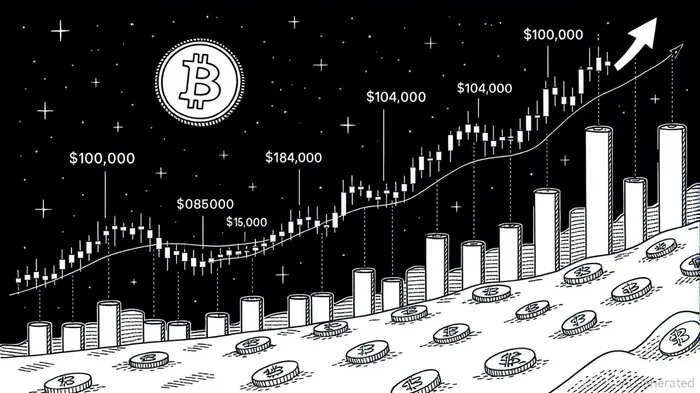
The cryptocurrency market is at a pivotal inflection point in 2025, driven by a rare alignment of macroeconomic tailwinds, institutional adoption, and the lingering momentum from the 2024 halving event. While the next halving isn't until 2028, the post-2024 cycle has already reshaped Bitcoin's trajectory, creating a unique opportunity for investors to position themselves ahead of the next leg of growth.
The 2024 Halving: A Catalyst for Institutional Confidence
The April 2024 halving reduced Bitcoin's block reward to 3.125 BTC, but its impact was amplified by the approval of U.S. spot BitcoinBTC-- ETFs in January 2024. This regulatory breakthrough transformed Bitcoin from a speculative asset into a legitimate institutional-grade investment. By mid-2025, ETFs like BlackRock's iShares Bitcoin Trust (IBIT) had attracted over $86 billion in assets under management, with net inflows reaching $54.75 billion. This surge reflects a shift in institutional risk tolerance, as pension funds, sovereign wealth vehicles, and corporate treasuries now treat Bitcoin as a strategic hedge against inflation and dollar devaluation.
The 2024 halving also marked a departure from historical price patterns. Traditionally, Bitcoin peaks 12–18 months post-halving, but the ETF-driven demand front-loaded appreciation, pushing prices to a record $73,000 in March 2024. Post-halving, Bitcoin's 41.2% gain to $90,446 by November 2024 was modest compared to past cycles, but this subdued performance masked a deeper structural shift: institutional demand is now the primary driver of Bitcoin's price, not retail speculation.
Macroeconomic Tailwinds: Liquidity, Rates, and Dollar Dynamics
Bitcoin's price in 2025 is increasingly tied to global monetary policy. The Federal Reserve's pivot toward easing—projected to include three rate cuts in 2025—has reduced the opportunity cost of holding non-yielding assets like Bitcoin. With the CME FedWatch Tool showing a 99% probability of a 25-basis-point cut in the near term, liquidity injections are fueling risk-on sentiment. Historically, Bitcoin has exhibited a 0.78 correlation with global M2 money supply growth, with effects manifesting 90 days post-expansion. By July 2025, global M2 had hit $55.48 trillion, coinciding with Bitcoin's rebound from $80,000 to $110,000.
The U.S. dollar's strength remains a critical determinant. Bitcoin has shown an inverse correlation with the U.S. Dollar Index (DXY) of -0.4 to -0.8 over the past five years. A weaker dollar, driven by Fed easing or global reserve diversification, could catalyze further rallies. For example, the 2025 U.S. tariff announcement caused a 12% short-term price drop, but the market quickly priced in adjustments, allowing Bitcoin to rebound.
On-Chain Metrics: Undervaluation and Institutional Accumulation
Bitcoin's on-chain fundamentals suggest a compelling entry point for long-term investors. The Network Value to Transactions (NVT) ratio is at 1.51, below the overvaluation threshold of 2.2, indicating undervaluation relative to transactional utility. Exchange reserves have also declined to 2.1 million BTC—a 20% drop from 2024—tightening supply and creating a bullish backdrop.
Institutional accumulation is evident in ETF-related custodial wallets, which now hold over 1.3 million BTC. Short-term holder (STH) realized prices stabilized at $106,000 in August 2025, acting as a dynamic support level. The MVRV Z-Score approaching 3.5 historically signals overbought conditions, but such metrics often precede sharp rebounds in prior cycles.
Strategic Entry Points: DCA and High-Conviction Bets
For investors seeking to capitalize on Bitcoin's 2025 momentum, strategic entry points are emerging. A dollar-cost averaging (DCA) strategy is recommended for the $111,900–$113,800 range, where on-chain metrics suggest strong institutional buying. For high-conviction investors, the $100K–$105K zone represents a potential floor historically seen during bear markets, offering a compelling entry for long-term accumulation.
Options hedging is also viable, as implied volatility remains at multi-year lows, making out-of-the-money calls relatively affordable. Institutional-grade investors should monitor the 200-day moving average and Fibonacci retracement levels, which reinforce the $100K–$107K support zone.
The Road Ahead: A New Era for Bitcoin
Bitcoin's 2025 price trajectory is no longer a speculative narrative but a macroeconomic inevitability. With ETF inflows projected to surpass $20 billion in 2025 and EthereumETH-- ETFs in the approval pipeline, the asset class is poised for broader adoption. Central banks' tightening cycles and the U.S. Strategic Bitcoin Reserve's accumulation efforts will sustain demand, even as macroeconomic headwinds emerge.
For investors, the key is to act decisively at these strategic entry points. Bitcoin's role as a hedge, diversifier, and store of value is strengthening, and its integration into institutional portfolios is irreversible. As the market transitions from a speculative asset to a core portfolio component, the next leg of growth is within reach—for those who recognize the convergence of momentum, macroeconomic tailwinds, and institutional confidence.
In conclusion, Bitcoin's 2025 surge is not just about the halving cycle—it's about the structural forces reshaping global finance. The time to act is now, before the next wave of institutional capital and macroeconomic shifts propel Bitcoin to new heights.

Stay ahead of the market.
Get curated U.S. market news, insights and key dates delivered to your inbox.
AInvest
PRO
AInvest
PRO



Comments
No comments yet