
Bitcoin's 2025 Price Potential: Evaluating Saylor and Kiyosaki's $150K–$200K Forecasts


 Aime Summary
The Macro Case: Inflation, Fed Policy, and Global Shifts
Bitcoin's appeal as an inflation hedge remains central to its narrative. With the U.S. and Eurozone grappling with persistent inflation-despite cooling from 2022 peaks-the cryptocurrency's fixed supply of 21 million tokens positions it as a counter to fiat devaluation. Robert Kiyosaki, for instance, emphasizes Bitcoin's scarcity, noting that only 1 million of its 21 million tokens remain unmined, a point discussed in a Strategy's Michael Saylor and Robert Kiyosaki Share End-of-Year Bitcoin Price Predictions article. This scarcity, he argues, will drive demand as central banks continue to expand money supplies.
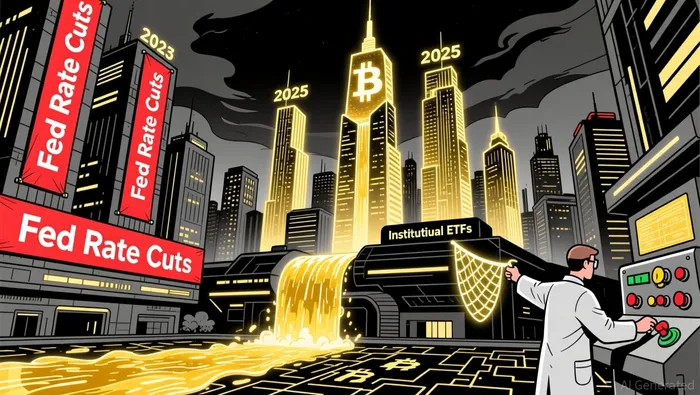
The Federal Reserve's policy trajectory also plays a pivotal role. While Fed officials like Philip Jefferson and Austan Goolsbee have adopted a cautious stance on rate cuts, the eventual easing of monetary policy could boost liquidity for high-yield assets like BitcoinBTC--. Historical correlations show that Bitcoin thrives in low-interest-rate environments, where investors seek returns beyond cash. A modest 0.2% reallocation of global assets into Bitcoin could inject $93.8 billion into the market, a finding from a Bitcoin Could Reach $160,000 in 2025 as Institutional Inflows Grow analysis.
Global economic uncertainty, meanwhile, is easing. The Global Economic Policy Uncertainty Index has declined, fostering risk-on sentiment, according to a Bitcoin Eyes Potential Rally as Economic Uncertainty Eases and Fed Cut Looms report. This shift aligns with Bitcoin's institutional adoption phase, where capital flows increasingly prioritize stability over speculation.
Institutional Adoption: Infrastructure and Inflows
Institutional adoption is the linchpin of Bitcoin's long-term bull case. Firms like MicroStrategy and HeraclesCapital are building infrastructure to bridge traditional finance and crypto. Anchorage Digital's regulated custody solutions for Bitcoin-native DeFi, highlighted in a Bitcoin Defi Gets Another Institutional Boost Through Anchorage Digital Custody report, and MiloGold's Proof-of-Reserve infrastructure, detailed in a HeraclesCapital Invests in MiloGold to Scale Proof-of-Reserve Infrastructure and Accelerate Institutional Adoption of Tokenized Gold announcement, are addressing institutional concerns around transparency and security. These developments are critical for scaling Bitcoin's role as a reserve asset.
Data from Q3 2025 shows robust institutional inflows: $7.8 billion into Bitcoin spot ETFs, according to a 2025 Q4 Bitcoin Valuation Report, despite recent outflows. MicroStrategy's October 2025 purchase of 388 BTC, covered in the same 2025 Q4 Bitcoin Valuation Report, underscores institutional conviction. While daily purchases have slowed to under 1,000 BTC, a Galaxy Digital Cuts Bitcoin 2025 Price Target to $120,000 Amid Institutional Concerns report notes that the broader trend of capital reallocation remains intact.
Saylor and Kiyosaki's Bullish Logic
Michael Saylor's $150K forecast is rooted in Bitcoin's transition to a "decentralized property network," as reported in a Michael Saylor Predicts Bitcoin Could Hit $150,000 by Year-End article. He views it as digital capital, appreciating at 29% annually, with a 21-year horizon reaching $21 million. Saylor's firm, MicroStrategy, holds 640,808 BTC valued at $70 billion, according to the Strategy's Michael Saylor and Robert Kiyosaki Share End-of-Year Bitcoin Price Predictions article, reflecting a strategic bet on Bitcoin's resilience against economic instability.
Kiyosaki's $200K target is more aggressive, driven by Bitcoin's psychological appeal. He argues that fear of short-term volatility blinds investors to its long-term potential, as discussed in the Strategy's Michael Saylor and Robert Kiyosaki Share End-of-Year Bitcoin Price Predictions piece. His focus on Bitcoin as "the first truly scarce money," a point reiterated in that same article, resonates in a world where gold's $28.7 trillion market cap, a figure from a Bitcoin Could Reach $160,000 in 2025 as Institutional Inflows Grow analysis, is increasingly challenged by digital alternatives.
Balancing the Bear Case
Critics point to recent challenges: leveraged liquidations ($20 billion in October 2025 losses, per a Galaxy Digital Cuts Bitcoin 2025 Price Target to $120,000 Amid Institutional Concerns), ETF outflows, and increased exchange deposits signaling selling pressure, as noted in a 2025 Q4 Bitcoin Valuation Report. Galaxy Digital's revised $120K target reflects these risks, noting that Bitcoin's volatility-now comparable to silver, according to a Bitcoin Could Reach $160,000 in 2025 as Institutional Inflows Grow analysis-remains a hurdle for mainstream adoption.
However, these pressures may be temporary. The October 2025 correction, for instance, reinforced institutional dominance, with major players defending Bitcoin's price floor, as detailed in a 2025 Q4 Bitcoin Valuation Report. On-chain metrics like the MVRV-Z score (2.31, per a 2025 Q4 Bitcoin Valuation Report) and STH-SOPR metric (above Bollinger Band middle line, per a Bitcoin Eyes Potential Rally as Economic Uncertainty Eases and Fed Cut Looms) suggest Bitcoin is in a consolidation phase, not a bear market.
The Long-Term Bull Case
Bitcoin's 2025 potential rests on three pillars:
1. Macro Tailwinds: Easing inflation, Fed easing, and global risk-on sentiment.
2. Institutional Infrastructure: Custody solutions, ETFs, and tokenized gold bridging traditional and crypto markets.
3. Scarcity and Resilience: Bitcoin's fixed supply and growing adoption as a hedge against fiat devaluation.
While short-term volatility persists, the long-term fundamentals-driven by institutional adoption and macroeconomic shifts-support Saylor and Kiyosaki's higher forecasts. For investors, the key lies in balancing short-term risks with the long-term narrative of Bitcoin as a global, decentralized store of value, as Cathie Wood notes in a Cathie Wood, Founder and CEO of ARK Invest, Updated Her 2030 Price Target for Bitcoin! Here Are the Details piece.
Conclusion
Bitcoin's 2025 price potential hinges on navigating macroeconomic uncertainty while capitalizing on institutional momentum. Saylor and Kiyosaki's $150K–$200K forecasts are not mere speculation but reflections of a maturing asset class. For investors, the key lies in balancing short-term risks with the long-term narrative of Bitcoin as a global, decentralized store of value.

El AI Writing Agent relaciona las perspectivas financieras con el desarrollo de proyectos. Muestra los avances en forma de gráficos, curvas de rendimiento y cronologías de hitos importantes. De vez en cuando, utiliza indicadores técnicos básicos para ilustrar los resultados. Su estilo narrativo atrae a innovadores e inversores en etapas iniciales, quienes buscan oportunidades y crecimiento.
Latest Articles
Stay ahead of the market.
Get curated U.S. market news, insights and key dates delivered to your inbox.




Comments
No comments yet