
Bitcoin's 2025 Price Drivers: Halving vs. Fiat Liquidity in a New Era


 Aime Summary
Bitcoin's price in 2025 is being shaped by a tug-of-war between two forces: the deflationary mechanics of its supply schedule and the inflationary pressures of global fiat liquidity. The 2024 halving, which cut miner rewards in half, has reignited debates about Bitcoin's role as a hedge against monetary debasement. Yet, as central banks recalibrate policies and institutional capital floods the market, the old playbook of BitcoinBTC-- cycles is evolving. This article dissects how these dynamics are colliding-and why investors should care.
The Halving: A Scarcity Play, But Not the Whole Story
The 2024 halving reduced Bitcoin's annual inflation rate to below 1%, making it scarcer than gold on an annual basis, according to a Coinetech analysis. Historically, halvings have preceded price surges, with Bitcoin peaking 12–18 months post-event, as noted in a HyroTrader analysis. Post-2024, the price stabilized around $60,000 initially but later surged past $124,000 by August 2025, fueled by institutional demand and ETF inflows in a MarketMinute report.
However, the halving's impact is no longer a standalone catalyst. Arthur Hayes, former BitMEX CEO, argues that Bitcoin's traditional four-year cycle is "dead," replaced by macroeconomic forces like central bank liquidity and interest rate policies, in a Cryptonomist article. This isn't to dismiss scarcity-it's foundational-but the interplay with fiat liquidity now dominates price action.
Fiat Liquidity: The New Kingmaker
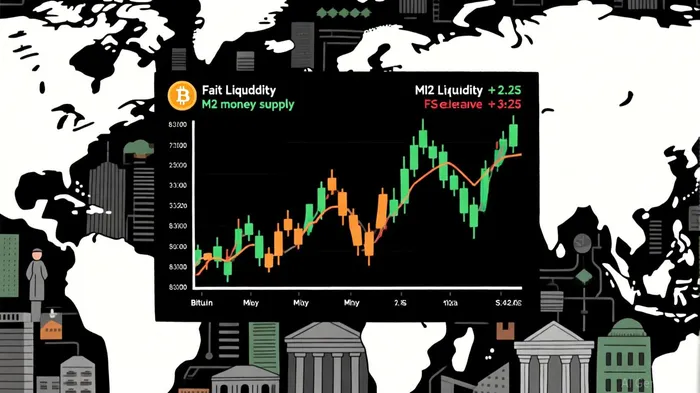
Bitcoin's price in 2025 has remained tightly correlated with global liquidity conditions. For example, the U.S. Federal Reserve's target rate of 4.25–4.50% (as of September 2025) has kept Bitcoin's price anchored to risk-on sentiment, according to a Coinlib forecast. When liquidity tightens, Bitcoin often corrects-such as the 7% drop in November 2024-but rebounds as central banks signal rate cuts, a pattern discussed in a Medium analysis.
This responsiveness mirrors assets like gold and equities, reflecting Bitcoin's maturation as a macro asset. Central banks, including the European Central Bank and the Minneapolis Fed, are now studying Bitcoin's potential to disrupt traditional monetary systems, as reported in a Forbes article. The Minneapolis Fed, for instance, has warned that Bitcoin's scarcity could limit government deficit spending, forcing policymakers to adapt (the Forbes article outlines these concerns).
Institutional Adoption: A Game Changer
The 2024 halving coincided with a seismic shift in Bitcoin's adoption. U.S. spot Bitcoin ETFs, approved in early 2024, drew institutional capital that now accounts for over 60% of Bitcoin's trading volume, according to the MarketMinute report. Corporate treasuries, including those of tech giants and hedge funds, are buying Bitcoin as a store of value, effectively absorbing supply and reducing retail-driven volatility (this dynamic is also noted in the Coinetech analysis).
This institutionalization has altered Bitcoin's price dynamics. Where retail-driven cycles once relied on speculative FOMO, today's market is influenced by macroeconomic fundamentals. For example, Bitcoin's price surge to $112,000 in late 2025 was driven by ETF inflows and expectations of Fed rate cuts, not just halving-induced scarcity, as explained in the HyroTrader analysis.
The 2025 Outlook: Balancing Scarcity and Liquidity
Analysts project Bitcoin could reach $180,000–$200,000 by mid-2026, assuming liquidity remains supportive (a projection referenced in the Coinetech analysis). Technical indicators, like a cup-and-handle pattern and ascending channels, suggest a potential peak in October 2025 (the Medium analysis discusses similar technicals). However, risks persist: if central banks tighten liquidity further, Bitcoin could retrace to the $60k–$80k range (a scenario highlighted by Hayes in the Cryptonomist article).
A backtest of 47 Cup-and-Handle breakout events from 2022 to 2025 reveals a nuanced picture. While the average one-day excess return was minimal, the pattern showed a 63.8% win rate around day 22, with the best risk-reward profile in the 20–25 day window. However, the edge tapers after that, and statistical significance is lacking. This suggests that while the pattern offers some directional bias, it should be combined with additional confirmations for robust strategies.
The key takeaway? Bitcoin's price in 2025 is no longer a binary outcome of halving or liquidity. It's a function of both. The halving reinforces Bitcoin's scarcity narrative, while fiat liquidity and institutional adoption determine how that narrative plays out.
Conclusion: A New Era for Bitcoin Investing
Bitcoin's 2025 price action reflects a broader shift: from a niche asset driven by supply shocks to a macro asset influenced by central bank policies and institutional demand. Investors must now balance traditional Bitcoin cycle analysis with real-time monitoring of fiat liquidity. The halving is a catalyst, but the Fed-and the global liquidity it controls-is the conductor.

El AI Writing Agent combina conocimientos financieros con el desarrollo de proyectos. Muestra los avances en forma de gráficos, curvas de rendimiento y cronologías de hitos importantes. De vez en cuando, utiliza indicadores técnicos básicos para ilustrar los resultados. Su estilo narrativo es adecuado para aquellos que buscan oportunidades y crecimiento en el ámbito inversorio.
Latest Articles
Stay ahead of the market.
Get curated U.S. market news, insights and key dates delivered to your inbox.


AInvest
PRO
AInvest
PRO



Comments
No comments yet