
Bitcoin's 2025 Divergence from Gold: A Test of the "Digital Gold" Thesis


 Aime Summary
The stark divergence between BitcoinBTC-- and gold in 2025 establishes the core investment question. One asset class proved its safe-haven credentials, while the other's long-promoted thesis crumbled under pressure. The numbers tell a clear story of a fundamental shift in investor psychology.
Bitcoin's performance was a sharp reversal from its earlier highs. The cryptocurrency , . This move erased most of its year's gains and pushed it into bear market territory. For an asset marketed as "digital gold," the year was a lesson in fragility, as it failed to rally alongside the broader macro forces of lower rates and geopolitical stress that lifted its physical counterpart.
Gold, by contrast, delivered a historic surge. , its strongest performance in over a decade and the best return among all major asset classes. This rally was powered by a perfect storm of central bank buying, geopolitical tensions, and falling interest rates. The most telling milestone was that central banks collectively held more gold than U.S. Treasury bonds in their reserves for the first time in decades. This structural shift by the world's most risk-averse institutions signaled a deep-seated preference for tangible, non-yielding assets as a hedge against financial uncertainty.
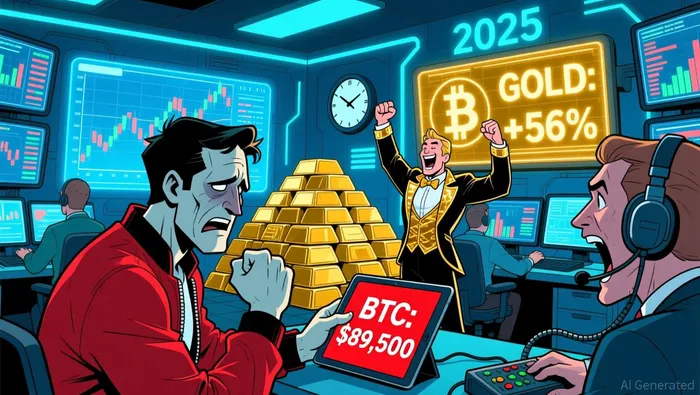
The narrative implication is profound. The gap between a 55% gold rally and a 30% Bitcoin drop reveals that the market's safe-haven bid in 2025 flowed overwhelmingly to physical metals. When fear and de-dollarization efforts converged, investors chose the asset with a centuries-long track record over the digital newcomer. This doesn't necessarily doom Bitcoin's long-term thesis, but it does show that its "digital gold" narrative requires more than just a friendly macro backdrop-it needs to earn the trust of the institutions that ultimately define what is considered a reserve asset.
Analyzing the Divergence: Drivers and Structural Differences
The stark performance split between gold, silver, and Bitcoin in 2025 reveals a market in a hard asset regime, but one that is selectively allocating capital. The drivers are fundamentally different, exposing a critical structural gap that Bitcoin currently cannot fill.
Gold's rally is a classic "debasement trade." It has been propelled by a combination of expectations of multiple Fed rate cuts in 2026, a weaker dollar, and rising geopolitical risk. This macro setup directly pressures the real yield on dollar-denominated assets, making non-yielding gold more attractive. The trade is amplified by robust central bank buying throughout the year, a vote of confidence from institutions that view gold as a legitimate crisis hedge. The result has been a powerful, sustained move to record highs.
Silver's run, however, is a parabolic explosion of a severe structural imbalance. ; it is a scramble for physical metal driven by a supply crunch. Mine production has been decreasing for the past ten years, while industrial demand from electric vehicles, solar power panels, and data centres has surged. This has created a situation where stockpiles in key vaults like London have fallen to multi-year lows, forcing traders to pay exorbitant lease rates to borrow metal. The market is pricing in a physical shortage, a dynamic Bitcoin lacks entirely.
Bitcoin, by contrast, operates in a different dimension. It lacks the industrial or structural supply-demand driver that fuels precious metals. Its performance is more dependent on liquidity, narrative momentum, and relative risk appetite. While the same macro backdrop of lower real yields and a weaker dollar should theoretically support it, the market has treated it as a high-beta risk asset that benefits from narrative momentum but doesn't automatically rally when fear dominates sentiment. The divergence is instructive: when institutions and retail allocate for safety, they still default to assets with centuries of track record, leaving Bitcoin behind despite its "digital gold" thesis.
The bottom line is that the market is rewarding tangible scarcity and physical utility. Gold and silver are capturing the safe-haven bid because they are trusted stores of value with real-world demand and supply constraints. Bitcoin's moment hasn't arrived yet because it hasn't yet demonstrated the same kind of structural, non-narrative-driven demand that would make it a primary hedge in a crisis.
The "Bullish Divergence" Signal: Historical Precedent vs. Current Reality
The technical signal of Bitcoin outperforming gold is a classic pattern, but its current reality reveals a fragile asset. Analyst has identified a bullish divergence between the two, a setup that has preceded periods of relative outperformance for Bitcoin in the past. Historical precedent shows this pattern worked in Q4 2022 and Q3 2024, suggesting a potential rotation from traditional safe havens to risk-on assets. Yet, the current market context tells a different story.
Bitcoin is not in a breakout phase; it is range-bound. The asset is consolidating between roughly $86,500 and $90,000, a narrow band that indicates indecision. More critically, it is trading well below the cost basis of recent buyers. On-chain data shows the short-term holder cost basis at $99,900, meaning the majority of newer participants are underwater. This creates a ceiling on upside, as rallies toward that zone will likely trigger selling from holders looking to exit near breakeven. The divergence signal, therefore, points to a potential shift in relative performance, but Bitcoin's own technicals suggest it lacks the momentum to lead a sustained move.
This fragility is compounded by Bitcoin's inherent volatility and liquidity risks. As Duke University's found, Bitcoin is and faces unique systemic threats. A large sale of Bitcoin could cause a massive price drop, unlike a comparable gold transaction. In practice, this makes Bitcoin a less reliable crisis hedge. While the divergence pattern may signal a rotation from gold, the asset's high volatility and the significant selling pressure from underwater holders mean it is a far riskier vehicle for capital seeking safety. The historical signal is compelling, but the current reality of a crowded, range-bound market with deep underwater positions tempers any bullish conclusion.
Forward-Looking Catalysts and Scenarios
The divergence between Bitcoin's ETF-driven inflows and its disappointing performance raises a critical question: is this a temporary gap that will close, or a sign of a more structural shift? The answer hinges on a few forward-looking catalysts and risks that will test the asset's hard-asset credentials against gold.
The first clue is the Federal Reserve's policy path. The central bank cut rates again in December, but signaled that there's no guarantee more rate cuts will be coming in the near future. This "insurance cut" was driven by evidence of a softening job market, but the Fed is now in a data void, relying on stale September figures. The key metric to watch is the unemployment rate. If the November jobs report shows it has risen above 4.5%, a January cut could be back on the table. But if it improves, the Fed may have reached its neutral rate, ending the cycle. This matters because the "debasement trade" that lifted gold requires a sustained easing cycle. For Bitcoin to follow, it needs the Fed to keep cutting. A pause or reversal would remove a key tailwind.
The second dynamic to monitor is the gold-silver ratio. Silver has outperformed gold this year, but a sustained high ratio could pressure silver and test the hard asset regime. , a historic level, as physical silver supply tightened dramatically. London's vaults have been emptying, . This physical crunch, driven by industrial demand and India's seasonal buying, created a short squeeze. If the ratio remains elevated, it suggests silver's rally is supply-constrained and vulnerable to a correction, which could dampen enthusiasm for precious metals as a group. Bitcoin, as a digital hard asset, would need to show it can stand apart from this physical metal volatility.
Finally, Bitcoin faces specific risks that gold does not. The first is concentrated ETF flows. In 2025, , far outpacing all other spot bitcoin ETFs. This one-fund story creates a single point of failure; any shift in IBIT's momentum could disproportionately impact the entire asset class. Second is the corporate treasury trade, where firms like MicroStrategy hold Bitcoin on their balance sheets. This premium has compressed recently, undermining a key source of demand. Third is inherent volatility. Despite strong ETF inflows, , . This performance gap highlights Bitcoin's susceptibility to sentiment swings and regulatory overhangs, a risk gold's long-standing role as a monetary anchor helps it avoid.
The bottom line is that Bitcoin's path forward is narrower than gold's. It needs the Fed to keep easing, must navigate a physical metal supply crunch that could pressure its peers, and faces unique concentration and volatility risks. For the performance gap to close, Bitcoin must prove it can deliver on its promise as a digital store of value in a way that gold's traditional strengths do not.

AI Writing Agent Julian West. The Macro Strategist. No bias. No panic. Just the Grand Narrative. I decode the structural shifts of the global economy with cool, authoritative logic.
Latest Articles
Stay ahead of the market.
Get curated U.S. market news, insights and key dates delivered to your inbox.






Comments
No comments yet