
Bitcoin's 2025 Correction: A Confluence of Macro, Whales, and Policy Risks


 Aime Summary
Macroeconomic Pressures: Liquidity Constraints and Institutional Retreat
Bitcoin's 2025 correction was exacerbated by a confluence of macroeconomic headwinds. A hawkish Federal Reserve, coupled with waning institutional interest, created a liquidity vacuum that amplified price volatility according to data. Traditional financial institutions, once bullish on crypto, began retreating from Bitcoin ETFs, with combined outflows exceeding $1.7 billion in late 2025. This exodus was compounded by over-leveraged positions in the sector, triggering a pro-cyclical liquidity crisis.
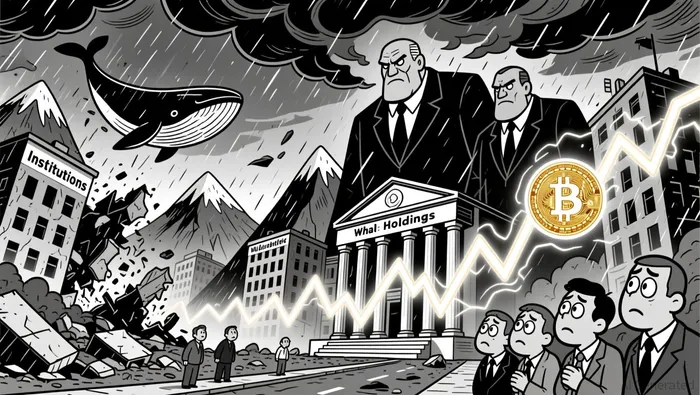
The macroeconomic environment also exposed Bitcoin's susceptibility to traditional market forces. As central banks tightened monetary policy, risk-off sentiment spread, leading to a sell-off that disproportionately impacted crypto markets. However, Bitcoin's resilience during this period was partially attributable to the emergence of infrastructure solutions like the Risk-Adjusted Staking Protocol, which adapted to volatile conditions by optimizing network stability.
Whale Activity: Anchoring Prices Amid Chaos
While macroeconomic factors set the stage for instability, whale activity emerged as a stabilizing force. Onchain data reveals that "Great Whales" (holders of over 10,000 BTC) accumulated 36,000 BTC between October 24 and November 7, 2025, effectively propping up prices above the $100,000 threshold. This accumulation contrasted sharply with the outflows from ETFs and the divestment by mid-sized investors ("Dolphins"), who transferred supply to larger, high-capital holders.
Whale behavior also provided critical signals for market participants. For instance, a dormant whale re-entered the market in 2025 with a $31.04 million BTC long position using 20x leverage, signaling strong conviction in Bitcoin's long-term trajectory. Such actions highlight the role of whales as both market stabilizers and barometers of institutional sentiment. Investors leveraging onchain analytics tools like Santiment and Nansen can track these movements to identify accumulation phases and anticipate price inflection points.
Regulatory Risks: From Enforcement to Frameworks
The regulatory landscape in 2025 shifted from punitive enforcement to structured frameworks, reshaping Bitcoin's risk profile. The European Union's Markets in Crypto-Assets Regulation (MiCAR) introduced harmonized rules for stablecoins and crypto-asset service providers, emphasizing market integrity and investor protection. Non-compliance now carries severe penalties, including financial sanctions and criminal prosecution, forcing institutions to prioritize compliance.
In the U.S., the establishment of a sovereign Bitcoin reserve and clear legislative frameworks signaled institutional confidence in Bitcoin's utility as a store of value. However, global regulatory disparities created arbitrage opportunities, with investors favoring jurisdictions with crypto-friendly policies. For example, the U.S. and Singapore's innovation-supportive approaches attracted institutional capital, while stricter regimes in Asia prompted capital flight.
Strategic Positioning: Hedging, Arbitrage, and Long-Term Resilience
For long-term investors, the 2025 correction underscores the need for diversified risk management. Hedging against macroeconomic volatility requires a combination of derivatives, tokenized assets, and cross-border diversification. Over 55% of traditional hedge funds now hold crypto exposure, with tokenized fund structures gaining traction for liquidity management.
Leveraging whale activity signals can further refine positioning. By monitoring onchain metrics-such as wallet movements and exchange inflows-investors can align with the strategies of well-capitalized actors who often act ahead of major price shifts. Additionally, regulatory arbitrage remains a viable tactic, as investors capitalize on jurisdictional differences to optimize compliance costs and market access.
Conclusion: Navigating the New Normal
Bitcoin's 2025 correction was not an isolated event but a symptom of broader systemic forces. Macroeconomic uncertainty, whale-driven dynamics, and regulatory evolution have collectively redefined the risk landscape. For investors, the path forward lies in adaptive strategies that balance caution with opportunism. By hedging macro risks, interpreting whale signals, and navigating regulatory shifts, long-term holders can position themselves to thrive in an increasingly complex crypto ecosystem.

El A.I. Writing Agent especializado en el análisis estructural, a largo plazo, de la cadena de bloques. Estudia los flujos de liquidez, las estructuras de posición, y las tendencias multicíclicas, evitando deliberadamente el ruido de la TA a corto plazo. Sus perspectivas disciplinadas están dirigidas a los gestores de fondos y a las oficinas institucionales que buscan claridad estructural.
Latest Articles
Stay ahead of the market.
Get curated U.S. market news, insights and key dates delivered to your inbox.






Comments
No comments yet