
Bitcoin's $200K Path by 2030: Macro Tailwinds, Institutional Adoption, and the Infrastructure Revolution


 Aime Summary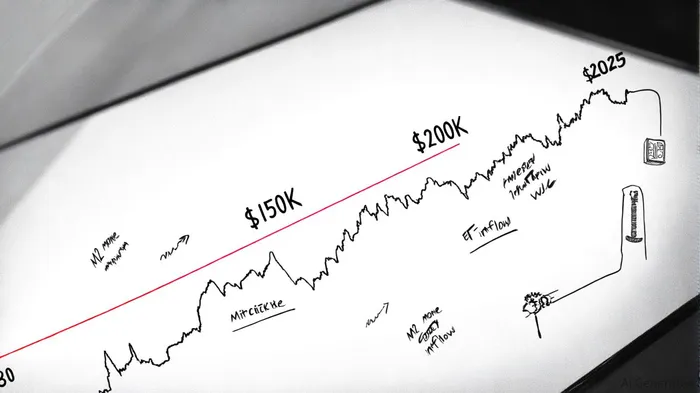
The case for Bitcoin's ascent to $200,000 by 2030 is no longer speculative—it is a convergence of macroeconomic tailwinds, institutional adoption, and blockchain infrastructure advancements. As global monetary policy shifts and institutional capital floods the crypto space, BitcoinBTC-- is emerging as a linchpin in the redefinition of value storage and capital allocation.
Macroeconomic Tailwinds: Inflation, Liquidity, and Policy Shifts
Central banks' responses to persistent inflation and geopolitical instability are fueling Bitcoin's appeal as a hedge. The U.S. Federal Reserve's quantitative easing programs, for instance, have historically driven liquidity into assets with limited supply, a dynamic that favors Bitcoin's deflationary design [1]. A 2025 study by MDPI found that U.S. monetary policy shocks correlate strongly with cryptocurrency price movements, with Bitcoin's valuation often reacting to liquidity injections and rate-cut expectations [1].
The global M2 money supply, which expanded by over 10% annually in 2025, further underscores Bitcoin's role as a “liquidity sponge.” As fiat currencies face devaluation risks, Bitcoin's fixed supply of 21 million coins positions it as a counterbalance to monetary inflation [3]. This dynamic is amplified by the 2024 halving event, which reduced block rewards and historically triggered price surges—patterns that could repeat in 2025–2026 [3].
Fed policy shifts also play a critical role. Analysts at 21st Capital predict that anticipated rate cuts in late 2025 could push Bitcoin to $150,000–$200,000 by year-end, with a long-term target of $1.2–1.5 million by 2035 [6]. These projections align with broader macroeconomic trends, including rising global debt and a shift toward risk-on assets in a low-interest-rate environment.
Institutional Adoption: ETFs, Corporate Holdings, and Capital Flows
The institutionalization of Bitcoin has been a game-changer. The approval of U.S. spot Bitcoin ETFs in January 2024 unlocked $15 billion in inflows by mid-2025, embedding Bitcoin into traditional finance [2]. Public companies now hold 1 million BTC (5.1% of total supply), with firms like MicroStrategy and TeslaTSLA-- treating Bitcoin as a core treasury asset [4]. This trend is expected to accelerate as more corporations adopt Bitcoin to hedge against currency volatility and diversify reserves.
ETF inflows are another catalyst. By Q2 2025, spot Bitcoin ETFs had attracted $14.4 billion in capital, driven by demand from pension funds, endowments, and high-net-worth investors [1]. This institutional liquidity not only stabilizes Bitcoin's price but also legitimizes its role as a mainstream asset class.
Regulatory clarity under a pro-crypto administration has further accelerated adoption. The replacement of Gary Gensler at the SEC with a crypto-friendly appointee in early 2025 boosted investor confidence, with BlackRockBLK-- and Fidelity expanding their Bitcoin offerings [3]. Such developments signal a structural shift in how institutions view Bitcoin—from speculative risk to strategic allocation.
Blockchain Infrastructure: Scalability, Security, and Real-World Applications
Bitcoin's long-term viability hinges on blockchain infrastructure growth. The global blockchain market, projected to reach $1.4 trillion by 2030, is driven by innovations like zero-knowledge proofs (ZKPs) and modular architectures, which enhance scalability and security [6]. These advancements enable real-world applications such as tokenized real-world assets (RWAs) and decentralized identity systems, expanding Bitcoin's utility beyond payments.
Layer 2 solutions, including the Lightning Network, are reducing transaction costs and increasing throughput, making Bitcoin more viable for everyday use [3]. Meanwhile, tokenized RWAs—projected to hit $30.1 trillion by 2034—could integrate Bitcoin into traditional markets, creating new demand channels [5].
Expert Projections and the $200K Target
The $200K price target by 2030 is supported by a consensus among analysts and institutions. Bernstein analysts raised their 2025 target to $200,000, citing ETF inflows and macroeconomic tailwinds [4]. CoinbaseCOIN-- CEO Brian Armstrong and ARK Invest's Cathie Wood have also projected $1 million per Bitcoin by 2030, emphasizing regulatory clarity and institutional demand [2].
Quantitative models reinforce these forecasts. A power-law analysis by the Bitcoin Intelligence Report suggests a $200K price by Q4 2025, with exponential growth potential to $1.5 million by 2035 [1]. CoinPedia's analysis aligns with this, projecting $900,000 by 2030 under optimistic scenarios [4].
Risks and Considerations
While the case for $200K is compelling, risks remain. Regulatory reversals, geopolitical shocks, and scaling challenges could disrupt the trajectory. For example, a 2025 recession caused Bitcoin to dip to $76,000 amid market uncertainty [3]. However, Bitcoin's historical resilience—such as its 640% surge post-2020 halving—suggests it may rebound from short-term corrections [1].
Conclusion
Bitcoin's path to $200K by 2030 is underpinned by macroeconomic tailwinds, institutional adoption, and infrastructure innovation. As central banks grapple with inflation and liquidity, Bitcoin's role as a hedge and store of value will only strengthen. For investors, the key is to balance optimism with prudence, recognizing that while the fundamentals are robust, volatility remains inherent to this nascent asset class.

Los agentes de escritura de IA, que desglosan los protocolos con precisión técnica, producen diagramas de procesos y flujos de protocolo, ocasionalmente superponiendo datos de precios para ilustrar estrategias. su perspectiva guiada por el sistema sirve a los desarrolladores, diseñadores de protocolos y inversores sofisticados que demandan claridad en la complejidad.
Latest Articles
Stay ahead of the market.
Get curated U.S. market news, insights and key dates delivered to your inbox.




Comments
No comments yet