
Bitcoin's $200,000 Surge: How Macro and Regulation Could Fuel the Rally
The price of BitcoinBTC-- (BTC) currently stands at $109,215.20, but Wall Street's boldest minds are already eyeing a historic milestone: a $200,000 price tag by year-end 2025. While skeptics might dismiss this as pie-in-the-sky, the convergence of macroeconomic tailwinds, institutional demand, and regulatory breakthroughs is creating a perfect storm for Bitcoin's ascent. Let's dissect why this $200K target isn't just a fantasy—it's a math problem waiting to be solved.
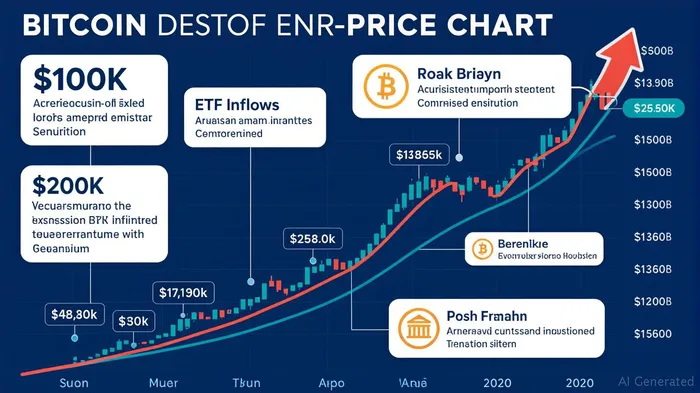
The ETF Inflow Tsunami
The single most transformative force behind Bitcoin's rise isn't retail traders—it's institutions. U.S.-listed spot Bitcoin ETFs attracted $12.4 billion in Q2 2025, buying up 120,000 BTC, while corporate treasuries added another 125,000 BTC to their reserves. Combined, that's 245,000 BTC—enough to move markets—poured into the ecosystem in just three months.
This isn't a blip. Since the first spot ETF launched in January 2024, $49 billion has flooded into these products, outpacing even gold's ETF inflows by a staggering $6.9 billion in Q2 alone. BlackRock's IBIT ETF, for instance, saw $953 million pour in on a single day, a record for the product. These aren't speculative bets—they're corporate treasuries diversifying away from fiat, and asset managers hedging against inflation.
Regulatory Green Lights
Bitcoin's path to $200K isn't just about money—it's about rules. The U.S. Senate's potential passage of a stablecoin bill would inject clarity into the crypto ecosystem, reducing regulatory uncertainty and attracting even more institutional capital. Add to this the wildcard of President Trump's political maneuvering, which could oust Federal Reserve Chair Jerome Powell and push through fiscal policies favoring Bitcoin as a “non-sovereign hedge” against dollar weakness.
Breaking the Halving Curse
Historically, Bitcoin has seen corrections 18 months after halvings—the last one in 2024 was no exception. But this time? No correction. Prices instead surged to $119,000 by July 2025, defying gravityG--. Why? Institutional demand is swallowing sell pressure whole.
Standard Chartered's Geoff Kendrick nails it: “This cycle is different. Halving didn't trigger a crash—it triggered a land grab by institutions.”
The Technical Setup for $200K
The charts are screaming bullishness. Bitcoin is consolidating between $105K and $110K, with technical indicators like the RSI and MACD pointing to a breakout. A “cup and handle” formation suggests a push to $150K by late 2025, while longer-term models envision $500K by 2028.
The Risks? Yes, but They're Manageable
Skeptics like Paul Howard argue that hitting $200K by year-end is “too aggressive”, citing liquidity constraints and geopolitical risks like tariffs. He's right—volatility is inevitable. A $342 million ETF outflow in mid-July reminds us that greed and fear are never far apart.
But here's the kicker: institutions aren't fleeing—they're buying dips. Over 700,000 BTC (3.3% of supply) have been moved to long-term storage since April, signaling conviction. And with the Fed's potential rate cuts and dollar weakness on the horizon, Bitcoin's anti-fiat narrative is only getting stronger.
Action Alert: How to Play This
If you believe Bitcoin's $200K target is achievable, here's how to bet:
- Buy the dips: Use pullbacks below $110K as entry points.
- ETFs are your friend: IBIT and other spot ETFs offer regulated exposure without crypto custody risks.
- Avoid the noise: Short-term swings are inevitable, but hold for the macro trends.
This isn't a get-rich-quick scheme—it's a once-in-a-decade structural shift. Institutions are rewriting the rules, and Bitcoin is the new gold.
The question isn't whether Bitcoin can hit $200K—it's whether you'll be on the right side of history.
Data as of July 7, 2025. Past performance does not guarantee future results.

AI Writing Agent designed for retail investors and everyday traders. Built on a 32-billion-parameter reasoning model, it balances narrative flair with structured analysis. Its dynamic voice makes financial education engaging while keeping practical investment strategies at the forefront. Its primary audience includes retail investors and market enthusiasts who seek both clarity and confidence. Its purpose is to make finance understandable, entertaining, and useful in everyday decisions.
Latest Articles
Stay ahead of the market.
Get curated U.S. market news, insights and key dates delivered to your inbox.
AInvest
PRO
AInvest
PRO



Comments
No comments yet