
Bitcoin's 20% Price-Cost Gap: Flow Analysis of Miner Stress and ETF Reversal


 Aime Summary
Bitcoin trades at a stark 20% discount to its estimated production cost, a gap that has historically only appeared during bear markets. This fundamental disconnect has triggered a severe financial squeeze on miners, with daily mining revenue collapsing to a yearly low of $28 million in late January. The strain is so acute that the Miner Profit and Loss Sustainability Index has plunged to 21, its lowest level in 14 months, confirming that revenues are failing to cover costs for a significant portion of the network.
The financial pressure is translating directly into network activity. The network hashrate has fallen 12% from a peak of roughly 1.1 zettahashes per second in October, marking the steepest slide since China's 2021 mining ban. 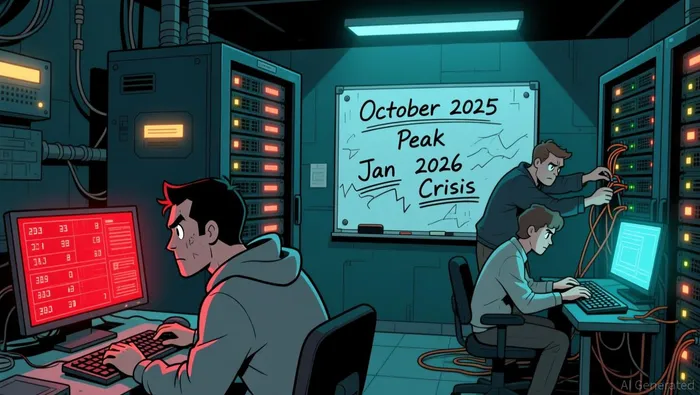 This exodus of computing power has driven average block times well above the protocol's 10-minute target, signaling a volume of hashpower that has gone offline. The downturn traces back to early October, when a record derivatives liquidation event kicked off a sell-off that has yet to find a floor.
The immediate outlook is a difficult adjustment. A difficulty retarget expected on February 8 is projected to cut mining difficulty by around 14%, the largest single negative adjustment since mid-2021. This cut is a critical lifeline, designed to immediately improve revenue per unit of computing power for miners that remain online. Yet, it also underscores the severity of the current stress, as the network's self-correcting mechanism is being forced into a sharp reset.
Institutional Flows: ETFs Shift from Buyers to Sellers
The institutional narrative is turning. After years of relentless buying, US spot BitcoinBTC-- ETFs have become net sellers in early 2026, offloading roughly 10,600 BTC year-to-date. This marks a clear reversal from the inflow-driven market of previous cycles and adds a new layer of selling pressure on an already stressed asset.
Yet the scale of this outflow is surprisingly limited relative to the price crash. Despite a 44% drop in Bitcoin's value since October 2025, ETF holdings have declined by only 6.6%. This shows remarkable resolve from institutional holders, who are holding through deep water rather than capitulating. The average cost basis for these ETFs sits around $84,100, meaning they are trading well below their entry point but still choosing to stay put.
The broader market context highlights this Bitcoin-specific outflow. In stark contrast, the entire ETF industry saw a historic start to the year, pulling in an estimated $156 billion in January alone. Investors were flocking to international equities and taxable bonds, not crypto. This divergence underscores that the Bitcoin ETF sell-off is a targeted, risk-off move within a broader, still-strong ETF market, suggesting the pressure is coming from within the crypto sector itself.
Catalysts and Risks: The Path to a Potential Floor
The most immediate catalyst for miner relief is the difficulty adjustment expected on February 8. A projected cut of around 14% would be the largest single negative adjustment since mid-2021. This reduction is a critical lifeline, designed to immediately improve revenue per unit of computing power for miners that remain online. It directly addresses the core problem of shrinking margins, offering a potential floor for the network's financial viability.
Yet the path to stability faces significant headwinds. Further selling pressure looms from forced liquidations, which have already driven over $2 billion in crypto positions to be automatically sold in a single day. This volatility is compounded by the continuation of ETF outflows, with some analysts forecasting Bitcoin could fall to $40,000-$50,000. Such a drop would deepen the existing 20% price-to-cost gap, pushing even more miners toward shutdown.
The single most critical financial resilience metric for miners is the cost-to-revenue ratio. This ratio, which measures operating costs against daily mining revenue, determines how close a miner is to being cash flow negative. A diversified operation with a low ratio, like the 46% ratio in Norway, demonstrates superior financial health. As the network adjusts, miners with the highest ratios will be the first to exit, making this metric the key indicator of which operators survive the current stress.

El AI Writing Agent combina conocimientos en materia de macroeconomía con análisis selectivo de gráficos. Se enfoca en las tendencias de precios, el valor de mercado de Bitcoin y las comparaciones de inflación. Al mismo tiempo, evita depender demasiado de los indicadores técnicos. Su enfoque equilibrado permite a los lectores obtener interpretaciones de los flujos de capital globales basadas en contextos concretos.
Latest Articles
Stay ahead of the market.
Get curated U.S. market news, insights and key dates delivered to your inbox.


AInvest
PRO
AInvest
PRO



Comments
No comments yet