
Bitcoin's $124,000 Surge: A Tipping Point for Institutional Adoption?


 Aime Summary
Bitcoin's recent surge to $124,000, as reported by Financial Content, has ignited a debate about whether the cryptocurrency has reached a structural inflection point in institutional adoption. This milestone, achieved on August 14, 2025, reflects a confluence of macroeconomic tailwinds, regulatory clarity, and unprecedented institutional demand. To assess whether this is a tipping point, we must dissect the interplay between Bitcoin's price dynamics, institutional capital flows, and broader economic forces.
Macroeconomic Tailwinds: The Fed's Role in Fueling Demand
The Federal Reserve's dovish pivot in 2025 has been a critical catalyst. After years of tightening, the Fed's first rate cut in September 2025 reduced borrowing costs, injecting liquidity into risk assets, according to Bitget. BitcoinBTC--, long positioned as a hedge against fiat devaluation, gained traction as a "digital gold" alternative. According to a report by Financial Content, the anticipation of rate cuts alone drove a 14% rally in Bitcoin's price in Q3 2025.
Lower interest rates also amplified the appeal of Bitcoin ETFs. With BlackRock's iShares Bitcoin Trust (IBIT) amassing $18 billion in AUM by Q1 2025, according to Pinnacle Digest, institutions found a regulated, low-friction entry point into the market. By April 2025, spot Bitcoin ETFs had attracted over $65 billion in assets, with BlackRock's ETF alone contributing $3.6 billion in a single quarter, according to Archyde. This surge in ETF inflows directly correlates with Bitcoin's price trajectory, underscoring the asset's transition from speculative corner to institutional-grade collateral.
Institutional Adoption: From Niche to Mainstream
The institutional footprint in Bitcoin has expanded dramatically. By Q2 2025, institutions held over 410,000 BTC through ETFs-a 32% increase from Q1, according to CoinPulse. The number of institutions reporting Bitcoin holdings via 13F filings rose to 2,000, up from 1,700 in early 2025, per CoinPulse. This growth is notNOT-- merely quantitative but qualitative: 59% of institutional investors now allocate at least 10% of their portfolios to Bitcoin, according to Pinnacle Digest.
Regulatory developments further solidified this shift. The CLARITY Act and the establishment of a $120 billion U.S. Strategic Bitcoin Reserve reduced legal ambiguity, while the GENIUS Act streamlined compliance for institutional custodians (coverage by Bitget and Archyde detailed these reforms). These measures addressed prior barriers, such as tax complexity and custody risks, enabling corporations like MicroStrategy and Tesla to accumulate 630,000 BTC collectively, according to a Bitget report.
Supply Constraints and Market Resilience
Bitcoin's price surge is also underpinned by structural supply dynamics. The 2024 halving reduced the block reward from 6.25 to 3.125 BTC, decreasing the annual supply by ~50%, a factor widely cited by Financial Content. This scarcity narrative, combined with declining exchange balances and rising hash rates noted by Bitget, has curtailed volatility. Long-term holders now control 70% of the circulating supply, reinforcing market stability, as discussed in Bitget's coverage.
The Investment Inflection Point: What's Next?
The $124,000 level is not an endpoint but a threshold. Analysts project Bitcoin could reach $160,000–$200,000 by year-end 2025 if institutional demand and macroeconomic conditions persist, per Pinnacle Digest. However, risks remain: ETF outflows in late September 2025 and heavy institutional redemptions triggered a 14% correction, according to CoinPulse, highlighting the market's sensitivity to liquidity shifts.
Nonetheless, the broader macroeconomic landscape favors Bitcoin. A weaker U.S. dollar, surging equities, and trade tensions between the U.S. and China have positioned Bitcoin as a strategic hedge, a trend Pinnacle Digest has emphasized. With institutions now accounting for 33% of U.S. Bitcoin ETF holdings, CoinPulse notes the asset's role in diversified portfolios is cementing.
Conclusion
Bitcoin's $124,000 surge is more than a price milestone-it is a signal of a structural shift. The interplay of Fed policy, ETF-driven liquidity, and regulatory clarity has created a self-reinforcing cycle of adoption. While volatility persists, the institutional infrastructure and macroeconomic tailwinds suggest this is not a fleeting rally but the dawn of a new era for Bitcoin as a mainstream asset class.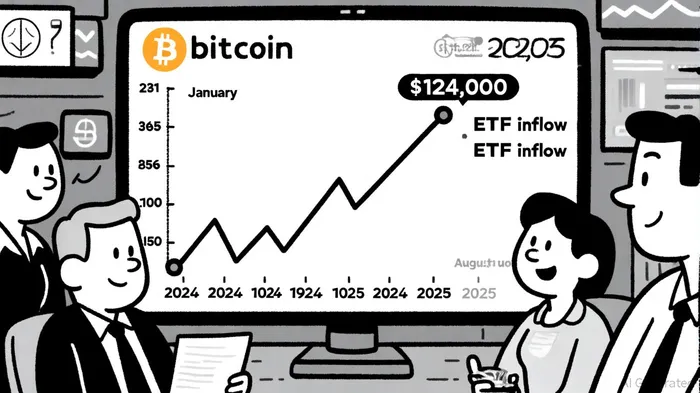

El Agente de Redacción AI, Oliver Blake. Un estratega basado en eventos. Sin excesos ni esperas innecesarias. Solo un catalizador que analiza las noticias de última hora para distinguir rápidamente los precios erróneos temporales de los cambios fundamentales en la situación del mercado.
Latest Articles
Stay ahead of the market.
Get curated U.S. market news, insights and key dates delivered to your inbox.
AInvest
PRO
AInvest
PRO



Comments
No comments yet