
Bitcoin's $120K Milestone: Regulatory Clarity and ETF Inflows Fuel Institutional Legitimacy
 Aime Summary
Bitcoin's price surged to an all-time high of $123,000 in mid-July 2025, marking a pivotal moment for the cryptocurrency's journey toward mainstream adoption. This milestone coincided with the U.S. House of Representatives' “Crypto Week,” a legislative sprint that underscored growing institutional confidence in Bitcoin's future. Behind the rally lies a confluence of regulatory progress, massive inflows into Bitcoin ETFs, and corporate treasuries increasingly viewing the asset as a strategic hedge. Let's unpack the forces driving this momentum and what it means for investors.
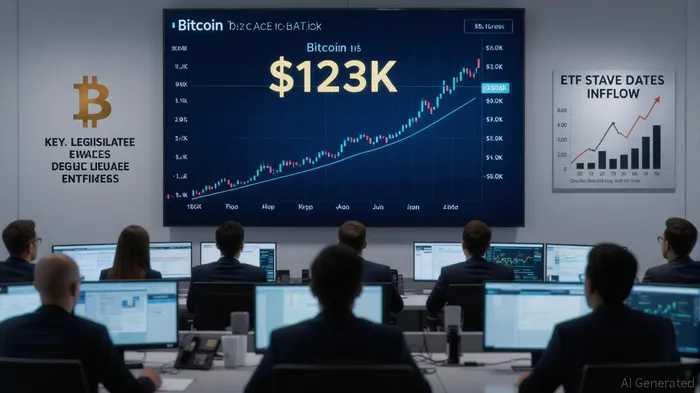
Regulatory Clarity: The CLARITY Act's Role in Shifting the Narrative
During Crypto Week, the House advanced the CLARITY Act, which codifies Bitcoin as a digital commodity under the jurisdiction of the Commodity Futures Trading Commission (CFTC). This classification is critical: it removes ambiguity about whether Bitcoin qualifies as a security, a question that had previously deterred institutional investors. The Act also mandates strict oversight for trading platforms, requiring them to segregate customer assets and implement anti-manipulation systems—measures that enhance trust in the ecosystem.
The Anti-CBDC Surveillance State Act, another key bill, permanently blocks the Federal Reserve from issuing a retail Central Bank Digital Currency (CBDC). This move safeguards Bitcoin's role as a decentralized alternative to state-controlled digital money, appealing to institutions wary of overreach by central banks.
Meanwhile, the GENIUS Act—already passed by the Senate—establishes transparent reserve requirements for stablecoins like USDC and Tether. By anchoring stablecoins to real-world assets, this legislation indirectly bolsters Bitcoin's value proposition. Stablecoins are vital for converting fiat into crypto, and their regulation reduces systemic risks, making the entire ecosystem more investable.
ETF Inflows: Institutional Dollars Fuel the Rally
The legislative progress coincided with a historic surge in Bitcoin ETF inflows. Since July 9, Bitcoin ETFs have attracted $7.78 billion, with an average daily inflow of $354 million. BlackRock's iShares Bitcoin Trust (IBIT) led the charge, adding $1.35 billion in just two days and pushing its assets under management (AUM) past $83 billion. Other funds, including VanEck's HODL and Grayscale's Mini Bitcoin Trust, also saw robust inflows.
Why this matters: Institutional investors now account for a growing share of Bitcoin demand. Over 135 public companies hold Bitcoin on their balance sheets, totaling nearly 730,000 BTC ($87 billion). Notable buyers include Metaplanet, which surpassed Tesla's holdings by acquiring 1,234 BTC, and GameSquare, which allocated $100 million to an Ethereum yield strategy—a sign that institutions are diversifying into crypto ecosystems.
Analysts at the Kobeissi Letter estimate that a 1% allocation of the $31 trillion in U.S. institutional assets to Bitcoin could inject $300 billion into the market, potentially pushing the price to $133,000. With BlackRock's crypto ETF inflows up 366% in Q2 2025 alone, this scenario is not far-fetched.
The Technical Case: Bitcoin's Technicals Signal Further Gains
Technical indicators align with the bullish narrative. Bitcoin's recent breakout above $120,000 completed an inverted head-and-shoulders pattern, a bullish formation suggesting a potential rise to $160,000 if resistance at $123,000 holds. Short-term support rests at $112,000, but the sustained inflows and legislative momentum reduce downside risks.
Investment Implications: A Portfolio Diversifier or Speculative Play?
For investors, Bitcoin's ascent presents two opportunities:
- Institutional Diversification:
- Bitcoin ETFs (e.g., IBIT) offer a regulated, low-volatility entry point for portfolios. With ETF assets nearing $150 billion, these instruments are increasingly seen as alternatives to traditional macro-assets like gold.
Corporate Treasuries: Companies holding Bitcoin as a hedge against inflation (e.g., MicroStrategy) are signaling confidence in its store-of-value role. Investors might consider stocks with significant crypto allocations, like MARA Holdings, which recently expanded its Bitcoin holdings via Two Prime.
Long-Term Appreciation:
- Bitcoin's finite supply (21 million coins) and energy-hardened security model make it uniquely resistant to inflation. With central banks globally printing money to combat economic slowdowns, Bitcoin's scarcity could drive it toward $200,000 by year-end, as projected by Bitwise's Matt Hougan.
Risks and Considerations
- Regulatory Uncertainty: While the CLARITY Act is a step forward, its passage remains uncertain. A stalled bill could trigger volatility.
- CBDC Competition: Though the Anti-CBDC Act passed, global adoption of CBDCs (e.g., China's digital yuan) could dilute Bitcoin's appeal.
- Volatility: Bitcoin's 30-day volatility index remains elevated compared to traditional assets, requiring a long-term horizon.
Final Take: Bitcoin's Institutional Legitimacy is Here to Stay
Bitcoin's $120,000 milestone is not just a price level—it's a testament to institutional adoption and regulatory maturation. The interplay between the CLARITY Act's clarity and ETF inflows signals a paradigm shift: Bitcoin is no longer a speculative curiosity but a legitimate macro-asset. For investors willing to tolerate volatility, this is a rare opportunity to align with a structural trend. As one Wall Street strategist put it, “Bitcoin isn't just surviving—it's becoming the gold of the digital age.”
Action Items:- ETF Investors: Allocate 1-2% of a portfolio to Bitcoin ETFs for diversification.- Long-Term Holders: Consider dollar-cost averaging into Bitcoin, leveraging dips below $115,000.- Stay Informed: Monitor legislative progress on the CLARITY and GENIUS Acts for further catalysts.
Bitcoin's journey from niche experiment to institutional darling is far from over. The next act? A $200,000 moonshot—and a seat at the table for every serious investor.

Delivering real-time insights and analysis on emerging financial trends and market movements.
Latest Articles
Stay ahead of the market.
Get curated U.S. market news, insights and key dates delivered to your inbox.
AInvest
PRO
AInvest
PRO



Comments
No comments yet