
Bitcoin's $118K Milestone: Why Institutional Adoption Signals a New Era in Crypto Markets
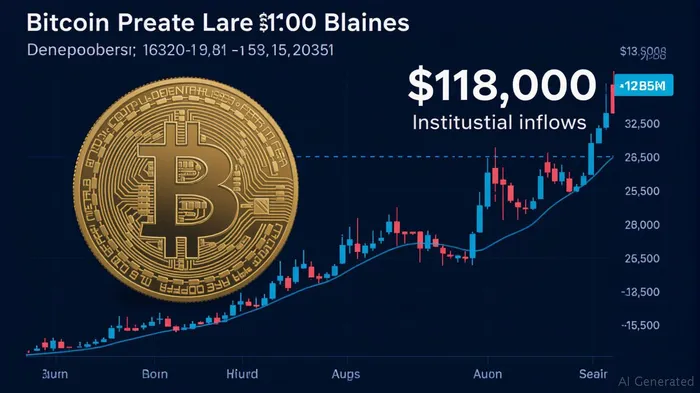
Bitcoin's price has surged to an all-time high of $118,000 in July 2025, marking a pivotal moment for the cryptocurrency's legitimacy as a mainstream asset. While speculative mania has fueled past BitcoinBTC-- rallies, this milestone is distinct: it's being driven by institutional adoption, regulatory clarity, and macroeconomic tailwinds that suggest a sustainable shift in crypto's trajectory. Here's why this rally may endure—and how investors can capitalize on it.
The Institutional Surge: ETFs Lead the Charge
The most significant driver of Bitcoin's record price is the $1.18 billion poured into Bitcoin ETFs on a single day in July 2025—the largest daily inflow of the year. This follows a broader trend of institutional money flooding into crypto via regulated instruments. For example, , with assets like the Valkyrie Bitcoin Strategy ETF and Invesco Bitcoin Trust absorbing billions. Meanwhile, corporate treasuries—such as those of Elon Musk's TeslaTSLA-- and Square (now Block)—have quietly expanded their Bitcoin holdings, signaling a shift from “moonshot” speculation to strategic asset allocation.
This institutional inflow has created a bullish supply-demand imbalance. On-chain data shows Bitcoin's on-exchange supply has dwindled as holders move coins to cold storage, a sign of long-term accumulation. Additionally, over $550 million in short positions were liquidated in 24 hours during the rally, reducing downward pressure. The result? A market where retail and institutional buyers are competing for a shrinking pool of tradable Bitcoin, pushing prices higher.
Macro Trends: Inflation, the Fed, and the Weakening Dollar
Bitcoin's surge is also tied to macroeconomic conditions that make it an attractive hedge. The U.S. dollar has weakened by over 8% year-to-date against major currencies, a trend exacerbated by the Federal Reserve's internal divisions over interest rates. Minutes from the Fed's June meeting revealed a split between policymakers advocating for rate cuts and those fearing inflation relapse. This uncertainty has fueled demand for Bitcoin as a “digital gold”—a store of value uncorrelated with traditional assets.
While inflation has cooled from its 2022 peak, it remains a lingering concern. Bitcoin's scarcity (with ~89% of its 21 million supply already mined) and its resistance to central bank manipulation make it a compelling alternative to cash in a low-yield environment.
Regulatory Clarity: The GENIUS Act and Trump's Crypto-Friendly Policies
A critical underpinning of this rally is regulatory progress. The Senate recently passed the GENIUS Act, which establishes consumer protections for stablecoins and begins formalizing crypto's role in the financial system. This legislation, expected to advance in the House, reduces the regulatory uncertainty that historically spooked institutions. Meanwhile, President Donald Trump's administration has championed crypto-friendly policies, including a proposed “Strategic Bitcoin Reserve” to diversify U.S. foreign exchange reserves.
These moves have emboldened investors. Unlike the Wild West days of 2017 or 2021, today's Bitcoin market operates within a framework where regulators are actively shaping rules rather than stifling innovation. This clarity has drawn in pension funds, family offices, and even legacy financial institutionsFISI-- like BlackRockBLK-- and Fidelity.
Technical and Sentiment Analysis: Is This a Bubble?
Critics argue that $118,000 is irrational. Yet metrics suggest caution, not panic. Bitcoin's Long-Term Holder Net Unrealized Profit and Loss (NUPL) metric, which measures investor euphoria, sits at 0.69—below the 0.75 threshold that historically marked speculative peaks. Meanwhile, the Relative Strength Index (RSI) remains under 70, avoiding overbought territory. This indicates that long-term holders are not yet cashing out en masse, and the rally retains room to grow.
Of course, risks linger. A hawkish Fed pivot or a legislative misstep could trigger a correction. But the structural tailwinds—ETF adoption, corporate treasuries, and regulatory progress—are too strong to dismiss. Analysts like Markus Thielen of 10x Research note that Bitcoin's current cycle differs from prior ones due to its maturity: “This isn't a 'get rich quick' story anymore. It's about strategic allocation in a fragmented financial system.”
Investment Strategy: ETFs for Risk-Mitigated Growth
For investors, the question is: how to participate without the volatility of direct Bitcoin ownership? The answer lies in regulated instruments like Bitcoin ETFs. These vehicles offer exposure to Bitcoin's price movement while reducing risks like custody issues, liquidity gaps, and price manipulation. For example, the ProShares Bitcoin Strategy ETF (BITO) has returned +120% since its 2021 launch, outperforming direct Bitcoin purchases during corrections.
ETFs also provide diversification. Pairing a small allocation (e.g., 1–3% of a portfolio) to Bitcoin via ETFs with traditional assets like stocks and bonds can enhance risk-adjusted returns. For those wary of crypto's volatility, this approach strikes a balance between innovation and prudence.
Conclusion: A New Paradigm for Crypto
Bitcoin's $118,000 milestone isn't just a number—it's a sign that crypto is maturing. The days of Bitcoin being a fringe experiment are fading. With institutions, corporations, and governments now treating it as a legitimate asset, this rally reflects a structural shift, not a fleeting frenzy. While Bitcoin's journey is far from smooth, the foundations for long-term sustainability are in place. For investors, the path forward is clear: embrace regulated access to Bitcoin's upside while mitigating its inherent risks. The crypto revolution isn't over—it's just getting started.

Stay ahead of the market.
Get curated U.S. market news, insights and key dates delivered to your inbox.
AInvest
PRO
AInvest
PRO



Comments
No comments yet