
Bitcoin's $116K–$120K Consolidation and the Implications for Altcoins
 Aime Summary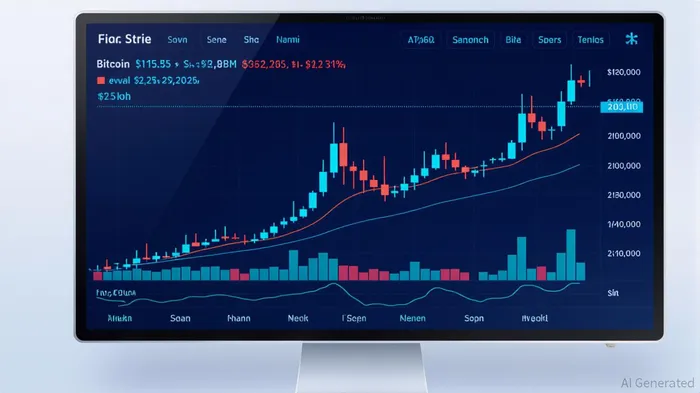
Bitcoin's current consolidation phase between $116,000 and $120,000 is more than a technical pause—it is a critical inflection point for the entire crypto market. This range, which has held for weeks, reflects a tug-of-war between bulls seeking to retest recent highs and bears testing the resilience of key support levels. For investors, the implications extend beyond BitcoinBTC-- itself, reshaping risk dynamics and capital flows across the altcoin ecosystem.
A Technical Crossroads
The $116,000 support zone has become a focal point. A breach here would signal a breakdown in the bullish narrative, potentially triggering a retest of the 50-day EMA at $110,589 and beyond. Conversely, a sustained close above $120,250—a level that has repeatedly repelled downward pressure—could reignite the uptrend. Technical indicators are mixed: the RSI on the 4-hour chart hovers at 51, suggesting waning momentum, while the daily chart's RSI near 65 hints at underlying strength. The MACD, meanwhile, remains in neutral territory, underscoring the market's indecision.
On-chain data adds nuance. A net outflow of 11.7K BTC from exchanges in recent weeks suggests whales and long-term holders are accumulating, reducing near-term supply. Yet derivatives markets tell a different story: short positions now dominate at 53.1%, with the long/short ratio at 0.88. This bearish tilt creates a potential short squeeze if Bitcoin stabilizes. For now, the market is in a state of equilibrium, with every candlestick swing amplifying the tension between conviction and caution.
Institutional Tailwinds, Retail Caution
Institutional demand remains a powerful tailwind. Despite recent ETF outflows—$131.35 million in early July—cumulative inflows of $6.6 billion in late July underscore the sector's resilience. Companies like MicroStrategyMSTR-- and VolconVLCN-- continue to load up on Bitcoin, treating it as a core asset rather than a speculative play. This institutional fortitude is critical: it provides a stable base for the market, even as retail participation wanes.
Retail sentiment, however, has turned frosty. Weighted sentiment has dipped below -1.03, and Social Dominance has fallen to 27%, levels not seen since late 2024. New UTXO creation—a proxy for grassroots buying—is slowing, indicating that the retail-driven frenzy of previous bull cycles is absent. This lack of FOMO-driven demand means Bitcoin's next move will depend not on mass retail euphoria but on institutional execution and macroeconomic catalysts.
Altcoins in the Crosshairs
Bitcoin's consolidation has created a vacuum that altcoins are racing to fill. The broader crypto market has seen a $216 billion surge in altcoin market cap over two weeks, the largest such increase on record. EthereumETH--, in particular, has emerged as the new epicenter of speculative capital. Its open interest dominance climbed to 38%, the highest since April 2023, while perpetual trading volumes surpassed Bitcoin's for the first time since 2022.
Solana, XRPXRP--, and smaller-cap tokens like UNI and XRP have also benefited, with open interest in these assets swelling by $18 billion in July alone. However, this rapid capital rotation comes with risks. Altcoin open interest has exceeded the +2 standard deviation threshold for leverage for 12 consecutive days, a fragile state that amplifies the potential for sharp corrections. The Altcoin Season Index, now near 50, suggests early-stage capital rotation, but it also underscores the market's vulnerability to overbought conditions.
Risk Diversification in a Post-Consolidation World
The post-consolidation environment demands a nuanced approach to risk management. Bitcoin's $116K–$120K range is a microcosm of the broader market's structural shifts. As altcoins gain traction, investors must balance exposure across major protocols while hedging against liquidity crunches.
Institutional strategies offer a blueprint. Post-July 8, when Bitcoin broke out to $123K, investors reallocated capital to Ethereum and SolanaSOL--, leveraging their technical progress and ecosystem growth. Ethereum's triple-bottom formation at $2,500 attracted long-term buyers, while Solana's staking ETF and EVM-compatible sidechain drew tactical positioning. Yet even these leaders show volatility—Solana's funding rates oscillated wildly, reflecting a lack of sustained conviction.
For individual investors, the lesson is clear: diversification is not a luxury but a necessity. A portfolio skewed toward a single asset or sector risks being blindsided by a breakdown in Bitcoin or a liquidity shock in altcoins. Dollar-cost averaging, stop-loss orders, and stablecoin hedges are tools to deploy here.
The Path Forward
Bitcoin's consolidation will end eventually. Whether it breaks out or breaks down, the next move will reverberate across the crypto market. For altcoins, the coming weeks will test whether the current rally is a sustainable trend or a speculative bubble.
Investors should prepare for both scenarios. If Bitcoin reclaims $120K, altcoins could surge further, with Ethereum and Solana leading the charge. But if the support at $116K fails, altcoins may face a cascading sell-off, particularly those with high leverage.
In this environment, discipline and adaptability are paramountPARA--. The crypto market is evolving rapidly, and the days of buying and holding Bitcoin alone are over. A diversified, data-driven approach—rooted in an understanding of market structure and risk—will be the key to navigating what lies ahead.

Stay ahead of the market.
Get curated U.S. market news, insights and key dates delivered to your inbox.




Comments
No comments yet