
Bitcoin at $112K: Is This a Capitulation Point or a Strategic Entry?
 Aime Summary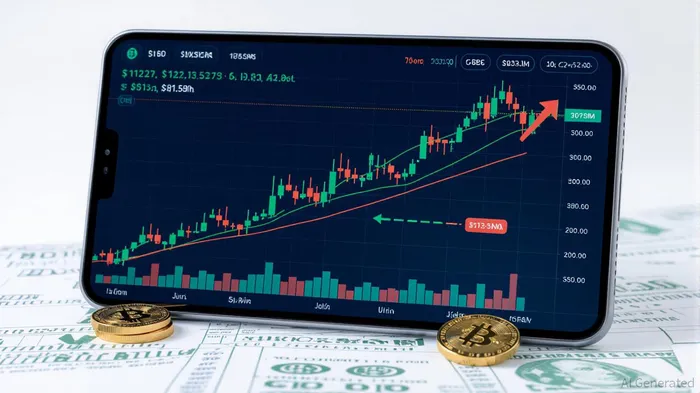
The BitcoinBTC-- market has reached a pivotal moment near $112,000, where divergent forces of institutional conviction and retail fear are colliding. This price level, once a psychological floor, now serves as a battleground between long-term institutional buyers and short-term retail panic. For investors, the question is not just whether Bitcoin will hold here—but whether this is a capitulation point or a strategic entry for those with a macroeconomic lens.
Institutional Conviction: A Bullish Undercurrent
Institutional investors have shown no signs of retreating. Companies like MicroStrategy (rebranded as "Strategy") and Tether have continued to accumulate Bitcoin at scale, even as the price dipped below $113,000. Strategy's Q2 2025 performance—$10 billion in profit and a $2.5 billion preferred share issuance—funded the purchase of 21,021 BTC at an average price of $117,000. This aggressive buying, despite a broader market correction, underscores institutional confidence in Bitcoin's long-term value.
The U.S. regulatory environment has also shifted in favor of crypto assets. The SEC's new "Crypto" initiative, which includes rules for tokenization and DeFi, is reducing uncertainty and fostering innovation. Meanwhile, exchange-traded funds (ETFs) like BlackRock's iShares Bitcoin Trust (IBIT) have attracted $13.7 billion in inflows in 2025 alone, with institutions allocating billions to Bitcoin as a strategic asset.
On-chain data further supports institutional accumulation. While transfer volumes and active wallet counts have declined, Bitcoin outflows from exchanges (-0.51% in early August) suggest long-term holders are locking in their positions. The top five Bitcoin holders now control ~771,551 BTC, a concentration that gives them significant influence over price dynamics.
Retail Fear: A Bearish Overhang
Retail sentiment, however, tells a different story. The Bitcoin Fear & Greed Index has plummeted to 44, entering "extreme fear" territory. Social media platforms are flooded with panic selling, with traders abandoning positions after Bitcoin's 8.5% drop from its $124,000 peak. This bearish shift mirrors historical mid-cycle corrections in 2017 and 2021, where retail panic preceded rebounds.
The technical breakdown below the 50-day simple moving average ($115,870) and the formation of a potential head-and-shoulders pattern have amplified fears. A breach of the $112,000 neckline could trigger a deeper correction toward $108,000 or $105,150. The Average Directional Index (ADX) has weakened to 36%, signaling a consolidation phase rather than a sustained trend.
Retail-driven ETF outflows have also added downward pressure. U.S. spot Bitcoin ETFs saw $523 million in redemptions in a single day, with funds like Fidelity's FBTC and Grayscale's GBTC experiencing significant redemptions. This exodus reflects short-term uncertainty ahead of the Federal Reserve's Jackson Hole symposium, where investors await clues on rate policy.
Macro-Driven Dynamics: A Tug-of-War
The broader macroeconomic context is a critical factor. Weak U.S. Non-Farm Payrolls (NFP) data—adding just 73,000 jobs in July—has increased the likelihood of Fed easing. While the Fed has kept rates in the 4.25–4.50% range, internal disagreements are growing, with two voting members advocating for cuts. This "risk-off" sentiment has driven capital into safe-haven assets like gold and government bonds, while Bitcoin, a risk-on asset, has faced selling pressure.
However, the Fed's potential dovish pivot could act as a floor for Bitcoin. If Chair Jerome Powell signals rate cuts at Jackson Hole, it could reinvigorate risk appetite and provide a catalyst for a rebound. The Bitcoin Cycle Extreme Oscillator, which spiked to overheated levels in July, now suggests a correction is in progress—but institutional demand and leveraged futures buying remain strong enough to prevent a full-blown bear market.
Strategic Entry or Capitulation?
For investors, the $112,000 level represents a critical inflection point. Historically, similar corrections in 2017 and 2021 were followed by rebounds, with Bitcoin eventually surpassing previous highs. If institutions continue to accumulate and the $112,000 support holds, this could be a strategic entry point for long-term buyers.
However, caution is warranted. A breakdown below $112,000 could test the $110,000 and $108,000 levels, with the Max Pain Price at $118,000 acting as a key resistance target. The options market's bearish-bullish divide—dominant call options at $135,000–$140,000 versus declining put volume—suggests that while bulls are hedging for a rebound, the market is not yet fully committed to a bullish narrative.
Investment Advice: Balancing Risk and Opportunity
- For Long-Term Investors: Consider dollar-cost averaging into Bitcoin at $112,000, using the pullback as an opportunity to accumulate alongside institutional buyers. Monitor the Fed's Jackson Hole speech for signals on rate policy.
- For Short-Term Traders: Exercise caution around the $112,000 level. A breakdown could trigger a deeper correction, while a rebound above the 200-SMA ($117,000) would signal renewed bullish momentum.
- For Portfolio Diversifiers: Allocate a small portion of risk assets to Bitcoin ETFs like IBITIBIT-- or FBTC, which offer exposure to institutional-grade Bitcoin holdings.
In conclusion, Bitcoin's $112,000 level is neither a capitulation point nor a guaranteed entry—it is a crossroads. Institutional conviction and regulatory tailwinds suggest the bull case remains intact, but retail fear and macroeconomic risks demand vigilance. For those with a multi-year horizon, this may be the moment to separate noise from signal and position for the next leg of the cycle.

Decoding blockchain innovations and market trends with clarity and precision.
Latest Articles
Stay ahead of the market.
Get curated U.S. market news, insights and key dates delivered to your inbox.




Comments
No comments yet