
Is Bitcoin's $111K Support a Strategic Entry Point Amid Macro Volatility?


 Aime Summary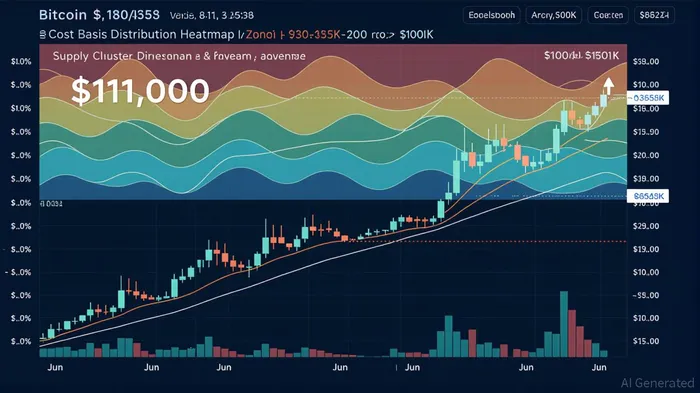
Bitcoin's recent 7-week low at $111,000 has ignited a critical debate: Is this a disciplined entry point for long-term investors, or a warning sign of deeper macroeconomic-driven corrections? The answer lies in dissecting the interplay between structural demand, institutional accumulation, and macro risk management.
Structural Demand: ETFs and Institutional Confidence
The U.S. spot BitcoinBTC-- ETFs have emerged as a cornerstone of Bitcoin's bull case. By Q2 2025, these funds amassed $65 billion in assets under management, with BlackRock's IBIT alone accounting for 3% of the total Bitcoin supply. Despite recent volatility, ETF inflows remain resilient, with net inflows of $250 million in early August. Fidelity's $64.76 million inflow underscores institutional confidence, even as short-term outflows (e.g., BlackRock's $615 million weekly outflow) highlight market fragility.
Structural demand is further reinforced by corporate treasury allocations. MicroStrategy's $71 billion BTC purchase and Smarter Web's dual cash-and-Bitcoin policy reflect a growing institutional consensus that Bitcoin is a macroeconomic hedge. These moves, coupled with post-halving supply constraints, create a floor for Bitcoin's price, even amid short-term turbulence.
Institutional Accumulation: On-Chain Resilience
On-chain metrics paint a nuanced picture. The Whale Accumulation Score (0.90) mirrors 2019 bull market levels, signaling strategic buying by large players. Mid-tier holders (100–1,000 BTC wallets) now control 23.07% of the total supply, while long-term holders (LTHs) have locked in Bitcoin through Value Days Destroyed (VDD) metrics. This accumulation is concentrated in the $93K–$110K range, a dense cost basis cluster that has historically acted as a support floor.
The Cost Basis Distribution (CBD) Heatmap reveals a critical inflection point: Bitcoin's recent pullback to $111K has partially filled the “air gap” in this cluster, redistributing supply at discounted prices. Short-term holders (STHs) with cost bases at $113.6K and $107K remain under pressure, but the Relative Unrealized Loss metric (0.5%) remains far below historical bear market thresholds (30%+). The Spent Output Profit Ratio (SOPR) near 1.0 suggests minimal profit-taking or loss-realization, indicating a fragile equilibrium.
Macro Risk Management: Fed Uncertainty and Political Headwinds
Bitcoin's price action is inextricably tied to macroeconomic conditions. The Federal Reserve's delayed dovish pivot—projecting only 100 basis points of rate cuts by late 2026—has created a “high for real long” scenario, distorting risk appetite and capital flows. This policy fragmentation, combined with Trump-era tariff risks and regulatory uncertainty (e.g., the pending CLARITY Act), amplifies volatility.
Retail fragility exacerbates these risks. Short-term holders (STHs) saw a 30–38% reduction in UTXO positions held under 18 months, with $900 million in derivatives liquidations in August (90% longs). The taker buy/sell ratio hit its lowest level since November 2021, underscoring retail selling pressure. Meanwhile, perpetual futures markets lean bearish, with Cumulative Volume Delta (CVD) bias turning negative on exchanges like Binance and Bybit.
Tactical Investment Framework: Navigating the Inflection Point
For investors, the $111K support level represents a strategic entry point—but only with disciplined risk management. Here's a framework to navigate this inflection point:
- Dollar-Cost Averaging (DCA) on Red Days: Allocate capital during dips to $110K–$115K, leveraging ETF inflows and institutional accumulation.
- Tactical Entries at Key Levels:
- Support: $110K–$111K (on-chain floor).
- Resistance: $117K–$120K (resumption of uptrend).
- Stop-Loss: Below $107K (triggering deeper corrections).
- Position Sizing and Hedging: Given overbought conditions (RSI 60–73), limit exposure to 10–15% of a diversified portfolio. Use options or futures to hedge against Fed-driven volatility.
- Macro Diversification: Balance Bitcoin exposure with EthereumETH-- (ETH) and macro-hedged assets (e.g., gold, U.S. Treasuries). ETH's 4% intraday rise during BTC weakness highlights its role as a risk-on proxy.
Conclusion: A Calculated Bull Case
Bitcoin's $111K support level is a critical battleground between structural demand and macroeconomic headwinds. While institutional accumulation and ETF inflows provide a strong floor, retail fragility and Fed uncertainty pose risks. For long-term investors, this dip offers a disciplined entry point—provided they prioritize risk management and avoid overexposure to overbought conditions. The coming weeks will test whether $111K holds as a strategic base or gives way to deeper corrections. For now, the data suggests the bull thesis remains intact, but vigilance is paramount in this volatile environment.

Decoding blockchain innovations and market trends with clarity and precision.
Latest Articles
Stay ahead of the market.
Get curated U.S. market news, insights and key dates delivered to your inbox.




Comments
No comments yet