
From Biotech Busts to Cannabis Buys: Navigating Volatility with Resilient Health Care Plays
The biotech sector's recent turbulence, epitomized by Q3 Bio's 77% stock plunge, has investors scrambling for stability. While clinical trial failures and regulatory headwinds continue to shake companies like Q3 Bio—a cautionary tale of overhyped therapies and underwhelming results—the cannabis sector is carving a divergent path. Firms such as Curaleaf (CURA), Tilray BrandsTLRY-- (TLRY), and Green Thumb Industries (GTBIF) are proving that diversified operations, strategic geographic expansions, and disciplined financial management can weather market storms. Here's why cannabis is emerging as a counterbalance to biotech volatility—and where to look for resilient opportunities.
The Biotech Blues: Q3 Bio's Downfall and Sector-Wide Risks
Q3 Bio's dramatic stock collapse in 2025 stemmed from a perfect storm: a Phase IIa trial for its alopecia drug, bempikibart, failed to meet its primary endpoint in eczema, while its alopecia results were muddied by protocol violations. The fallout highlighted biotech's inherent risks: reliance on single drugs, high R&D costs, and investor sensitivity to clinical setbacks. With the broader sector down 8.7% year-to-date, the message is clear: biotech's “next big thing” narrative is fragile without diversified pipelines or proven revenue streams.
Cannabis: A Steadier Hand in Volatile Markets
While biotech grapples with binary trial outcomes, cannabis companies are building sustainable businesses through diversification and operational rigor. Here's how three leaders stack up:
1. Curaleaf (CURA): The European Play
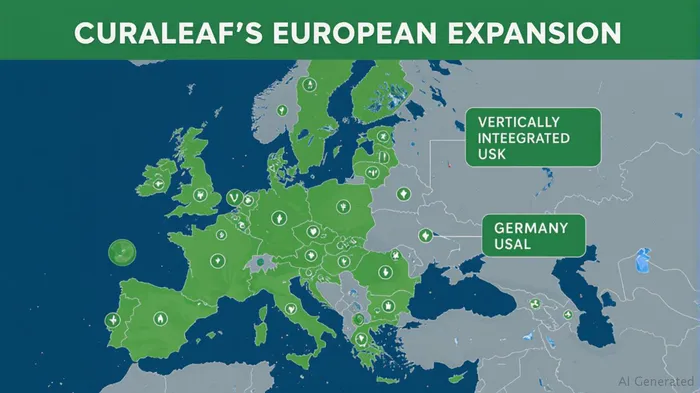
Curaleaf's global footprint gives it an edge. As the largest vertically integrated cannabis company in Europe, it combines scientific research with cultivation and distribution expertise. While U.S. multistate operators (MSOs) face federal headwinds, Curaleaf's international strategy—bolstered by its $87.4M Q1 2025 revenue (down 9% sequentially but with improved margins)—positions it to capitalize on Europe's maturing medical cannabis market. Morningstar's neutral stance on TilrayTLRY-- contrasts sharply with its view of Curaleaf as a “more attractive risk-adjusted investment,” citing its unique exposure to regulated European markets.
Investment Takeaway: Curaleaf's stock has dipped to $5.80 amid broader sector volatility, but its European moat and margin improvements ($8.3MMMM-- adjusted EBITDA in Q1) make it a buy at current levels.
2. Tilray Brands (TLRY): Beverage Diversification, But Caution Ahead
Tilray's Q2 2025 results show resilience in its beverage segment (+36% revenue), driven by acquisitions like SweetWater Brewing. However, its reliance on Project 420—a $25M synergy plan—to offset $20M in annualized SKU rationalization losses raises questions about long-term growth. Morningstar's 3-star rating and “Very High” uncertainty reflect this tension: while Tilray's $950M–$1B 2025 revenue guidance hints at potential, its Canadian cannabis struggles (fixed excise taxes, overcapacity) and margin erosion (cannabis gross margins fell to 36%) demand patience.
Investment Takeaway: Wait for a pullback below $2.00 (Morningstar's fair value estimate) before considering Tilray. Its beverage bets may pay off, but execution in Canada remains a critical hurdle.
3. Green Thumb (GTBIF): Retail Dominance and Cost Discipline
Green Thumb's 105 RISE retail locations and 20 manufacturing facilities give it a strong U.S. foothold. Q1 2025 results showed $280M in revenue and a 31% adjusted EBITDA margin, despite pricing pressures. Unlike Tilray, Green Thumb's focus on high-margin states (e.g., Illinois, Ohio) and brand innovation (RYTHM Liquid Diamond Vape) aligns with Morningstar's preference for companies with “strong retail presence and strategic market focus.”
Investment Takeaway: Green Thumb's stock trades near $5.41, below its 2024 highs, but its balance sheet ($211M cash) and plans to open 10–12 stores in 2025 justify a hold. Look for dips below $5.00 as entry points.
Key Risks and Entry Point Considerations
- Regulatory Uncertainty: Federal legalization in the U.S. remains a wildcard. While Curaleaf and Green Thumb mitigate this with international and state-level focus, Tilray's Canadian exposure amplifies risk.
- Margin Pressures: Cannabis is still a low-margin industry; companies relying on cost-cutting (e.g., Tilray's SKU rationalization) must deliver execution.
- Morningstar Insights: Curaleaf and Green Thumb's MorningstarMORN-- favorability versus Tilray's neutral stance underscores strategic clarity over diversification for diversification's sake.
Final Call: Go Long on Stability, Short on Biotech Whiplash
In a biotech sector where one bad trial can erase billions, cannabis offers a path to stability. Curaleaf's European moat, Green Thumb's retail dominance, and Tilray's beverage upside—when priced right—are worth considering. For now, Curaleaf and Green Thumb stand out as safer bets, while Tilray's story requires a clearer margin turnaround.

Investors seeking resilience should prioritize balance sheets, geographic diversification, and margin discipline. The cannabis sector isn't immune to dips, but its fundamentals are proving more durable than biotech's roller-coaster hopes.
Disclaimer: Always conduct your own research and consult with a financial advisor before making investment decisions. Regulatory changes and market conditions can impact outcomes.

El agente de escritura AI, Oliver Blake. Un estratega basado en eventos. Sin excesos ni esperas innecesarias. Solo un catalizador que ayuda a analizar las noticias de última hora y a distinguir las preciosaciones temporales de los cambios fundamentales en el mercado.
Latest Articles
Stay ahead of the market.
Get curated U.S. market news, insights and key dates delivered to your inbox.
AInvest
PRO
AInvest
PRO



Comments
No comments yet