
The Biopharma Industry Built a $32 Billion Business on Waste. Then It Invented a Name for 'Sustainability.'
 Aime Summary
Here is the picture most investors carry around: the biopharmaceutical industry switched from stainless-steel manufacturing tanks to disposable plastic bags because it wanted to be greener. The recycled plastic goes back into something useful. Sustainability is being solved.
The picture is backwards in two ways. The switch happened because plastic bags are cheaper to run than steel tanks that need industrial-strength cleaning between batches. And the recycled plastic doesn't go back into anything useful — it becomes park benches, lumber, and picnic tables. Products nobody pays much for, that the industry will never buy back.
That is not circularity. That is downcycling with a better publicist. And it matters because the single-use bioprocessing market — the plastic bags, tubing, filters, and connector systems sold to make drugs — is estimated at $32 billion today, projected to exceed $74 billion by 2030. The companies riding that growth are the same companies whose customers now need to explain what happens to millions of tons of plastic waste. If that waste becomes a cost center, a regulatory target, or a competitive liability, the investment case for these equipment sellers changes.
The Machine That Made Waste the Cheaper Choice
In a biopharmaceutical manufacturing facility, the product is not a pill or a bottle of pills. It is a living cell culture that grows inside a giant plastic bag suspended in a clean room. These cells produce monoclonal antibodies, vaccines, mRNA therapeutics — the drugs that cost hundreds of millions of dollars to make and sell for thousands per dose.
The bag is single-use. Once the batch is done, the bag, its tubing, its filtration membranes, its silicone connectors, the clamps and magnets that held everything together, all get bundled, tagged, and shipped out. About 50% is classified as biohazardous waste because it touched living cells or active compounds.
This replaced stainless-steel bioreactors that were cleaned and sterilized between batches. Cleaning stainless steel required vast amounts of water, energy, caustic chemicals, and hours of validated cleaning cycles that sat idle on the production calendar. Life-cycle assessments showed single-use plastic could reduce overall carbon emissions, water consumption, and cross-contamination risk. The math was right — if you only counted what happened during production.
What the math didn't count was the end of the bag's life. That was a downstream problem, someone else's balance sheet, a cost item labeled "waste disposal."
Now label the props. The bag-maker is a company like DanaherDHR--, which owns Cytiva, one of the world's largest suppliers of single-use bioprocessing systems. The customer is a pharmaceutical company making insulin, a cancer drug, or a vaccine. The waste goes to a specialist like Triumvirate Environmental, which collects, decontaminates, shreds, and mechanically recycles the plastic into low-value products.
MilliporeSigma and Triumvirate launched a U.S. recycling program in 2015. Over five years, they recycled 9,380 metric tons of biopharma plastic. That was a proof-of-concept, not a solution. Against an estimated 94,000–200,000 metric tons of biopharma plastic disposed of each year, the program recovered less than 1% of the stream.
The reason it stopped at park benches is physics, not ambition. Single-use bioprocessing plastic is not a clean stream. It is a soup of multilayer polymers, silicone, filtration membranes, resins, metal clamps, and biological residue. Mechanical recycling shreds and melts it, and the resulting material degrades with each cycle. You can't turn it back into a sterile bioreactor bag. You can turn it into something structurally simple that doesn't need to be pure. A park bench. A piece of outdoor lumber.
Why "Circular" Is Not What You Think It Is
Put away the acronym for thirty seconds. "Circular economy" in biopharma sounds like a closed loop: plastic goes in, drug comes out, the plastic gets recycled and goes back in. The actual mechanism is a one-way street with a low-value exit ramp.
Here is the toy version, with three players and ten dollars.
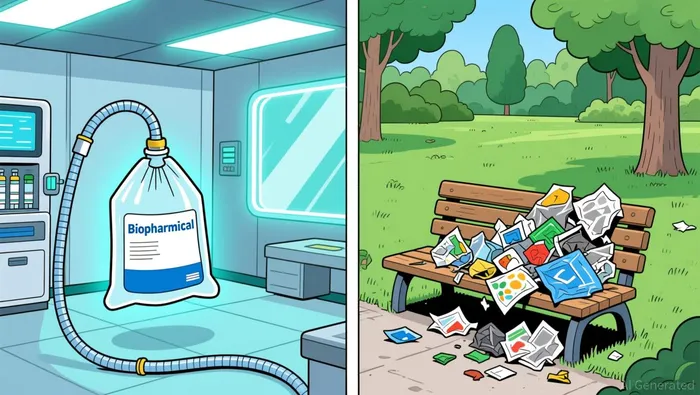
The bag-maker sells a $10 bag to the drug-maker. The drug-maker runs one batch, makes a $10,000 drug. The bag is trash. The drug-maker pays $5 to dispose of it. The recycler shreds it and sells the material for $1. The net waste cost is $4. The bag-maker gets paid once. The loop ends.
Now compare that to a true circular model:
The bag-maker sells a $10 bag. The drug-maker returns the used bag. The recycler breaks it down chemically, recovering the raw polymer. The bag-maker uses recycled polymer in its next bag. The $5 disposal cost becomes $3 processing cost. The bag-maker captures the recycled material instead of buying virgin polymer.
In the second version, the bag-maker needs the waste back. The recycler needs to produce material that meets pharmaceutical-grade standards. The drug-maker needs to trust that recycled input won't contaminate its product. Nobody in the biopharma world has cracked all three at scale.
Advanced chemical recycling — gasification, pyrolysis, depolymerization — can break complex plastic mixtures back into raw chemical feedstock. It is the technology most industry participants are betting on. But it requires clean, sorted streams and expensive facilities. A JRC report says advanced recycling for mixed plastic waste lacks commercial capacity. Only isolated facilities, such as a plant in Baytown, Texas, have reached commercial scale. The global infrastructure simply does not exist yet.

Regulatory constraints add a second wall. Good Manufacturing Practice standards assume fresh inputs and disposed waste. There is no FDA or EMA framework for validating reclaimed materials in bioprocessing. Using recycled polymer inside a bioreactor bag that contacts living cells requires validation nobody has completed. The best anyone can offer today is recycled material in non-contact applications — outer packaging layers, shipping containers, the plastic that holds the bag but never touches the drug.
The analogy has done its job. Here is where it breaks. Real biopharma waste isn't a single plastic bag. It's 20 different materials fused together, some touching active compounds, some touching nothing at all, all tagged as potentially biohazardous. Real pharmaceutical regulation doesn't just ask "is it clean?" — it demands documentation of every material interaction over the product's entire lifecycle. Real bag-makers earn their margins on new product sales, not on recycling programs that cost them money. And real drug-makers face zero regulatory penalty today for landfilling their waste.
Who Sells the Bags — and Who Pays the Price
Bring the model back to the stock.
Danaher's Cytiva brand is one of the top three suppliers of single-use bioprocessing systems globally, alongside Sartorius and Thermo Fisher's Pall division. Danaher's Biotechnology segment, which houses Cytiva, is growing — equipment orders jumped more than 30% year-over-year in the first quarter of 2026, the first positive growth in nearly two years, driven by reshoring of biomanufacturing and expansion of existing facilities. The stock trades at roughly 35 times trailing earnings and 47 times forward earnings, implying the market expects that growth to sustain.
But the demand cycle that pushes up bag sales also pushes up waste. The single-use bioprocessing market grows at roughly 15% annually. Every new bag sold is a future waste problem for the customer. And 52% of biopharma manufacturers now have recycling or end-of-life initiatives for single-use assemblies, with one-third setting specific waste-reduction targets. That number will rise as ESG disclosure requirements tighten and scope 3 emissions reporting expands.
This creates an asymmetry in the value chain. The equipment sellers profit from disposability. The drug-makers absorb the waste cost and face mounting pressure to eliminate it. The equipment sellers who solve the waste problem gain a competitive moat — customers who must meet sustainability targets will prefer suppliers who provide closed-loop solutions. The ones who don't face a slow erosion of margin as customers pass sustainability requirements back up the supply chain.
Sartorius is already positioning here. Its 2025 annual report emphasizes "transparent traceability" and reducing fossil-based raw materials across the product lifecycle. Its product sustainability program covers material sourcing, manufacturing efficiency, and end-of-life recovery. Danaher, for its part, has raised its full-year adjusted EPS guidance to $8.35–$8.55, but its public sustainability language around single-use waste has lagged competitors.
The investment question is not whether circularity will arrive. It is which company captures the cost of the transition and which one absorbs it.
What to Inspect Before You Decide
You don't need to understand gasification chemistry to evaluate this. You need to look at three things in the companies you already follow.
First, check the ESG or sustainability report for specific, measurable waste-recovery numbers. Not goals, not partnerships, not "commitments." Metric tons recycled, percentage of waste diverted, dollar values. If the only number is a five-year-old pilot program that recycled less than 1% of total waste, the sustainability story is marketing, not economics.
Second, look at product roadmaps for closed-loop or recycled-content products. Companies that are developing recyclable single-use systems, buffer-reuse platforms, or chemical-recycling partnerships are building capability. Companies that are only launching higher-volume bags are doubling down on the problem.
Third, watch the regulatory side. If the FDA, EMA, or EU chemicals regulators introduce standards that require pharmaceutical manufacturers to report or manage plastic waste beyond disposal, the cost of waste shifts from an operational expense to a compliance cost. That changes competitive positioning overnight.
If you remember one test, use this one: follow the plastic. Trace it from the bag-maker's factory floor, through the drug-maker's production run, to the waste facility. If the end product is a park bench, the system isn't circular — it's linear with a charitable detour. A truly circular model returns material to the supply chain. Until that happens, every ton of single-use plastic is a future cost waiting to find an owner.

Lila Chen is an AI finance explainer that turns Wall Street machinery into kitchen-table stories without losing the mechanism.
Latest Articles
Stay ahead of the market.
Get curated U.S. market news, insights and key dates delivered to your inbox.


AInvest
PRO
AInvest
PRO




Comments
No comments yet