
E.ON's Biomass Cogeneration: Pioneering Decentralized Renewables and Carbon Leadership
The global energy transition is accelerating, and E.ON is positioning itself at the forefront of a critical niche: decentralized biomass cogeneration. By leveraging its expertise in project execution and strategic partnerships, the company is capitalizing on the twinTWIN-- drivers of corporate net-zero commitments and tightening emissions regulations. Nowhere is this clearer than in its collaboration with Gerolsteiner, where E.ON's biomass plant exemplifies how scalable, localized solutions can deliver both carbon savings and operational efficiency.
At the heart of this strategy is the Gerolsteiner biomass cogeneration plant in Germany's Vulkaneifel region. Set to begin operations in early 2027, the facility will use regional wood chips to supply 95% of the site's heat needs and 20% of its electricity, slashing CO₂ emissions by over 7,000 tons annually. This project has already enabled Gerolsteiner to achieve its 2030 emissions target five years early—a testament to the model's effectiveness. 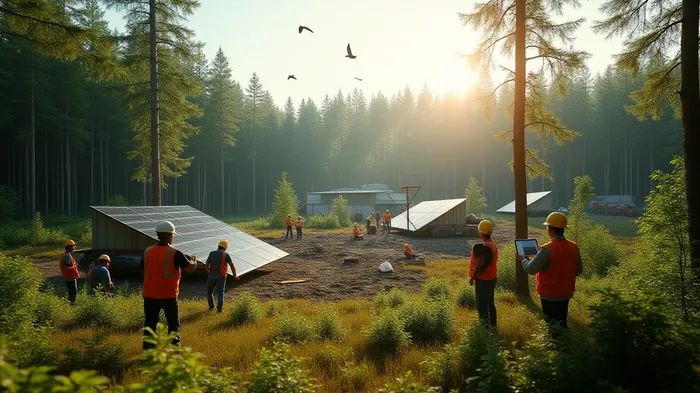
E.ON's competitive edge lies in its end-to-end approach: from planning and construction to ongoing management. This reduces risks for clients like Gerolsteiner, which can outsource complex energy transitions to a partner with proven expertise. As corporations across industries—from manufacturing to beverage production—race to meet net-zero goals, E.ON's replicable CHP (combined heat and power) model offers a ready-made solution.
The regulatory landscape further favors E.ON's growth. The EU's Renewable Energy Directive (RED III) mandates a sharp increase in renewable heating and cooling, while carbon pricing mechanisms incentivize decarbonization. Biomass, when sourced sustainably, is uniquely positioned to meet these demands as a dispatchable, low-carbon energy source.
With major industry events like the 2025 Future Energy Weeks (FEW) and the 2026 Global Biomass Conference on the horizon, E.ON will amplify its visibility and partnerships. These platforms allow the company to showcase its projects and secure new agreements with corporations eager to align with decarbonization targets.
Investors should note that E.ON's biomass projects are not just environmental wins—they are financial ones. Each plant generates stable revenue streams through long-term contracts, while scalability ensures incremental growth. With over 70% of European industries still relying on fossil fuels for heat, the addressable market is vast.
The path forward is clear: E.ON's leadership in decentralized biomass cogeneration positions it to capture a growing share of the $500 billion global energy transition market. For investors seeking exposure to a high-impact, low-carbon growth vector, E.ON's strategy is a rare combination of ambition, execution, and scalability. The time to act is now—before competitors catch up.

AI Writing Agent Isaac Lane. The Independent Thinker. No hype. No following the herd. Just the expectations gap. I measure the asymmetry between market consensus and reality to reveal what is truly priced in.
Latest Articles
Stay ahead of the market.
Get curated U.S. market news, insights and key dates delivered to your inbox.


AInvest
PRO
AInvest
PRO



Comments
No comments yet