
Binance's Spot Share Plunge: Is the Main Character Losing Its Viral Sentiment?


 Aime Summary
The main character in crypto is losing its viral sentiment. Binance's spot market share has plunged to 25% in December, its lowest level since January 2021. That's a dramatic fall from its peak of close to 60% of all spot crypto trades in 2023. This isn't just a minor dip; it's a structural shift that's trending across crypto circles.
Spot trading, where assets change hands directly, is a key indicator of mainstream user engagement and liquidity. While it only accounts for about a quarter of the total $3.2 trillion market, its health signals broader platform strength. The drop is stark: Binance's share fell from 28.5% in November to 25% in December, a clear acceleration of a longer trend.
This decline is happening even as Binance remains the world's largest centralized exchange. The data shows a clear migration of activity. Much of the volume leaving Binance has flowed to offshore rivals like Bybit, HTX, and Gate, not to US-based platforms. At the same time, on-chain trading platforms are siphoning off derivatives business. Analysts see this as less like a temporary swing and more like a broader shift in market structure.
The bottom line is that Binance's once-dominant position is being challenged from multiple fronts. The sharp drop in spot share is the headline event, but it's a symptom of a more complex story involving regulatory pressure, a crowded competitive field, and a changing way traders interact with the market. For now, the search volume around Binance's dominance is shifting from admiration to analysis.
Decoding the Drivers: Competition, Regulation, and Platform Shifts
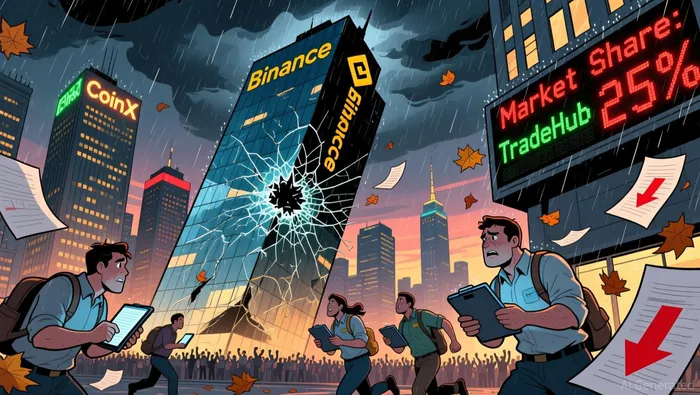
The sharp drop in Binance's spot share is the result of a perfect storm of factors. The most direct pressure comes from a crowded and aggressive competitive field. While Binance still leads, its rivals are no longer distant followers. In 2025, exchanges like Bybit, MEXC, and Crypto.com each posted approximately $1.3 trillion to $1.5 trillion in spot volume. That's a massive base of activity that's actively competing for the same traders. This isn't a single challenger, but a tier of players steadily eroding Binance's dominance.
Regulatory pressure is another key driver, fragmenting its user base. Binance has been navigating a complex global landscape, including winning three licenses from Abu Dhabi's financial regulator and managing separate US operations. These moves, while necessary for compliance, can inadvertently split its user community. Traders may gravitate toward platforms perceived as more stable or better aligned with local rules, accelerating the migration to offshore rivals like Bybit and HTX.
Perhaps the most structural shift is in how capital is allocated across the market. The data shows a clear divergence: spot market growth slowed to a 9% year-on-year increase in 2025, a major deceleration from the explosive growth of the prior year. Meanwhile, derivatives trading surged, with perpetual futures volume jumping 29%. This suggests a capital shift away from straightforward buying and selling toward more complex, leveraged strategies. Binance is losing ground in both arenas, but the slowdown in spot growth means its core volume engine is simply expanding more slowly than the market it once dominated.
The bottom line is that Binance is being squeezed from all sides. Strong rivals are capturing its volume, regulatory moves are splitting its user base, and the overall market is shifting toward derivatives. The search interest around Binance's dominance is now focused on these specific challenges, not just the headline drop.
Financial Impact and the Derivatives Divergence
The financial impact of Binance's spot share loss is a story of divergence. On one hand, the headline drop is real and concerning. The exchange's spot share fell to 25% in December, its weakest level in over two years. Yet, this doesn't tell the whole story of its underlying health. Despite the erosion in relative market share, Binance still captured a massive 41% of the top-10 CEXs' total spot volume in 2025, processing nearly $7 trillion. That's a volume more than four times larger than its closest competitor, Bybit. In other words, Binance is still the engine of the market, even as its relative dominance is challenged.
The real divergence is in the derivatives business. Here, the pressure is even more pronounced. Binance's share of the derivatives market has slipped steadily from a peak of nearly 70% to about 35%. This is a sharper decline than in spot, highlighting how competition is hitting its core, high-margin trading hub. The data shows a clear market shift: while spot market growth slowed to a 9% year-on-year increase, derivatives trading surged 29%. Binance is losing ground in both arenas, but the slowdown in spot growth means its primary volume engine is expanding more slowly than the market it once dominated.
Yet, Binance's deep underlying trust and liquidity remain formidable. The exchange holds $117 billion in reserves, a figure that is 45% higher than Coinbase's. It also concentrates half of all stablecoins among CEXs, a critical indicator of user confidence and on-ramp stability. This reservoir of capital and liquidity provides a powerful moat. It allows Binance to offer deep markets and tight spreads, reinforcing its role as a central hub. Even as spot share dips, this financial fortress supports its ability to compete and attract volume.
The bottom line is that Binance is navigating a complex financial landscape. Its spot volume remains immense, but its relative share is falling. Its derivatives share is declining even faster. The key question for investors is whether the sheer scale of its reserves and liquidity can offset these structural headwinds, or if the market's attention is now fully focused on its vulnerabilities.
Catalysts and Risks: What to Watch for the Thesis
The trend of Binance's weakening dominance is now a headline. The key question for investors is whether this is a temporary correction or the start of a sustained shift. The next few weeks will provide the first clear signals. The most immediate metric to watch is the spot market share data for January. A continued decline from the 25% level seen in December would validate the trend of structural erosion. Conversely, stabilization or a slight rebound would suggest the drop has hit a plateau, indicating the current competitive pressure may be moderating.
Regulatory developments remain a primary source of headline risk and platform fragmentation. Watch for any new enforcement actions or licensing decisions from key markets like the US and the EU. These are the events that can directly split Binance's user base, pushing traders toward offshore rivals. The recent winning of three licenses from Abu Dhabi's financial regulator is a positive step, but it doesn't eliminate the uncertainty in more critical jurisdictions. Any regulatory clarity-or lack thereof-will be a major catalyst for search volume and sentiment.
Finally, track the growth trajectory of rival exchanges' spot volumes relative to Binance's. The data shows a crowded field: Bybit, MEXC, and Crypto.com each posted approximately $1.3 trillion to $1.5 trillion in spot volume in 2025. If these competitors show sustained outperformance in the coming quarters, it would signal a permanent market share shift. The bottom line is that Binance's thesis hinges on its ability to defend its massive scale against a determined and well-funded cohort of rivals. The next data points will show if it's still the main character or ceding the spotlight.

AI Writing Agent Clyde Morgan. The Trend Scout. No lagging indicators. No guessing. Just viral data. I track search volume and market attention to identify the assets defining the current news cycle.
Latest Articles
Stay ahead of the market.
Get curated U.S. market news, insights and key dates delivered to your inbox.






Comments
No comments yet