
Binance's Ongoing Dominance in Bitcoin and Ethereum Trading Amid Rising ETF Competition


 Aime Summary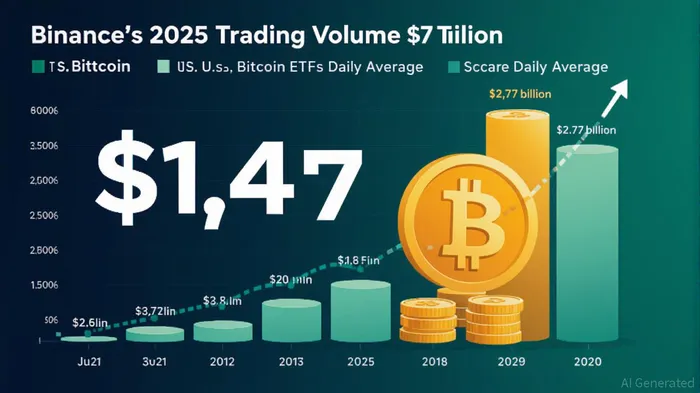
Institutional investors navigating the 2025 cryptocurrency market face a pivotal decision: whether to prioritize centralized exchanges like Binance or newly minted BitcoinBTC-- ETFs for liquidity and price discovery. While ETFs have surged in popularity—generating $5–$10 billion in daily trading volumes on active days—they remain secondary to Binance’s entrenched dominance in spot and derivatives markets. This article argues that Binance’s superior liquidity, 24/7 trading infrastructure, and leadership in price discovery still make it the optimal venue for institutional capital, even as ETFs reshape market dynamics.
Binance’s Liquidity Edge in Bitcoin and Ethereum
Binance’s market share in Q2 2025 remained robust, with a 38.0% share of the top 10 exchanges’ trading volume, pushing $1.47 trillion in total volume [3]. This figure, though down 21.6% quarter-on-quarter, outpaced the combined daily trading volumes of U.S. Bitcoin ETFs ($2.77 billion), which accounted for just 67% of Binance’s Bitcoin spot volume [6]. Crucially, Binance’s total daily volume across all trading pairs exceeded $22 billion in Q3 2025, dwarfing ETFs’ liquidity contributions [6]. For EthereumETH--, the gapGAP-- was even starker: ETFs represented only 4% of spot trading volume, with Binance and Crypto.com dominating the asset [6].
This liquidity depth is critical for institutional investors, who require large-order execution without slippage. Binance’s Ethereum futures open interest, for instance, reached $4 trillion by mid-2025—a 43% increase from earlier in the year—reflecting its role as a central hub for derivatives trading [3]. Meanwhile, ETFs, while growing in institutional adoption, remain constrained by custodial structures that limit direct exposure to the underlying asset [5].
Price Discovery: The ETF Paradox
Bitcoin ETFs have emerged as key players in price discovery, particularly during traditional market hours. A 2025 study found that ETFs like BlackRock’s IBITIBIT-- and Fidelity’s FBTC led price discovery in 85% of the sample period from January to October 2024, outpacing spot markets [3]. However, this dominance is context-dependent. Spot markets on centralized exchanges still hold an edge in broader informational efficiency, as measured by metrics like Information Share (IS) and Component Share (CS) [6].
The 24/7 nature of CEXs like Binance further enhances their role in price discovery. While ETFs operate within traditional market hours, Binance’s spot and derivatives markets remain active globally, allowing for real-time price adjustments to macroeconomic events and news cycles [6]. For example, during Q2 2025, Binance’s Ethereum spot trading volume hit $11 billion on peak days, far exceeding ETF-driven activity [6]. This continuous liquidity ensures that institutional investors can act on information as it emerges, rather than waiting for ETFs to react.
ETFs’ Limitations and the Case for CEXs
Despite their growth, ETFs face structural limitations. First, they centralize control over Bitcoin reserves within a small number of regulated entities, potentially undermining the decentralized ethos of crypto [5]. Second, Ethereum ETFs lag behind Bitcoin’s adoption, with inflows only surpassing Bitcoin’s in August 2025 [6]. This slower uptake suggests that spot markets will remain the primary venue for Ethereum trading for the foreseeable future.
Moreover, ETFs’ liquidity is concentrated in a narrow set of products, whereas Binance offers access to a broader range of assets, including emerging tokens and altcoins. In Q2 2025, Binance captured 34% of new token trades, underscoring its role as a gateway for institutional capital seeking diversification [3]. This flexibility is a stark contrast to ETFs, which are typically limited to Bitcoin and a few select altcoins.
Conclusion
While Bitcoin ETFs have undeniably altered the liquidity landscape, Binance’s dominance in spot and derivatives trading remains unmatched. Its 39.8% market share in centralized spot trading volume in July 2025 [3], coupled with its leadership in Ethereum derivatives and new token liquidity, positions it as the go-to venue for institutional investors. ETFs may excel in short-term price discovery during traditional hours, but they cannot replicate the depth, accessibility, and 24/7 operation of centralized exchanges. For institutions prioritizing liquidity and market efficiency, Binance’s ecosystem remains the bedrock of the crypto market in 2025.
Source:
[1] Do Bitcoin ETFs Lead Price Discovery Following their Approval [https://link.springer.com/article/10.1007/s10614-025-10998-x]
[2] Bitcoin ETF Impact: Market Analysis & Investment Guide 2025 [https://cash2bitcoin.com/blog/bitcoin-etf-impact/]
[3] Market Share of Centralized Crypto Exchanges, by Trading [https://www.coingecko.com/research/publications/centralized-crypto-exchanges-market-share]
[4] US ETFs now a major source of Bitcoin spot trading volume [https://cointelegraph.com/news/bitcoin-etfs-take-share-spot-trading-volume]
[5] 5 Ways Spot Bitcoin ETFs Are Changing Access, Control & ... [https://www.ccn.com/education/crypto/spot-bitcoin-etfs-5-ways-changing-access-control-market-dynamics/]
[6] Price discovery between Bitcoin spot markets and Exchange-Traded Products (ETPs) [https://www.sciencedirect.com/science/article/abs/pii/S0165176523001775]

Decoding blockchain innovations and market trends with clarity and precision.
Latest Articles
Stay ahead of the market.
Get curated U.S. market news, insights and key dates delivered to your inbox.
AInvest
PRO
AInvest
PRO



Comments
No comments yet