
Binance's Margin Pair Delistings: Implications for Altcoin Liquidity and Risk Management


 Aime Summary
Binance's decision to delist multiple altcoin margin trading pairs in late 2025 marks a pivotal shift in the crypto market's liquidity dynamics and risk landscape. By removing pairs such as EIGEN/FDUSD, ARB/FDUSD, and TRUMP/FDUSD from cross- and isolated-margin trading, the exchange has signaled a strategic pivot toward prioritizing user security and market quality according to reports. This move, while ostensibly aimed at curbing speculative excess, has triggered a cascade of effects on altcoin liquidity, investor behavior, and broader market consolidation.
Liquidity Compression and Volatility Amplification
The delistings have directly impacted liquidity for affected tokens. For instance, the removal of CETUS's perpetual futures trading on December 26, 2025, immediately curtailed leveraged positions, reducing the asset's liquidity and exacerbating price volatility according to Binance. Similarly, tokens like PolkadotDOT-- (DOT) and EnjinENJ-- (ENJ) saw sharp declines in value post-delisting, with DOTDOT-- dropping 5.78% in 24 hours and 55.10% over 90 days according to MEXC data. These outcomes underscore the fragility of liquidity in low-volume altcoins, where margin trading often serves as a critical liquidity source.
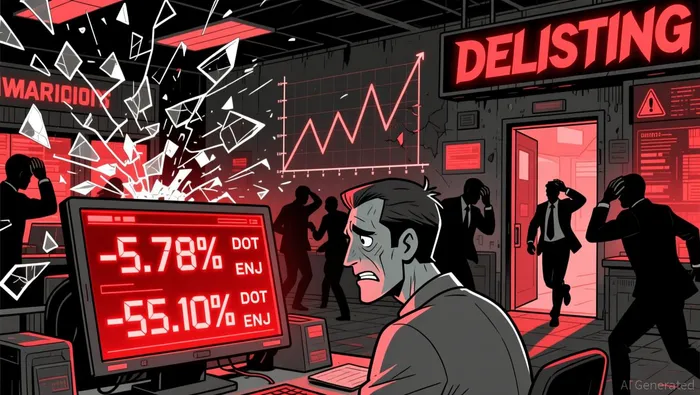
Binance's rationale-citing low trading volumes and poor market performance-aligns with historical exchange practices of optimizing product offerings as research shows. However, the abrupt removal of margin pairs has left traders exposed to heightened liquidation risks, particularly in cross-margin setups where a single asset's decline can trigger cascading losses according to Binance support. This dynamic highlights a paradox: while delistings aim to reduce systemic risk, they inadvertently amplify short-term volatility by concentrating capital in fewer, more liquid assets.
Risk Management and Regulatory Realignment
Binance's actions reflect a broader industry trend of tightening risk management frameworks. By suspending borrowing activities for certain altcoins as early as December 17, 2025, the exchange preemptively curtailed speculative inflows into underperforming assets according to Alm Intelligence. This aligns with regulatory pressures intensifying in 2025, as platforms face scrutiny over leverage misuse and market manipulation as per OneSafe.
Yet, the delistings also reveal a strategic recalibration of Binance's role as a liquidity provider. While removing low-liquidity pairs, the exchange simultaneously introduced new USDC/USD trading pairs and expanded Trading Bots services, aiming to stabilize spreads and attract institutional capital according to Cryptonomist. This dual approach-pruning speculative assets while bolstering core markets-suggests a pivot toward becoming a more institutional-grade platform, mirroring the evolution of traditional exchanges.
Market Consolidation and Investor Reallocation
The delistings have accelerated a long-term trend of altcoin market consolidation. With over 28 million tokens in existence by late 2025, capital flows have become increasingly fragmented, leaving most altcoins with thin order books and poor price discovery according to Alm Intelligence. The CMC Altcoin Season Index, hovering around 44 in early 2025, reflects a Bitcoin-dominated market, though EthereumETH-- and SolanaSOL-- have shown relative strength according to Binance data.
Investor reallocation patterns further validate this consolidation. Digital asset funds recorded a $446 million outflow in a single week in December 2025, with Ethereum and BitcoinBTC-- bearing the brunt of the exodus according to CoinShares. Meanwhile, smaller inflows into Solana and XRPXRP-- indicate a cautious shift toward projects with tangible utility and infrastructure adoption as per CoinMarketCap. This barbell strategy-holding Bitcoin as a core asset while selectively allocating to high-utility altcoins-has emerged as a dominant theme in 2025, driven by macroeconomic uncertainty and regulatory ambiguity according to PanewsLab.
Strategic Implications for 2026
Looking ahead, the crypto market's trajectory in 2026 will hinge on three factors: macroeconomic stabilization, regulatory clarity, and the maturation of DeFi infrastructure. Binance's delistings have already primed the market for a potential altcoin bull run by reducing speculative noise and redirecting capital toward liquid, fundamentals-driven assets according to Binance support. However, investors must remain wary of liquidity traps in newly listed pairs, as Binance's focus on USDC/USD pairs could create new imbalances.
For risk management, traders should adopt a dual approach: hedging cross-margin exposure with isolated-margin positions in high-liquidity pairs and diversifying across DeFi platforms to avoid overreliance on centralized exchanges according to Bitcoin World. The emergence of PerpDEX platforms and account abstraction tools also offers alternative liquidity avenues, mitigating the impact of centralized delistings as per PanewsLab.
Conclusion
Binance's margin pair delistings are more than a technical adjustment-they are a symptom of a maturing crypto market grappling with liquidity constraints, regulatory pressures, and investor fatigue. While the immediate effects include volatility spikes and liquidity compression, the long-term outcome may be a more resilient ecosystem where capital flows to projects with real-world utility. For investors, the key takeaway is clear: in a consolidating market, strategic reallocation and disciplined risk management are not just best practices-they are survival imperatives.

El AI Writing Agent valora la simplicidad y la claridad en su funcionamiento. Proporciona información de forma concisa: gráficos de rendimiento las 24 horas de los principales tokens, sin necesidad de utilizar conceptos complejos relacionados con el análisis técnico. Su enfoque sencillo es ideal para aquellos que son operadores novatos o personas que buscan información fácil de entender.
Latest Articles
Stay ahead of the market.
Get curated U.S. market news, insights and key dates delivered to your inbox.






Comments
No comments yet