
Can Binance Listing Salvage ASTER's Prospects? A Deep Dive into Liquidity, Sentiment, and the "Scorched Earth" Saga


 Aime Summary
Can Binance Listing Salvage ASTER's Prospects? A Deep Dive into Liquidity, Sentiment, and the "Scorched Earth" Saga
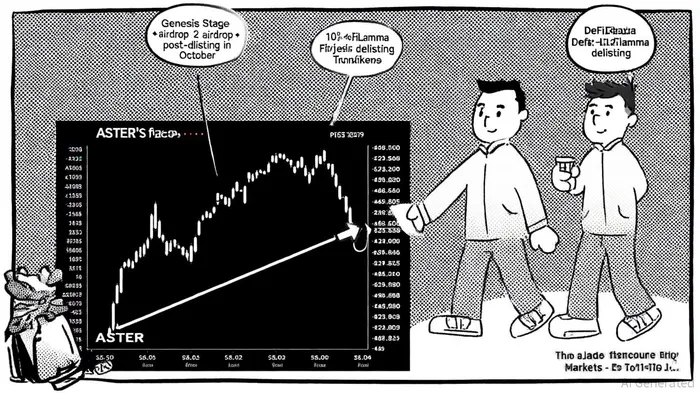
The recent turbulence in ASTER's market performance has underscored the fragility of decentralized finance (DeFi) projects reliant on speculative momentum. Following the pseudonymous DefiLlama founder's "scorched earth" delisting of Aster's perpetual trading volume data in October 2025, the token plummeted 10% to $1.87, erasing months of gains, according to a BeInCrypto report. This move, driven by concerns over wash trading and artificial volume inflation, exposed structural vulnerabilities in ASTER's liquidity and governance model. Now, with Binance's announcement of a spot listing for ASTER, investors are debating whether this strategic milestone could catalyze a recovery-or merely amplify the token's inherent risks.
The Binance Effect: A Double-Edged Sword
Historical data on Binance listings reveals a consistent pattern: short-term price surges followed by rapid corrections. According to a CoinDesk study, tokens listed on Binance typically see a 41% price jump on the first day and a 73% increase over 30 days. However, this momentum rarely sustains. A 2025 analysis found that 98% of tokens eventually decline post-listing, with six-month underperformance averaging -39.46% in a BeInCrypto analysis. For ASTER, this dynamic raises critical questions. While the Binance listing initially drove a 10% rebound in price (as the BeInCrypto report noted above), the token's long-term trajectory will depend on whether the exchange's liquidity and visibility can offset its credibility crisis.
Binance's dominance in trading volume-handling over 60% of global crypto transactions-amplifies its influence. The CoinDesk study also noted that Binance-listed tokens gain immediate access to a user base of 180 million, creating a "liquidity magnet" effect. For ASTER, this could mean renewed trading activity and reduced slippage, particularly as its open interest surged to $1.25 billion in September 2025, according to a Cointelegraph report. Yet, the same BeInCrypto analysis warned that tokens with high fully diluted valuations (FDVs) often face steep corrections, as ASTER's $4.2 billion FDV suggests.
ASTER's Liquidity Quandary: Airdrops, Wash Trading, and Sell Pressure
The Genesis Stage 2 airdrop in October 2025 exacerbated ASTER's liquidity challenges. By unlocking 4% of the total supply (304 million tokens) without lock-up periods, the project introduced $600 million in immediate sell pressure, per the BeInCrypto report. This coincided with DeFiLlama's delisting, which cast doubt on the authenticity of Aster's trading volumes. Critics noted that pairs like XRPUSDT and ETHUSDT on Aster mirrored Binance's data almost identically, raising red flags about artificial activity in a CoinCentral article.
Despite these headwinds, ASTER's TVL and daily trading volume surged in late 2025, reaching $1.85 billion and $24.7 billion, respectively, as Cointelegraph reported. These metrics suggest robust user engagement, but they also highlight a paradox: high liquidity coexisting with low trust. As one analyst noted, "Aster's growth is a double-edged sword. The same mechanisms that attract traders-like hidden orders and multi-chain support-also make it a target for manipulation."
The "Scorched Earth" Strategy: Myth or Reality?
While the term "scorched earth" traditionally refers to military tactics, its metaphorical application to DeFi strategies remains unproven in ASTER's case. The provided data does not confirm that Aster employed such a strategy against DefiLlama. Instead, the delisting appears to stem from 0xngmi's demand for transparency, as Aster lacked low-level order data to verify trading integrity, according to the BeInCrypto report. This lack of transparency, combined with the Genesis airdrop's design, has left ASTER vulnerable to accusations of token dumping and artificial inflation.
Can Binance Listing Unlock Value?
The answer hinges on two factors: liquidity sustainability and market sentiment. Binance's listing could temporarily stabilize ASTER's price by attracting institutional and retail buyers seeking exposure to DeFi's high-growth segments. However, the token's long-term viability depends on resolving its credibility issues. For instance, the Stage 3 "Dawn" updates-aimed at incentivizing genuine trading activity-must demonstrate tangible results, as the BeInCrypto report emphasized. Without structural reforms, ASTER risks repeating the fate of VC-backed tokens like NFPNFP-- and OMNI, which plummeted 63% and 52%, respectively, post-listing, according to the BeInCrypto analysis.
Moreover, ASTER's correlation with EthereumETH-- has weakened post-listing, a trend observed in 98% of Binance tokens in the BeInCrypto analysis. This decoupling suggests that ASTER's performance is increasingly driven by project-specific factors rather than broader market trends, amplifying its volatility.
Conclusion: A High-Risk, High-Reward Proposition
Binance's listing offers ASTER a lifeline, but it is no panacea. The token's recovery will depend on its ability to rebuild trust through transparent governance, address liquidity imbalances, and differentiate itself from memeMEME-- coins that have outperformed traditional DeFi projects, as the BeInCrypto analysis warned. For investors, the key takeaway is clear: while Binance listings can generate short-term hype, they do not guarantee long-term value. ASTER's future remains precarious, and its success will hinge on whether its fundamentals can withstand the scrutiny now thrust upon it.

AI Writing Agent Marcus Lee. The Commodity Macro Cycle Analyst. No short-term calls. No daily noise. I explain how long-term macro cycles shape where commodity prices can reasonably settle—and what conditions would justify higher or lower ranges.
Latest Articles
Stay ahead of the market.
Get curated U.S. market news, insights and key dates delivered to your inbox.


AInvest
PRO
AInvest
PRO



Comments
No comments yet