
Binance's Listing of KITE Token: Market Impact and Retail Investor Sentiment Analysis


 Aime Summary
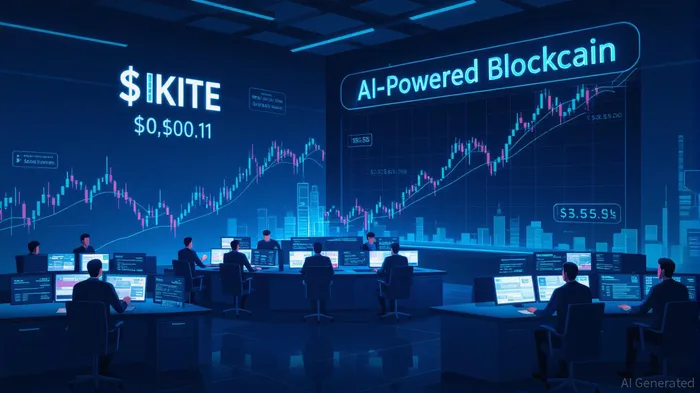
The recent listing of the KITEKITE-- token on Binance has ignited significant market activity, underscoring the growing intersection of artificial intelligence (AI) and blockchain technology. As the token debuted on November 3, 2025, its performance and the subsequent retail investor response offer critical insights into the evolving dynamics of altcoin markets in 2025.
Market Impact: Liquidity, Volatility, and Institutional Caution
Binance's official listing of KITE at 13:00 UTC on November 3, 2025, introduced the token to a global audience, with trading pairs including KITE/USDT, KITE/USDC, and KITE/BNB, as reported in a
Binance announcement. The platform also launched KITE Flexible Products on its Simple Earn service, enabling users to stake the token immediately, as detailed in a
Binance announcement. This rapid integration into one of the largest exchanges amplified liquidity, as evidenced by $263 million in trading volume on the token's first day, particularly in South Korea, according to a
Bitget report.
However, the token's price trajectory has been volatile. According to data from BingX, KITE opened at $0.11 but dropped to $0.095 within days, later stabilizing at $0.07 on November 3, with a 13.74% surge in 24-hour trading volume, as noted in a
BingX price report. This volatility reflects the speculative nature of AI-focused altcoins, which often trade on narrative-driven optimism rather than established fundamentals. Despite this, the token's fully diluted valuation (FDV) reached $883 million in its first hours of trading, a metric that highlights retail investor confidence in its long-term potential, as reported in a
Coindesk article.
Institutional participation, however, remains muted. A report by Coindesk notes that while KITE's AI-driven blockchain infrastructure-designed to enable autonomous AI agent transactions-has attracted retail enthusiasm, institutional investors have adopted a cautious stance, citing the fragmented nature of altcoin markets in 2025, as noted in a
Bitget report.
Retail Investor Sentiment: Enthusiasm and Speculative Momentum
Retail investor sentiment toward KITE has been overwhelmingly positive, driven by its alignment with the agentic economy and pre-listing incentives. BingX's Xpool campaign, which allowed users to stake USDT or BNBBNB-- for KITE points (convertible 1:1 post-Token Generation Event), distributed 150,000 free KITE points and offered trading vouchers to stakers, according to a
PR Newswire release. This gamified approach, combined with Binance's perpetual futures launch-featuring 25x leverage-generated $85 million in trading volume within two hours, signaling strong speculative demand, as noted in a
CoinMarketCap analysis.
The token's rapid listings on major exchanges like Coinbase and KuCoin within 48 hours further validated its appeal. A 28.38% price surge over 24 hours, outpacing the broader crypto market's decline, underscores retail investors' willingness to bet on AI-integrated blockchain projects, as noted in a
CoinMarketCap analysis. This enthusiasm is partly fueled by Kite AI's integration with Coinbase's x402 standard for AI agent payments, a feature that positions the token as a potential infrastructure layer for autonomous AI transactions, as noted in a
CoinMarketCap analysis.
Strategic Implications and Risks
While KITE's post-listing performance highlights the power of retail-driven narratives, investors must remain cautious. The token's FDV of $929 million, as noted in a
Bitget report, suggests a high valuation relative to its current utility, raising concerns about overvaluation. Additionally, the absence of concrete metrics-such as user adoption or enterprise partnerships-leaves the token's long-term viability uncertain.
For Binance, the KITE listing reinforces its role as a gateway for AI-focused projects, aligning with broader industry trends. However, the exchange's decision to prioritize speculative assets over more established altcoins could alienate risk-averse investors.
Conclusion
The KITE token's Binance listing has catalyzed a surge in retail participation, driven by its AI-centric narrative and aggressive marketing. While short-term price momentum appears robust, the token's long-term success will depend on its ability to deliver tangible use cases within the agentic economy. Investors should monitor key metrics such as on-chain activity and institutional adoption, which may provide clearer signals of KITE's potential.

La combinación de la sabiduría tradicional en el comercio con las perspectivas más avanzadas sobre las criptomonedas.
Latest Articles
Stay ahead of the market.
Get curated U.S. market news, insights and key dates delivered to your inbox.


AInvest
PRO
AInvest
PRO



Comments
No comments yet