
Binance's KITE Token Launchpool: A Strategic Entry Point for Crypto Investors?


 Aime Summary
Tokenomics: Incentives and Supply Dynamics
Binance's KITE token operates on a total supply of 10 billion tokens, with 1.8 billion currently circulating (18% of the total supply). The token's distribution model emphasizes community and ecosystem growth, allocating 48% of the supply to these purposes, while 50 million tokens are reserved for marketing. This structure aims to bootstrap liquidity and adoption, a strategy that has proven effective in prior Binance Launchpool projects.
The Launchpool itself offers users the ability to stake BNBBNB--, FDUSD, and USDCUSDC-- to earn KITE rewards, creating a dual incentive: earning yield on stablecoins while acquiring a token with speculative upside. Additionally, an airdrop event initiated on November 1, 2025, further amplifies participation by rewarding early stakers. Such mechanisms are designed to distribute tokens broadly, reducing centralization risks and fostering organic demand. However, the high fully diluted valuation (FDV) of $929 million, compared to its current market cap of $151 million, raises concerns about potential overvaluation and liquidity constraints.
Market Performance: Volatility and Momentum
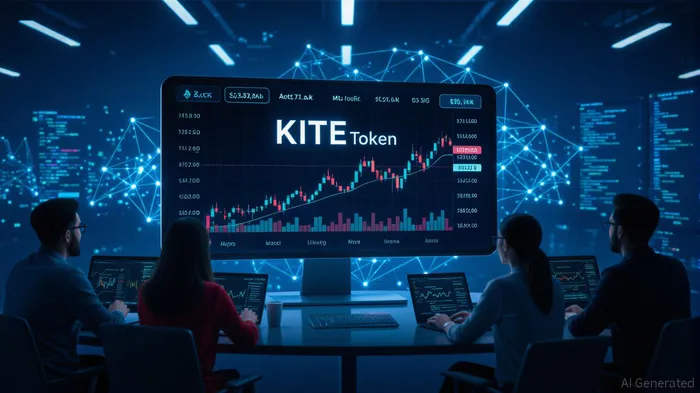 KITE's initial market performance has been marked by sharp volatility. On its listing day (November 3, 2025), the token saw a $263 million trading volume, with a 6.48% 24-hour price increase, outperforming the broader crypto market. Subsequent gains, including a 14.31% 24-hour surge and a 52.33% 30-day rise, underscore its appeal to speculative traders. Technical indicators, such as a price above the 7-day simple moving average ($0.0953) and a Relative Strength Index (RSI) approaching overbought levels, suggest short-term bullish momentum.
However, this volatility is not without risks. The token's FDV-to-market cap ratio of over 5:1 implies that a significant price correction could occur if demand wanes. Moreover, the Biconomy $8,000 trading competition, which drove much of the early volume, ends on November 28, 2025, raising questions about whether organic demand will sustain the price. Analysts are closely watching the November 24 DevConnect panel for signals on institutional adoption and ecosystem progress.
Long-Term Viability: Ecosystem Integration and Competitive Positioning
KITE's long-term prospects hinge on its ability to establish itself as infrastructure for AI agent economies. The token's integration with cross-chain platforms like Pieverse and alignment with Coinbase's x402 protocol for AI commerce highlight its strategic positioning in the AI-native blockchain space. These partnerships enable autonomous, frictionless microtransactions, a use case that could gain traction as AI agents become more prevalent in decentralized systems.
Comparisons to similar tokens like Fetch.ai and SingularityNET reveal both strengths and challenges. While Fetch.ai focuses on a broader range of agent-based tasks (e.g., supply chain optimization), KITE's niche in secure, low-cost AI agent payments positions it to capture a specific segment of the market. Additionally, KITE's roadmap includes agent-aware multisig modules and programmable governance, features that could differentiate it from competitors like Fetch.ai's FETFET-- token according to market analysis. Institutional backing, including partnerships with Coinbase Ventures and PayPal, further validates its potential according to industry reports.
Broader Trends and Institutional Adoption
The KITE token's success is also tied to macro-level trends in crypto and AI. The integration of AI with blockchain, exemplified by projects like IPO Genie and Near's Intents, is reshaping payment systems and data privacy. Meanwhile, institutional adoption-reflected in the growth of exchange-traded products (ETPs) for XRPXRP-- and Dogecoin)-suggests a maturing market that could benefit tokens with clear utility, such as KITE. However, regulatory uncertainties and the recent 25% decline in the AI crypto sector highlight the sector's fragility.
Conclusion: Strategic Entry Point or Speculative Bet?
Binance's KITE token presents a mixed picture for investors. Its tokenomics and Launchpool incentives create a strong on-ramp for participation, while its integration with AI payment infrastructure aligns with a transformative trend. However, the token's high FDV, reliance on short-term trading incentives, and competitive landscape necessitate caution. For investors with a medium-term horizon and a tolerance for volatility, KITE could offer exposure to the AI blockchain revolution. Yet, its long-term success will depend on sustained ecosystem development, regulatory clarity, and the ability to differentiate itself in a crowded market.

Blending traditional trading wisdom with cutting-edge cryptocurrency insights.
Latest Articles
Stay ahead of the market.
Get curated U.S. market news, insights and key dates delivered to your inbox.






Comments
No comments yet