
Binance's Kite Listing and Crypto Market Sentiment: Navigating Regulatory and Market Implications for Investors


 Aime Summary
Market Dynamics: Volatility, Liquidity, and Structural Risks
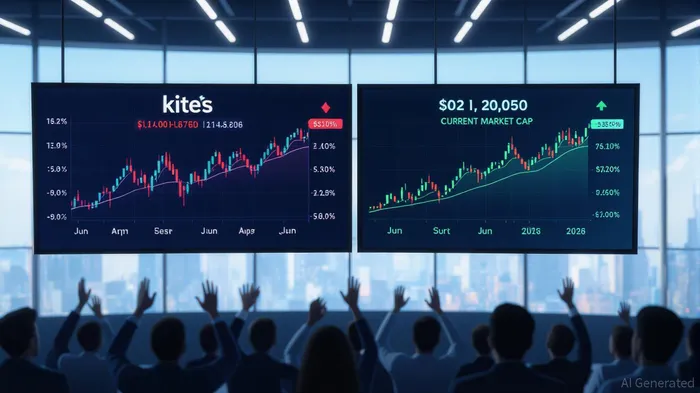
KITE's debut on Binance on November 3, 2025, saw a dramatic price drop of 14% within hours, from $0.11 to $0.095, despite generating $263 million in trading volume. This volatility is emblematic of new crypto listings, where retail-driven speculation often overshadows fundamental value. The token's fully diluted valuation of $929 million far exceeds its current market cap of $167 million, signaling structural inflation risks tied to its tokenomics.
Short-term price surges, such as a 6.48% gain in 24 hours driven by a BiconomyBICO-- trading competition, highlight the role of promotional incentives in attracting liquidity. However, such gains are typically followed by sell-offs as speculative positions unwind. Technically, KITE's RSI of 67.12 near the overbought threshold and its position above the 7-day SMA of $0.0953 suggest bullish momentum in the near term, though a breakdown below $0.095 could trigger profit-taking.
The token's ecosystem developments, including cross-chain partnerships with Pieverse and the Avalanche bridge deployment, aim to strengthen its utility in AI-driven micropayments according to market analysis. These initiatives add technical credibility but must be weighed against governance concerns, such as the 20% team token allocation and the absence of a detailed whitepaper as reported by analysts.
Regulatory Landscape: Compliance Challenges and Evolving Frameworks
Binance's KITE listing occurs amid a rapidly shifting regulatory environment. In the U.S., the exchange remains under scrutiny for past violations, with the SEC alleging that tokens like BNB and BUSD qualify as unregistered securities under the Howey Test. While Binance has paid $4 billion in settlements and implemented stricter compliance measures, the lack of explicit regulatory clarity for KITE raises questions about its classification.
The European Union's Markets in Crypto-Assets (MiCA) regulation has compelled exchanges like Binance to delist non-compliant stablecoins and enhance transparency according to industry reports. Although KITE is not explicitly mentioned in these adjustments, the broader trend toward compliance-focused listings suggests that the token must demonstrate adherence to evolving standards to retain institutional interest.
The SEC's proposed "token taxonomy" framework, outlined by Chairman Paul Atkins, could further complicate KITE's regulatory status. Under this framework, tokens may transition from securities to digital commodities as they mature, but such reclassifications depend on their economic reality and functional utility. For KITE, this means its long-term viability hinges on demonstrating a decentralized, functional system that aligns with the SEC's evolving criteria.
Investor Implications: Retail Optimism vs. Institutional Caution
Retail investors have shown strong interest in KITE, driven by airdrop incentives and trading competitions. The token's availability on Binance's Earn, Margin, and Futures platforms has amplified accessibility, though this also exacerbates liquidity risks as early investors offload holdings. In markets like South Korea, KITE has generated significant trading volume, reflecting its appeal to speculative traders.
In contrast, institutional participation remains muted. The token's low institutional ownership relative to its FDV suggests overvaluation concerns, while regulatory uncertainties deter large-scale adoption. For institutions, KITE's governance structure and lack of a robust whitepaper further amplify risks, particularly in jurisdictions with strict compliance requirements.
Conclusion: Balancing Innovation and Risk
The KITE tokenKITE-- embodies the dual-edged nature of crypto innovation: its AI-driven use cases and cross-chain partnerships offer compelling long-term potential, but its regulatory ambiguity and structural risks demand careful scrutiny. For retail investors, the token's volatility and promotional incentives present opportunities for short-term gains, albeit with significant downside risks. Institutional investors, meanwhile, must prioritize compliance and governance due diligence, as regulatory clarity-or the lack thereof-will ultimately determine KITE's market legitimacy.
As the crypto landscape evolves, the interplay between technological progress and regulatory adaptation will remain critical. Investors must navigate this dynamic environment with a balanced approach, leveraging technical and fundamental analysis while staying attuned to the shifting sands of global compliance frameworks.

Mezclando la sabiduría tradicional en el comercio con las perspectivas más avanzadas sobre criptomonedas.
Latest Articles
Stay ahead of the market.
Get curated U.S. market news, insights and key dates delivered to your inbox.


AInvest
PRO
AInvest
PRO



Comments
No comments yet