
Binance’s HEMI Airdrop and Strategic Ecosystem Play: A New Frontier for Bitcoin-Native DeFi


 Aime Summary
Binance’s recent foray into Bitcoin-native DeFi through the Hemi (HEMI) token airdrop and its integration of a modular Layer-2 infrastructure marks a pivotal moment in the crypto ecosystem. By leveraging Hemi’s innovative architecture, Binance is not only expanding Bitcoin’s utility but also positioning itself at the forefront of a $100+ billion cross-chain DeFi market. This article examines how Binance’s strategic ecosystem play—combining airdrop incentives, institutional backing, and cutting-edge technology—positions HEMI as a high-conviction investment for both speculative and long-term gains.
Binance’s Airdrop Strategy: Incentivizing Engagement and Adoption
Binance’s HEMI airdrop, launched in August 2025, distributed 200 million tokens (2% of the total supply) to users with 61+ Alpha Points in their Binance Wallet. This campaign incentivized technical participation through quests, testnet activity, and social media engagement, ensuring that only active users could qualify [1]. The vesting schedule for airdropped tokens further aligns user incentives with long-term retention, reducing speculative trading and fostering a committed community [3].
The airdrop is part of a broader Binance Wallet Booster campaign, which emphasizes testnet usage and onboarding. By rewarding users for interacting with Hemi’s Layer-2 infrastructure, Binance is accelerating the adoption of Bitcoin-native DeFi tools, such as Bitcoin-backed lending protocols and cross-chain exchanges [3]. This approach mirrors Binance’s historical success in driving user growth through gamified incentives, as seen with its BNBBNB-- airdrops and staking programs.
Hemi’s Layer-2 Innovation: Bridging Bitcoin and Ethereum
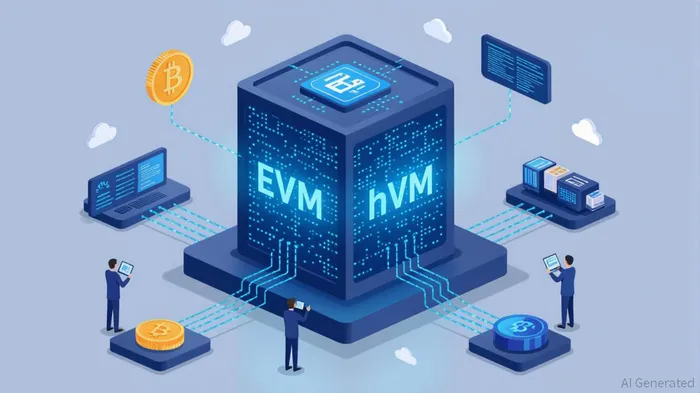
At the core of Hemi’s value proposition is its modular Layer-2 (L2) infrastructure, which integrates Bitcoin’s security with Ethereum’s programmability. The Hemi Virtual Machine (hVM) embeds a full BitcoinBTC-- node within an EthereumETH-- Virtual Machine (EVM) environment, enabling developers to build Bitcoin-native applications using familiar Solidity tools [1]. This architecture eliminates the need for oracles or centralized intermediaries, providing direct access to Bitcoin’s UTXO data and block headers [3].
Hemi’s Proof-of-Proof (PoP) consensus mechanism further enhances security by anchoring transactions to Bitcoin’s Proof-of-Work (PoW) model. This design ensures “superfinality” and minimizes cross-chain bridge risks, aligning with the modular blockchain trend of decoupling consensus and execution layers [4]. The Hemi Bitcoin Kit (hBK) complements this by offering APIs and SDKs for real-time Bitcoin data access, enabling trustless DeFi applications like liquid staking and yield strategies [1].
Tokenomics and Institutional Backing: A Foundation for Growth
The HEMI token’s tokenomics are structured to prioritize decentralization and ecosystem development. A total supply of 10 billion tokens is allocated as follows: 32% to the community and ecosystem, 28% to investors, 25% to the team, and 15% to the Hemispheres Foundation [1]. This distribution model, combined with a vesting schedule for team and investors (36 months with a 12-month cliff), ensures long-term token retention and aligns incentives with sustainable growth [2].
Hemi’s strategic partnerships with DeFi protocols like SushiSUSHI--, Pendle, and LayerZero, as well as its collaboration with MetaMask, underscore its role in the cross-chain DeFi market [1]. The project has raised $30 million in funding, including a $15 million round led by YZi Labs (Binance’s incubator), Republic DigitalRDAG--, and HyperChain Capital [3]. This institutional backing, coupled with 200,000 PoP miners and 20 million testnet transactions, validates Hemi’s potential to scale Bitcoin’s utility in DeFi [1].
Market Dynamics and Price Projections: A High-Conviction Investment
Post-airdrop, HEMI’s trading volume is expected to surge due to its listing on Binance Alpha and MEXC. Analysts project a launch price of $0.05, with potential early movement to $0.10–$0.15 and long-term targets of $0.50–$1.00 within 3–4 years [2]. These forecasts are supported by Hemi’s roadmap, which includes mobile app development, a DeFi wallet, and cross-chain exchange capabilities by late 2025 [2].
Binance’s introduction of a 50x leverage futures contract for HEMIUSDT amplifies speculative momentum, while MEXC’s zero-fee trading and airdrop promotions further drive liquidity [6]. The token’s utility in governance, staking, and cross-chain transfers—facilitated by Hemi’s Tunnels protocol—positions it as a critical asset in the Bitcoin-native DeFi ecosystem [5].
Why HEMI is a High-Conviction Investment
Hemi’s strategic alignment with Binance’s ecosystem, combined with its innovative architecture and institutional validation, creates a compelling case for early participation. The airdrop’s focus on user engagement ensures a robust community base, while the token’s utility and vesting schedule mitigate short-term volatility. For long-term investors, Hemi’s partnerships and roadmap suggest a trajectory toward becoming a foundational layer in Bitcoin’s DeFi expansion.
Conclusion
Binance’s HEMI airdrop and strategic ecosystem play represent a calculated move to bridge Bitcoin’s security with Ethereum’s programmability. By incentivizing user engagement, securing institutional backing, and leveraging cutting-edge technology, Hemi is poised to redefine Bitcoin’s role in DeFi. For investors, the combination of speculative potential and long-term utility makes HEMI a high-conviction opportunity in the evolving crypto landscape.
Source:
[1] Hemi: Bringing Programmability to Bitcoin [https://messari.io/report/hemi-bringing-programmability-to-bitcoin]
[2] Hemi Network Airdrop: Rewards, Binance Boost, TGE 2025 [https://blog.mexc.com/news/hemi-network-airdrop-guide/]
[3] Binance's Strategic Bet on Hemi (HEMI): A Convergence of [https://www.ainvest.com/news/binance-strategic-bet-hemi-hemi-convergence-institutional-confidence-speculative-potential-2508/]
[4] Hemi’s Proof-of-Proof Consensus Mechanism [https://hemi.xyz/blog/hemi-announces-15m-round-to-accelerate-bitcoin-programmability/]
[5] Hemi, World's Largest Bitcoin Programmability Layer [https://aijourn.com/hemi-worlds-largest-bitcoin-programmability-layer-launches-hemi-token-on-binance/]
[6] MEXC Announces Hemi (HEMI) Listing with $90000 in [https://bitcoinist.com/mexc-announces-hemi-hemi-listing-with-90000-in-hemi-and-15000-usdt-prize-pool/]

Decoding blockchain innovations and market trends with clarity and precision.
Latest Articles
Stay ahead of the market.
Get curated U.S. market news, insights and key dates delivered to your inbox.


AInvest
PRO
AInvest
PRO



Comments
No comments yet