
Binance Futures Trading Disruption: Implications for Risk Management in Crypto Futures Markets


 Aime Summary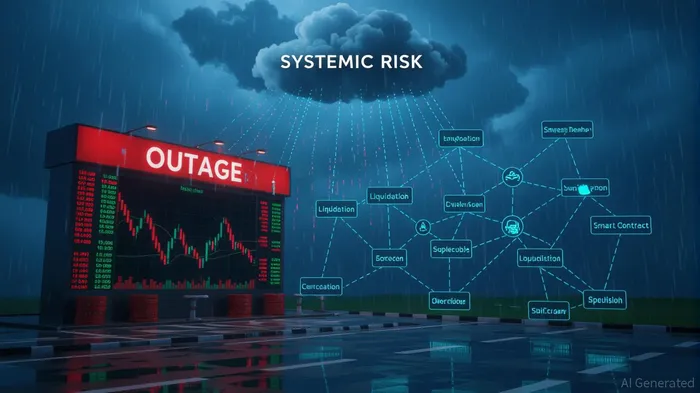
The August 29, 2025, Binance Futures trading outage—a 20-minute disruption of its Unified Margin (UM) system—exposed critical vulnerabilities in centralized crypto infrastructure. During the incident, traders were unable to open or close positions, triggering a 1.8% drop in BNBBNB-- and a BitcoinBTC-- dip below $110,000 amid heightened volatility [4]. This event, occurring during a $14.6 billion expiry for Bitcoin and EthereumETH-- futures, underscored how even brief outages on dominant platforms can ripple across global markets [6]. For investors, the episode raises urgent questions about systemic risk in crypto futures markets and the relative resilience of decentralized finance (DeFi) infrastructure.
Centralized Platforms: Operational Fragility and Market Contagion
Centralized exchanges (CEXs) like Binance dominate crypto derivatives trading, handling over 60% of global volume [1]. Their centralized architecture, however, creates single points of failure. The Binance outage, caused by a technical glitch in its UM system, highlighted how operational risks can cascade into market instability. During the 20-minute freeze, automated liquidation mechanisms on DeFi platforms were triggered by price declines on CEXs, exacerbating volatility [1]. This interdependence between centralized and decentralized ecosystems amplifies systemic risks, as DeFi protocols often rely on CEX price feeds and liquidity pools [4].
Regulators are now scrutinizing CEXs’ ability to withstand such shocks. The U.S. Commodity Futures Trading Commission (CFTC) has proposed mandatory reserve requirements for exchanges, suggesting an additional 6% to 14% in capital buffers to absorb extreme market events [1]. For Binance, the outage also revealed governance challenges: while the exchange restored services swiftly, users demanded transparency on the root cause, reflecting eroded trust in opaque operational practices [4].
DeFi’s Double-Edged Sword: Innovation vs. Resilience
Decentralized finance (DeFi) platforms, by contrast, lack centralized control but face distinct risks. The August 2025 outages revealed that DeFi’s reliance on smart contracts and automated liquidations can accelerate market downturns. For instance, the Base network—a Layer 2 solution—experienced a 30-minute block production halt due to its reliance on a single sequencer operated by CoinbaseCOIN--, exposing hidden centralization in critical infrastructure [3]. Similarly, flash loan attacks and governance exploits, as seen in past collapses like Terra’s UST and Iron Finance, demonstrate how algorithmic mechanisms can amplify crises [4].
Yet DeFi’s non-custodial model offers advantages. Unlike CEXs, where user funds are held in centralized wallets, DeFi protocols enable real-time auditing of transactions and eliminate counterparty risk [2]. During the Binance outage, decentralized exchanges (DEXs) saw a 25.3% increase in spot trading volume in Q2 2025, reaching $876 billion, as traders sought alternatives to centralized platforms [5]. Innovations like UniswapUNI-- v4’s cross-chain liquidity and Symbiosis’ swap protocols also highlight DeFi’s potential to reduce dependency on centralized infrastructure [5].
Risk Mitigation: Lessons for Investors
The Binance incident and DeFi’s mixed performance underscore the need for robust risk management strategies. For CEXs, stress testing and proof-of-solvency mechanisms are critical to maintaining trust. A recent study found that exchanges with higher reserve ratios experienced 30% fewer liquidity crises during market stress [1]. Meanwhile, DeFi platforms must prioritize smart contract audits, insurance mechanisms, and contingency planning. Cyber liability and errors & omissions (E&O) insurance, for example, can cover losses from hacks or code vulnerabilities [2].
Investors should also diversify exposure across centralized and decentralized ecosystems. While CEXs offer liquidity and advanced trading tools, DeFi’s transparency and composability provide a hedge against operational risks. Tools like Chainalysis and Nansen can help monitor systemic threats in real time, enabling proactive risk mitigation [5].
Conclusion
The Binance Futures outage serves as a wake-up call for the crypto industry. Centralized platforms must address operational fragility and governance opacity, while DeFi protocols need to strengthen smart contract security and liquidity buffers. For investors, the path forward lies in balancing innovation with resilience—leveraging the strengths of both ecosystems while mitigating their inherent risks. As regulators and market participants grapple with the implications of this incident, one truth is clear: the future of crypto futures markets hinges on infrastructure that can withstand both technical failures and systemic shocks.
Source:
[1] Centralized exchanges & proof-of-solvency: The guardians [https://www.sciencedirect.com/science/article/abs/pii/S1042443125000733]
[2] Risk Management in DeFi: Analyses of the Innovative [https://www.mdpi.com/1911-8074/18/1/38]
[3] Base Network Outage Raises Red Flags Over Centralized Sequencer Design [https://www.cryptoninjas.net/news/base-network-outage-raises-red-flags-over-centralized-sequencer-design/]
[4] Binance Outage Rattles Traders as Bitcoin and BNB Prices Drop [https://coinlaw.io/binance-futures-outage-bitcoin-dip/]
[5] Swaps vs. bridges vs. conversions: what's changing in 2025 [https://www.coinglass.com/ru/news/544399]

Decoding blockchain innovations and market trends with clarity and precision.
Latest Articles
Stay ahead of the market.
Get curated U.S. market news, insights and key dates delivered to your inbox.
AInvest
PRO
AInvest
PRO



Comments
No comments yet