
Binance Futures Outage: Navigating Short-Term Risks and Long-Term Opportunities in Crypto Derivatives


 Aime Summary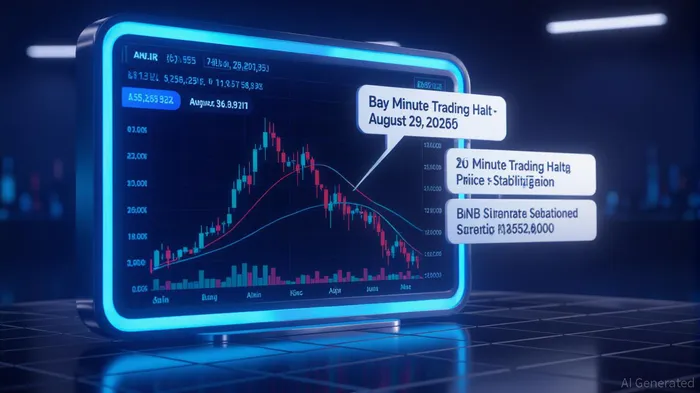
The recent Binance Futures outage on August 29, 2025, underscores the fragility of centralized infrastructure in the crypto derivatives market. A technical glitch in the platform’s Unified Margin (UM) system—a feature allowing traders to pool collateral across contracts—halted leveraged and stablecoin-settled trading for 20 minutes [1]. During this period, BitcoinBTC-- fell below $110,000, and BNBBNB-- dropped 1.8%, reflecting the market’s sensitivity to liquidity shocks [3]. While Binance restored services swiftly, the incident raises critical questions for investors: How should they assess the short-term risks of such outages, and what long-term opportunities might emerge from the resulting scrutiny?
Short-Term Risks: Volatility, Liquidity, and Trust Erosion
The outage exposed vulnerabilities in centralized exchanges, which handle over 60% of global crypto derivatives volume [4]. For traders, the inability to close positions during the 20-minute disruption amplified counterparty risk, particularly for leveraged positions. With $40 billion in open interest on Binance at the time [2], even brief outages can trigger cascading liquidations if panic selling follows.
Moreover, the incident coincided with a $14.6 billion crypto expiry event for Bitcoin and EthereumETH-- futures, compounding market stress [5]. This overlap highlights the interconnectedness of crypto markets, where technical issues on one platform can ripple across the ecosystem. For investors, the key takeaway is the need for diversified exposure to derivatives platforms, rather than overreliance on a single exchange.
Long-Term Opportunities: Infrastructure Innovation and Regulatory Clarity
While the outage was disruptive, it also catalyzed a necessary conversation about infrastructure resilience. Binance’s Unified Margin system, though innovative, demonstrated that pooled collateral models require robust fail-safes [6]. Competitors like Bybit and Kraken may gain market share by emphasizing uptime guarantees or hybrid custody models that blend centralized and decentralized features.
Regulators, too, are likely to respond. The outage occurred amid growing scrutiny of crypto derivatives, with the U.S. Commodity Futures Trading Commission (CFTC) already probing Binance’s compliance practices. A potential outcome could be stricter margin requirements or real-time reporting mandates for exchanges, which, while increasing operational costs, might ultimately reduce systemic risk [7]. For investors, this regulatory evolution could create opportunities in firms specializing in compliance technology or decentralized alternatives to centralized derivatives.
Balancing the Equation: Investor Strategy in a Fractured Market
The Binance outage serves as a case study in the dual nature of crypto markets: their volatility and technical risks are matched by their potential for innovation. Short-term investors should prioritize platforms with transparent risk management and redundancy protocols. Long-termers, meanwhile, might focus on the broader trend of infrastructure maturation, betting on firms that address the gaps exposed by such incidents.
As Binance and its peers refine their systems, the market will likely see a shift toward hybrid models that balance speed with security. For now, the lesson is clear: in crypto, even the most dominant players are not immune to disruption—and that uncertainty is both a hazard and a catalyst for progress.
Source:
[1] Binance Futures Trading Back Online After Brief Outage [https://www.coindesk.com/markets/2025/08/29/binance-halts-all-futures-trading-after-issue-on-unified-margin-platform]
[2] Binance's Unified Margin Glitch Tests Trader Confidence [https://www.ainvest.com/news/binance-unified-margin-glitch-tests-trader-confidence-2508/]
[3] Binance Outage Rattles Traders as Bitcoin and BNB Prices Drop [https://coinlaw.io/binance-futures-outage-bitcoin-dip/]
[4] Binance Futures Trading Back Online After Brief Outage [https://finance.yahoo.com/news/binance-futures-trading-back-online-065615955.html]
[5] Traders Lose Access as Binance Falters During $14.6B Crypto Expiry [https://www.ainvest.com/news/solana-news-today-traders-lose-access-binance-falters-14-6b-crypto-expiry-2508/]
[6] A 20-Minute Glitch Exposes Binance's Operational Weaknesses [https://www.ainvest.com/news/20-minute-glitch-exposes-binance-operational-weaknesses-2508/]
[7] Binance Resolves Futures Trading Outage, Confirms Full Service Restoration [https://www.binance.com/en/square/post/08-29-2025-binance-resolves-futures-trading-outage-confirms-full-service-restoration-28958774674201]

Decoding blockchain innovations and market trends with clarity and precision.
Latest Articles
Stay ahead of the market.
Get curated U.S. market news, insights and key dates delivered to your inbox.






Comments
No comments yet