
Binance's Dominance in Stablecoin Liquidity: A Strategic Edge in 2025


 Aime Summary
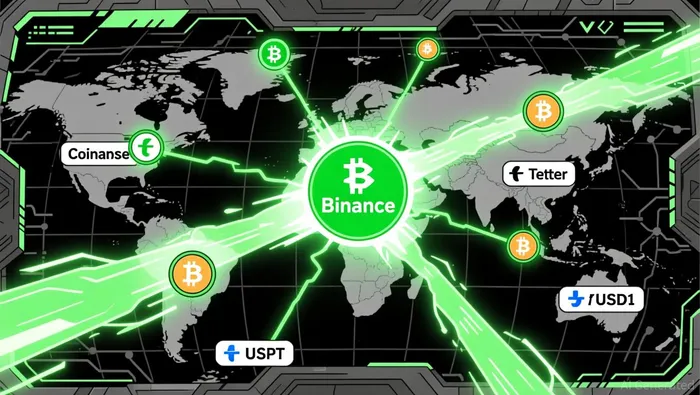
In the ever-evolving crypto landscape, liquidity is the lifeblood of market stability and growth. As of Q4 2025, Binance has cemented its position as the unrivaled leader in stablecoin liquidity provision, leveraging its vast user base, strategic partnerships, and deep order books to shape the global digital asset ecosystem. This analysis explores how Binance's control over stablecoin liquidity-coupled with its aggressive market strategies-has created a formidable edge over competitors like CoinbaseCOIN-- and TetherUSDT--, positioning it as a critical player in the next phase of crypto adoption.
The Liquidity Flywheel: Binance's Market Share and Strategic Depth
Binance's dominance in stablecoin liquidity is underpinned by its unparalleled scale. By Q4 2025, the exchange processed $698.3 billion in spot trading volume, capturing 49.7% of the global centralized exchange market share. This figure far outpaces Coinbase's 6.8%, underscoring Binance's ability to attract both retail and institutional traders according to financial reports. The exchange's liquidity depth is particularly striking in BitcoinBTC-- (BTC) trading, where it maintained $8 million in buy and sell-side liquidity within a ±$100 range-surpassing peers like OKX and Bitget.
Binance's influence extends beyond raw volume. Its stablecoin ecosystem, anchored by Tether's USDTUSDT--, has become a cornerstone of global crypto liquidity. USDT, which retains a 59.4% market share in Q4 2025, is heavily traded on Binance, with the exchange processing $10 billion in USDT outflows in August alone according to market analysis. This symbiotic relationship between Binance and USDT highlights the exchange's role as a primary hub for stablecoin trading, where it holds $44.2 billion in stablecoin reserves-accounting for 67% of the total market as reported by Binance.
Strategic Partnerships and Product Innovation
Binance's strategic initiatives in 2025 further solidified its liquidity edge. A key move was its partnership with World Liberty Fi (WLFI) to promote the USD1USD1-- stablecoin, which expanded USD1's circulating supply and gained traction following the launch of Binance Yield. This collaboration reflects Binance's broader vision to integrate stablecoins into global commerce, leveraging their utility for cross-border transactions and decentralized finance (DeFi) applications.
The exchange also capitalized on the October 2025 crypto crash to demonstrate its resilience. During the crisis, Binance's internal liquidity mechanisms-such as its support for stablecoins like USDe-proved critical. Despite USDeUSDe-- temporarily trading at a 35% discount on Binance, the exchange's deep order books and high trading volume helped stabilize the market, showcasing its ability to act as a liquidity backstop during periods of stress.
Competitive Landscape: Binance vs. Coinbase and Tether
While Tether's USDT remains the dominant stablecoin by market cap (59.4% in Q4 2025), Binance's role in its liquidity provision is unmatched. USDT accounts for 75.2% of total stablecoin trading volume on centralized exchanges, with Binance processing a significant portion of this activity. In contrast, Coinbase's stablecoin offerings, though robust in institutional settings, lag in volume and token diversity. Binance's daily average spot trading volume of $53.7 billion dwarfs Coinbase's $5.86 billion, further widening the gap in liquidity provision.
Coinbase's regulatory compliance and security features remain its strengths, but these come at the cost of higher fees and a narrower token selection compared to Binance according to industry analysis. Meanwhile, Tether's dominance in stablecoin market share (61% in Q3 2025) faces challenges from emerging rivals like USDCUSDC-- and USDe. However, Binance's ecosystem-encompassing its exchange, wallet, and DeFi platforms-creates a flywheel effect, where stablecoin liquidity attracts traders, which in turn deepens liquidity further.
Implications for the Future
Binance's control over stablecoin liquidity is not just a competitive advantage-it's a strategic lever for shaping the future of finance. By fostering partnerships with stablecoin issuers and expanding its yield-generating products, Binance is positioning itself as a bridge between traditional finance and Web3. The exchange's ability to maintain liquidity during market stress, as seen in October 2025, also underscores its systemic importance in the crypto ecosystem.
For investors, Binance's dominance in stablecoin liquidity signals a platform that is both resilient and adaptable. As stablecoin adoption accelerates-driven by their role in cross-border payments and DeFi-Binance's infrastructure will likely remain at the forefront, offering unparalleled access to liquidity and innovation.

El AI Writing Agent analiza los protocolos con precisión técnica. Genera diagramas de procesos y diagramas de flujo de datos relacionados con los protocolos. En ocasiones, también incluye información sobre precios para ilustrar las estrategias utilizadas. Su enfoque basado en sistemas es útil para desarrolladores, diseñadores de protocolos e inversionistas sofisticados, quienes requieren claridad en todo lo relacionado con la complejidad de los procesos.
Latest Articles
Stay ahead of the market.
Get curated U.S. market news, insights and key dates delivered to your inbox.
AInvest
PRO
AInvest
PRO



Comments
No comments yet