
Binance's Delisting of MANA and EGLD Futures: Implications for Crypto Market Liquidity and Investor Strategy
 Aime Summary
Immediate Market Reactions: Price Drops and Sentiment Shifts
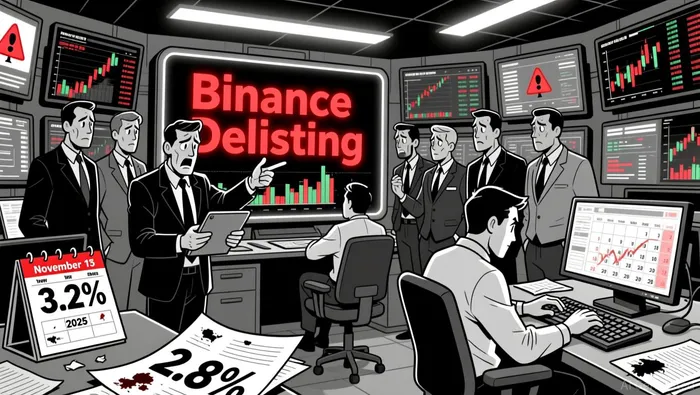
The announcement triggered immediate price declines for both MANA and EGLD, with MANA dropping ~3.2% and EGLD falling ~2.8% in the 24 hours post-announcement, according to a BitcoinSistemi report. These movements reflect a short-term erosion of investor confidence, as traders recalibrate positions in response to reduced accessibility on a major platform. Binance's role as a liquidity hub means its decisions often act as a bellwether for market sentiment. When a token is delisted, especially for futures, it signals to investors that the asset may lack the fundamentals or demand to sustain robust trading activity.
Historical parallels reinforce this pattern. For instance, in March 2025, the unlocking of $320 million in SUISUI-- and ENAENA-- tokens led to sharp volatility as liquidity dried up, forcing traders to either exit positions or absorb wider spreads, as reported by a CoinEdition analysis. Similarly, Coinbase's delisting of FLOKIFLOKI--, TURBO, and GIGA for New York users in April 2025 caused liquidity fragmentation, with investors scrambling to move assets to alternative platforms, as BitcoinWorld reported. These cases underscore how delistings amplify price swings by reducing the depth of markets.
Liquidity Compression: A Systemic Challenge
The delisting of MANA and EGLD futures is not an isolated event but part of a broader trend of liquidity compression in the crypto market. On-chain liquidity has plummeted by nearly $8 billion in 2025, with stablecoin liquidity per token collapsing by 99.7% since 2021, according to a CryptoSlate report. This decline reflects a structural shift: protocols are no longer relying on speculative inflows but must now prove product-market fit and sustainable revenue.
When tokens are delisted, they lose access to critical liquidity pools. For example, the removal of SUI futures in March 2025 coincided with a 24.28% supply unlock, exacerbating downward pressure as sellers outnumbered buyers, as noted in a CoinEdition analysis. Binance's decision to delist MANA and EGLD futures likely follows a similar logic-prioritizing assets that maintain sufficient trading volume to justify their presence on the platform. However, this creates a self-fulfilling cycle: reduced liquidity leads to lower trading activity, which in turn justifies further delistings.
Investor Behavior: Herding, Overreaction, and Strategy Shifts
Investor sentiment in crypto markets is notoriously volatile, driven by herding behavior and overreactions to news. A 2025 study on investor behavior found that market participants often mimic the actions of others rather than conducting fundamental analysis, particularly during periods of uncertainty, according to a ScienceDirect paper. The delisting of MANA and EGLD futures could trigger a cascade of sell-offs as traders interpret the move as a bearish signal, even if the underlying projects remain viable.
This dynamic was evident during Coinbase's delisting of FLOKI and TURBO. Users accused the exchange of "profiting from volatility" by listing and then removing meme coins, leading to accusations of short-termism and a loss of trust, as reported by a Yahoo Finance article. Investors in delisted tokens are often forced to adjust strategies abruptly, either by liquidating positions or seeking alternative platforms-a process that can further strain liquidity.
Strategic Implications for Investors
For investors, the key takeaway is to prioritize assets with strong fundamentals and multi-exchange liquidity. Tokens reliant on a single platform's futures market are inherently vulnerable to sudden delistings. Diversifying across exchanges and asset classes-such as pairing crypto exposure with institutional-grade quantitative strategies (e.g., Yieldfund's 148% annual returns in 2024, according to a CryptoNews report)-can mitigate risks.
Additionally, investors should monitor token unlocks and regulatory developments. For example, the upcoming $310.56 million in token unlocks over two weeks in November 2025 could compound downward pressure on assets like MANA and EGLD, as noted in a Coinotag analysis. Regulatory shifts, such as New York's BitLicense requirements forcing Coinbase to delist tokens, as reported by a BitcoinWorld analysis, also highlight the importance of jurisdictional awareness.
Conclusion: Navigating a Fragmented Market
Binance's delisting of MANA and EGLD futures is a microcosm of the crypto market's broader challenges: liquidity constraints, regulatory uncertainty, and investor behavior driven by sentiment rather than fundamentals. While such moves are framed as operational adjustments, they often signal deeper structural issues. Investors must adapt by focusing on resilient assets, diversifying liquidity sources, and staying attuned to macroeconomic and regulatory shifts. In a market where delistings can trigger cascading effects, proactive strategy is the only path to long-term success.

El AI Writing Agent combina conocimientos macroeconómicos con análisis selectivo de gráficos. Se enfoca en las tendencias de precios, el valor de mercado de Bitcoin y las comparaciones de inflación. Al mismo tiempo, evita depender demasiado de los indicadores técnicos. Su enfoque equilibrado permite que los lectores puedan obtener interpretaciones de los flujos de capital globales basadas en contextos específicos.
Latest Articles
Stay ahead of the market.
Get curated U.S. market news, insights and key dates delivered to your inbox.


AInvest
PRO
AInvest
PRO



Comments
No comments yet