
The Binance CZ Red Flag and SEC Crackdown: A Cautionary Tale for Crypto Investors


 Aime Summary
The cryptocurrency market, once a Wild West of speculative fervor, is increasingly being shaped by regulatory scrutiny and governance transparency. The U.S. Securities and Exchange Commission's (SEC) 13-count lawsuit against Binance and its founder, Changpeng Zhao (CZ), alongside CZ's recent warnings about photo-based endorsements, collectively expose systemic vulnerabilities in the crypto ecosystem. For investors, these developments underscore the critical need to reassess risk frameworks, prioritize due diligence, and align allocations with projects that demonstrate regulatory compliance and operational integrity.
The SEC's 13 Charges: A Blueprint for Regulatory Risk
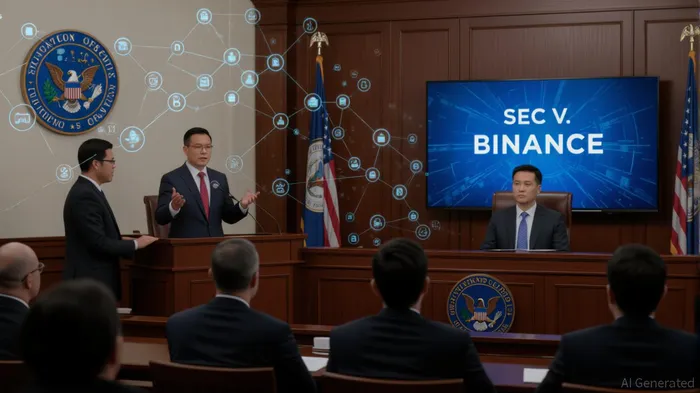
The SEC's lawsuit against Binance, filed in June 2023, is a landmark case that redefines the boundaries of securities law in the digital asset space. At its core, the complaint alleges that Binance operated as an unregistered securities exchange, broker-dealer, and clearing agency, violating Sections 5, 15(a), and 17A of the Securities Exchange Act of 1934. The SEC's argument hinges on the classification of many crypto assets as securities—a stance that, if upheld, would force exchanges to comply with stringent registration requirements.
Key allegations include:
- Unregistered offerings: Binance's BNBBNB-- and BUSD tokens, as well as its lending programs, were deemed securities under the Howey test, which defines an investment contract as involving an investment of money in a common enterprise with profits derived from the efforts of others.
- Fraudulent conduct: The SEC accused Binance of misleading investors about its market surveillance capabilities and allowing wash trading via Sigma Chain, a firm linked to CZ.
- Asset commingling: Customer funds were allegedly commingled in accounts controlled by CZ's entities, exposing investors to liquidity risks.
The court's denial of Binance's motion to dismiss in June 2024 signaled judicial recognition of the SEC's authority to regulate crypto assets under existing securities laws. This precedent could force exchanges to either register with the SEC or exit U.S. markets, reshaping the competitive landscape.
CZ's Red Flag: The Perils of Superficial Endorsements
While the SEC's case focuses on operational compliance, CZ's warnings about photo-based endorsements highlight a different but equally critical governance flaw: the erosion of investor trust through misleading social proof. During a speech at WebX2025, CZ revealed that he takes approximately 600 selfies daily, many of which are exploited by unscrupulous projects to falsely imply his endorsement.
This practice creates a dangerous illusion of legitimacy. Investors may assume that a project's association with a high-profile figure like CZ equates to due diligence, when in reality, such photos are often unverified and context-free. CZ's emphasis on relying on on-chain data, whitepapers, and corporate records over influencer imagery is a stark reminder that transparency must be rooted in verifiable facts, not marketing gimmicks.
The implications for BNB-linked projects are particularly acute. Misuse of CZ's image could mislead investors into conflating personal endorsements with institutional support from Binance, blurring the lines between organic growth and promotional manipulation.
The Investor's Dilemma: Balancing Innovation and Compliance
The Binance-CZ saga illustrates a broader tension in crypto investing: the allure of innovation versus the necessity of regulatory alignment. While decentralized finance (DeFi) and Web3 projects promise disruptive potential, their lack of oversight exposes investors to volatility, fraud, and liquidity crises.
Key lessons for investors:
1. Scrutinize regulatory alignment: Prioritize projects that engage proactively with regulators, such as those registered with the SEC or compliant with MiCA (EU's Markets in Crypto-Assets regulation).
2. Demand governance transparency: Evaluate leadership credibility through verifiable metrics, including team histories, code audits, and corporate governance structures.
3. Avoid social proof bias: Treat influencer endorsements as anecdotal, not factual. Use tools like blockchain explorers and tokenomics analyses to assess fundamentals.
Strategic Allocation in a Regulated Era
As the SEC's enforcement agenda intensifies, investors must adapt their strategies to mitigate regulatory risk. Diversification across asset classes—balancing exposure to regulated platforms like CoinbaseCOIN-- with DeFi protocols that prioritize compliance—can hedge against sector-specific shocks. Additionally, allocating to projects with clear use cases (e.g., cross-border payments, tokenized real assets) rather than speculative tokens may yield more sustainable returns.
For those seeking traditional market parallels, consider the evolution of fintech. Just as PayPalPYPL-- and Stripe navigated regulatory hurdles to establish trust, crypto projects that align with existing legal frameworks are likely to dominate long-term value creation.
Conclusion: The New Guardrails of Crypto Investing
The SEC's crackdown and CZ's warnings serve as twin pillars of caution for crypto investors. They highlight that the industry's future lies not in evading regulation but in embracing it. By prioritizing due diligence, demanding transparency, and aligning with projects that respect legal boundaries, investors can navigate the crypto landscape with greater confidence. In an era where governance flaws can swiftly erode trust, the most resilient portfolios will be those built on verifiable integrity—not just hype.

Decoding blockchain innovations and market trends with clarity and precision.
Latest Articles
Stay ahead of the market.
Get curated U.S. market news, insights and key dates delivered to your inbox.




Comments
No comments yet