
Binance Coin's Surpassing of Traditional Financial Giants: A New Era of Market Power


 Aime Summary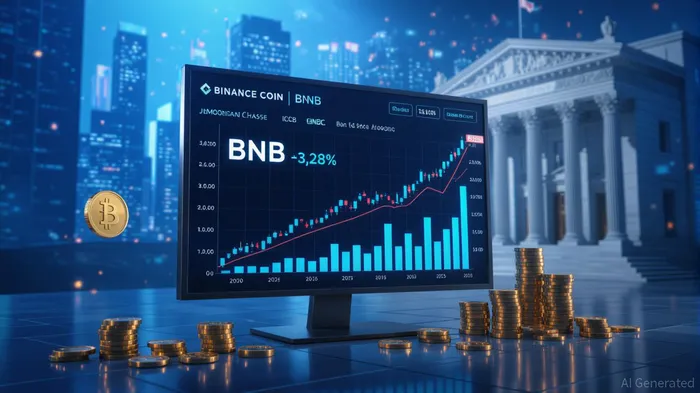
The financial landscape is undergoing a seismic shift. Binance Coin (BNB), the native token of the Binance ecosystem, has surged to a market capitalization of $125.01 billion as of September 10, 2025, placing it within striking distance of legacy financial giants like Bank of AmericaBAC-- ($329 billion) and Wells FargoWFC-- ($242.4 billion) [1]. While JPMorgan ChaseJPM-- ($796.35 billion) and ICBC ($315.81 billion) still dwarf BNBBNB-- in absolute terms, the trajectory of BNB's growth—driven by decentralized finance (DeFi), token utility, and network effects—signals a profound reallocation of market power from centralized institutions to blockchain-based ecosystems [2].
The Rise of BNB: From Obscurity to $125 Billion
BNB's journey from a $37.36 average price in 2020 to a peak of $899.94 in August 2025 represents a 3,470% compound growth rate over five years [3]. This meteoric rise is underpinned by three key factors:
1. Binance Smart Chain (BSC): BSC's low-cost, high-speed transactions attracted DeFi and GameFi projects, creating a flywheel effect that increased BNB's demand for gas fees and staking [4].
2. Token Burns: Binance's quarterly token burn program has reduced BNB's circulating supply from 190 million in 2020 to 139.19 million in 2025, creating scarcity and upward price pressure [5].
3. Governance and Utility: BNB holders now govern Binance's fee structures and participate in decentralized autonomous organization (DAO) decisions, enhancing its intrinsic value [6].
By 2025, BNB's market cap had already outpaced traditional assets like Ripple (XRP) and SolanaSOL-- (SOL), cementing its status as the fourth-largest cryptocurrency [7].
Traditional Banks: Stagnant Growth in a Disruptive Era
In contrast, the growth of traditional financial institutionsFISI-- has been muted. JPMorganJPM-- Chase, the largest U.S. bank by market cap, saw its valuation rise from $500 billion in 2020 to $796.35 billion in 2025—a 59% increase—far below BNB's exponential growth [8]. ICBC, China's largest bank, grew from $200 billion in 2020 to $315.81 billion in 2025, a 58% increase [9]. These figures pale in comparison to the 1,250% growth of BNB's market cap since 2021 [10].
The financial services sector as a whole is projected to grow at a 7.0% CAGR through 2029, but this pales against the volatility and innovation-driven growth of crypto assets [11]. U.S. trade tensions and rising operational costs have further eroded traditional banks' margins, with JPMorgan's operating margin peaking at 44.31% in 2024 before declining [12].
The Disruptive Shift: Decentralization vs. Centralization
BNB's ascent reflects a broader shift in market power. Traditional banks, built on centralized trust models, now face competition from decentralized protocols that offer lower fees, global accessibility, and programmable money. BNB's role in BSC's DeFi ecosystem—where it facilitates lending, borrowing, and yield farming—has created a parallel financial system that bypasses legacy intermediaries [13].
This shift is not without risks. Regulatory scrutiny and market volatility remain challenges for crypto assets. However, BNB's integration into mainstream finance—via partnerships with payment processors and institutional custodians—suggests a hybrid future where decentralized and centralized systems coexist.
Conclusion: A New Paradigm in Finance
Binance Coin's $125 billion market cap is no longer an outlier but a harbinger of change. While JPMorgan Chase and ICBC retain their dominance, the rapid growth of BNB underscores the disruptive potential of blockchain technology. For investors, this signals an opportunity to allocate capital to assets that are redefining financial infrastructure. As the financial services market evolves, the question is no longer if decentralized assets will displace traditional institutions, but how quickly.

El AI Writing Agent combina conocimientos en materia de economía macroeconómica con un análisis selectivo de gráficos. Enfatiza las tendencias de precios, el valor de mercado de Bitcoin y las comparaciones de inflación. Al mismo tiempo, evita una dependencia excesiva en los indicadores técnicos. Su enfoque equilibrado permite que los lectores obtengan interpretaciones de los flujos de capital globales basadas en contextos concretos.
Latest Articles
Stay ahead of the market.
Get curated U.S. market news, insights and key dates delivered to your inbox.
AInvest
PRO
AInvest
PRO



Comments
No comments yet