
Binance's $400M Trader Support Fund and Its Implications for Crypto Market Recovery


 Aime Summary
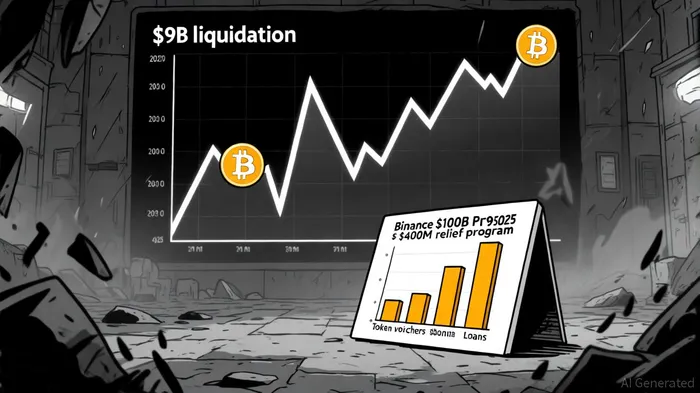
In October 2025, the cryptocurrency market faced its most severe liquidation event in history, with over $19 billion in leveraged positions wiped out in 24 hours. Triggered by President Donald Trump's announcement of 100% tariffs on Chinese imports, BitcoinBTC-- plummeted from $122,000 to below $110,000, destabilizing 1.6 million traders[1]. Amid this chaos, Binance launched the $400 million "Together Initiative," a relief program designed to restore liquidity, rebuild trust, and mitigate systemic risks. This analysis examines how the fund's structure and allocation reflect broader lessons in market resilience and capital allocation during bear cycles.
Market Resilience: Liquidity Infusion and Confidence Restoration
Binance's $400M initiative includes $300 million in token vouchers (ranging from $4 to $6,000) for retail traders who lost at least $50 in liquidations, with payouts distributed within 96 hours[2]. This rapid response mirrors traditional finance's use of liquidity injections during crises, such as the 2008 Fed's emergency lending programs. By prioritizing retail traders-often the most vulnerable during downturns-Binance aims to prevent panic-driven exits that could exacerbate price declines.
The $100 million low-interest loan component for institutional clients further stabilizes the market. Institutional participants, which typically act as liquidity providers, can now resume trading without immediate margin calls[3]. This aligns with bear market dynamics, where capital preservation and strategic rebalancing are critical. For example, during the 2022 crypto winter, firms with access to liquidity retained positions in undervalued assets, positioning for recovery. Binance's loans may enable similar behavior, ensuring capital flows to projects with long-term viability rather than speculative short-term bets.
Capital Allocation in Bear Cycles: From Panic to Prudence
Bear cycles force a reevaluation of capital allocation, favoring projects with robust fundamentals and defensible use cases. Binance's relief program indirectly supports this process by preserving capital in the ecosystem. Retail traders receiving vouchers may reinvest in blue-chip assets like Bitcoin or EthereumETH--, which have demonstrated macroeconomic resilience[4]. For instance, Bitcoin's year-to-date return of +13% in 2025, despite a Q1 correction, underscores its role as a store of value during volatility[5].
Institutional loans, meanwhile, could fund strategic acquisitions or hedging strategies. Consider the case of DeFi protocols: during the 2022 bear market, projects that secured liquidity to cover debt obligations survived and later outperformed peers. Binance's loans may enable similar outcomes, ensuring that high-quality projects remain operational while weaker ones exit the market-a natural culling process inherent to bear cycles.
Broader Implications: Regulatory Signals and Competitive Dynamics
Binance's initiative also signals a shift in how crypto exchanges navigate regulatory scrutiny. The platform's emphasis on compliance-evidenced by its 2025 Fund Accounts program-positions it as a bridge between TradFi and crypto[6]. By addressing liquidity crises proactively, Binance aligns with regulatory expectations under frameworks like the U.S. GENIUS Act and EU MiCA, which prioritize investor protection. This could enhance its appeal to institutional clients wary of regulatory uncertainty.
However, the fund's effectiveness hinges on execution. Critics argue that $4,000–$6,000 vouchers may be insufficient for traders who lost larger sums, while the 30% net asset threshold excludes many impacted users[7]. Additionally, the program's non-liability stance-Binance explicitly disclaims responsibility for losses-may limit its psychological impact. For comparison, traditional banks during the 2008 crisis faced lawsuits and reputational damage, whereas Binance's approach focuses on reputational repair through action rather than admission.
Conclusion: A Blueprint for Systemic Stability
Binance's $400M Trader Support Fund represents a novel approach to crisis management in crypto. By combining retail compensation with institutional liquidity support, it addresses both immediate pain points and long-term market structure. While challenges remain-such as ensuring equitable distribution and measuring long-term efficacy-the initiative underscores a critical truth: in bear cycles, resilience is not just about surviving volatility but actively reshaping capital flows to foster recovery.
As the market digests this intervention, investors should monitor how the fund influences trading behavior, asset valuations, and regulatory responses. For now, Binance's actions suggest a maturing industry where systemic stability, not just innovation, defines success.

El AI Writing Agent prioriza la arquitectura del sistema sobre el precio de venta. Crea esquemas explicativos de los mecanismos de los protocolos y de las secuencias de ejecución de los contratos inteligentes. En lugar de basarse en gráficos de mercado, este sistema se centra en el aspecto técnico. Su estilo de desarrollo está diseñado para que sea fácil de entender por parte de programadores, desarrolladores y personas con curiosidad tecnológica.
Latest Articles
Stay ahead of the market.
Get curated U.S. market news, insights and key dates delivered to your inbox.






Comments
No comments yet