
Binance's 2025 Trading Volume Surge: A Catalyst for Long-Term Crypto Market Consolidation
 Aime Summary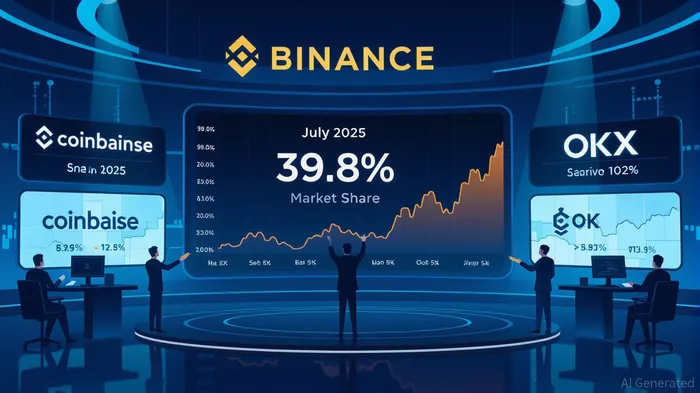
Binance's 2025 trading volume surge has not only solidified its position as the unrivaled leader in the cryptocurrency exchange sector but has also accelerated broader market consolidation. By capturing 39.8% of global spot trading volume in July 2025—nearly double the combined totals of its top five competitors—the exchange has reshaped liquidity dynamics, regulatory scrutiny, and institutional investment flows. For investors in crypto infrastructure and ecosystem plays, this dominance signals a pivotal shift in how value is distributed and captured within the digital asset landscape.
Strategic Dominance: Volume, Market Share, and Institutional Adoption
Binance's Q2 2025 performance was staggering. Despite a 27.7% industry-wide decline in trading activity, the exchange recorded a 61.4% month-over-month surge in spot trading volume, reaching $698.3 billion in July alone. This resilience underscores Binance's ability to attract liquidity even in volatile markets. Its cumulative trading volume for newly listed tokens ($133 billion) far outpaces competitors like HTX ($38 billion) and Bybit ($35 billion), reflecting strong investor confidence in its early-access opportunities and liquidity infrastructure.
The exchange's native token, BNBBNB--, has emerged as a linchpin of this strategy. BNB's 21.96% price gain in 2025—peaking at $882.58—has been driven by its utility in fee discounts, governance, and cross-chain applications. Institutional adoption has further reinforced its value: over 30 publicly traded firms now hold BNB as a reserve asset, including Nano Labs' $90 million allocation in 2025. This trend mirrors traditional finance's shift toward digital reserves, with BNB's deflationary mechanics (e.g., quarterly token burns destroying $1.6 billion in Q3 2025) creating a structural floor for its price.
Ecosystem Expansion: Layer-2 Integration and Institutional-Grade Infrastructure
Binance's strategic partnerships in 2025 have redefined BNB's role in the blockchain ecosystem. Two key projects—Bitcoin Hyper (HYPER) and Mantle (MNT)—are embedding BNB into next-generation infrastructure:
1. Bitcoin Hyper leverages Solana's Virtual Machine (SVM) and ZK-rollups to enable BitcoinBTC-- holders to access DeFi, staking, and dApps without leaving the Bitcoin network. BNB serves as a liquidity bridge and governance token, with HYPER's $7.93 million presale and 151% staking APY attracting both retail and institutional capital.
2. Mantle, an EthereumETH-- Layer-2 network, integrates BNB as a cross-chain asset and partners with EigenLayer and BitDAO's $200 million ecosystem fund. Mantle's Mantle Index Four (MI4) fund—a $400 million tokenized product—further drives demand for BNB in staking and governance.
These initiatives create a flywheel effect: increased utility drives demand for BNB, which in turn supports its price and scarcity. Binance's quarterly token burns (e.g., 2.1 million BNB destroyed in Q3 2025) amplify this dynamic, making BNB a hybrid of utility token and reserve asset.
Market Consolidation and Regulatory Implications
Binance's dominance has raised systemic concerns. European Securities and Markets Authority (ESMA) officials have warned about the risks of a single platform handling 40% of global trading volume, while the U.S. Department of Justice's 2023 settlement with Binance was interpreted as an acknowledgment of its systemic importance. However, the SEC's dismissal of its 2023 lawsuit in May 2025 has provided regulatory clarity, bolstering institutional confidence in BNB and Binance's ecosystem.
For investors, this consolidation presents both opportunities and risks. On one hand, Binance's liquidity infrastructure and institutional-grade partnerships (e.g., Dubai's crypto hub strategy) position it as a gateway for capital inflows. On the other, regulatory scrutiny could disrupt its operations if antitrust measures are enforced.
Investment Thesis: Crypto Infrastructure and Ecosystem Plays
For investors seeking exposure to Binance's ecosystem, the following strategies merit consideration:
1. BNB as a Dual-Asset Play: BNB's deflationary model, institutional adoption, and expanding utility in DeFi and cross-chain infrastructure make it a high-conviction buy. Its Sharpe ratio of 2.5 over five years and RSI of 87.54 in August 2025 suggest strong momentum.
2. Layer-2 Partnerships: Projects like Bitcoin Hyper and Mantle offer exposure to Binance's infrastructure expansion. Mantle's integration with EigenLayer and BitDAO's funding could drive BNB demand, while HYPER's staking APY provides yield generation.
3. Institutional-Grade Ecosystems: Binance's investment in DeFi protocols (e.g., Radiant Capital) and real-world asset issuance positions it as a hub for institutional adoption. The Mantle Index Four fund, for instance, could catalyze BNB's role in tokenized assets.
Conclusion: Navigating the New Normal
Binance's 2025 trading volume surge is more than a short-term market event—it is a catalyst for long-term consolidation in the crypto ecosystem. For investors, the key lies in balancing exposure to Binance's infrastructure plays (e.g., BNB, Mantle) with hedging against regulatory risks. As the exchange continues to expand its footprint in Layer-2 solutions and institutional-grade products, its ecosystem will likely remain a central driver of liquidity and innovation.
In this evolving landscape, strategic allocation to Binance's native token and its infrastructure partners offers a compelling opportunity to capitalize on the next phase of crypto adoption. However, investors must remain vigilant about regulatory developments and liquidity concentration risks, ensuring their portfolios are diversified across both centralized and decentralized ecosystems.

Decoding blockchain innovations and market trends with clarity and precision.
Latest Articles
Stay ahead of the market.
Get curated U.S. market news, insights and key dates delivered to your inbox.


AInvest
PRO
AInvest
PRO



Comments
No comments yet