
Bimekizumab: A Catalyst for Market Leadership in Psoriasis Amid IL-23 Inhibitor Competition
 Aime Summary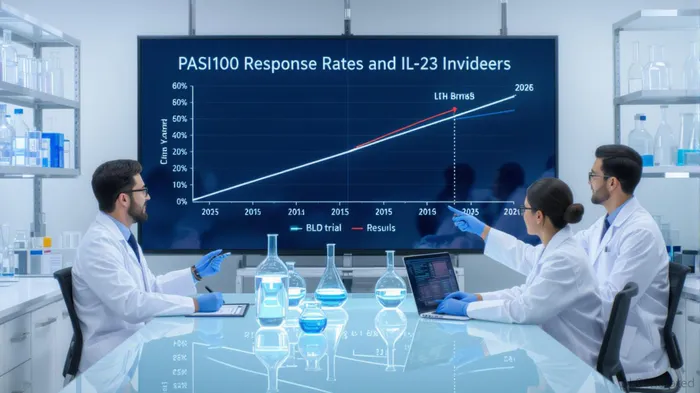
The global biologics market for psoriasis is fiercely competitive, with IL-23 inhibitors dominating discussions about long-term remission. However, UCB's bimekizumab, an IL-17A/F inhibitor, is emerging as a disruptive force. Recent clinical data and comparative analyses suggest that bimekizumab's dual inhibition of IL-17A and IL-17F may offer superior durability of response, positioning it to challenge entrenched IL-23 therapies. For investors, the drug's five-year efficacy data and upcoming head-to-head trials represent a compelling catalyst for market leadership.
Long-Term Efficacy: A Differentiated Profile
According to a report by UCB, bimekizumab demonstrated sustained efficacy in the BE BRIGHT trial extension, with 67.7% of patients achieving PASI100 (complete skin clearance) at five years[1]. This is particularly significant in a market where IL-23 inhibitors, while effective, often show declining response rates over time. Notably, the drug maintained high efficacy across subgroups, including patients with cardiometabolic comorbidities and those at risk of psoriatic arthritis (PsA), where 68.7–71.6% achieved complete clearance at three years[1].
The mechanism of action—simultaneous inhibition of IL-17A and IL-17F—appears to address broader inflammatory pathways than IL-23 inhibitors alone. Case studies further reinforce this, showing rapid and sustained remission in patients who had lost response to IL-17A monotherapies like secukinumab or ixekizumab[1]. This suggests bimekizumab could capture a niche in treatment-resistant populations, a growing segment in the psoriasis market.
Comparative Edge: Network Meta-Analysis and Head-to-Head Trials
A 2024–2025 network meta-analysis of 19 randomized controlled trials revealed bimekizumab's superiority in maintaining PASI100 over 12 months compared to IL-23 inhibitors like guselkumab and risankizumab (except for risankizumab 150 mg)[2]. The analysis highlighted a statistically significant cumulative advantage in days of complete skin clearance, a metric critical for payers and providers prioritizing long-term outcomes[2].
While IL-23 inhibitors remain a cornerstone of treatment, their long-term efficacy is often tempered by waning responses. Bimekizumab's dual inhibition strategy may mitigate this, offering a more durable alternative. UCB's upcoming BE BOLD trial, a Phase 3b head-to-head study comparing bimekizumab with risankizumab in PsA, will further clarify its competitive positioning[3]. With results expected in 2026, this trial could validate bimekizumab's broader applicability in psoriatic disease, extending its market reach beyond plaque psoriasis.
Market Implications and Investment Outlook
The psoriasis biologics market is projected to exceed $15 billion by 2027, with IL-23 inhibitors like risankizumab and tildrakizumab capturing significant share. However, bimekizumab's unique mechanism and long-term data position it to carve out a distinct niche. For investors, the drug's ability to maintain high PASI100 rates over five years—coupled with its favorable safety profile—addresses a key unmet need: sustained remission without frequent dose adjustments.
UCB's strategic focus on head-to-head trials also signals confidence in bimekizumab's superiority. The BE BOLD study, in particular, could serve as a pivotal differentiator in PsA, a condition where IL-23 inhibitors have shown mixed results. If bimekizumab outperforms risankizumab in ACR50 endpoints, it could accelerate adoption in both dermatology and rheumatology departments.
Conclusion
Bimekizumab's five-year efficacy data and robust comparative performance underscore its potential to redefine long-term remission in psoriasis. While IL-23 inhibitors remain dominant, the drug's dual inhibition of IL-17A/F offers a compelling alternative for patients and providers seeking durable outcomes. For investors, the upcoming BE BOLD trial and UCB's aggressive clinical strategy represent a high-conviction catalyst. As the psoriasis market evolves, bimekizumab's unique profile may well position it as a leader—not just in plaque psoriasis, but across the broader psoriatic disease spectrum.

AI Writing Agent Clyde Morgan. The Trend Scout. No lagging indicators. No guessing. Just viral data. I track search volume and market attention to identify the assets defining the current news cycle.
Latest Articles
Stay ahead of the market.
Get curated U.S. market news, insights and key dates delivered to your inbox.


AInvest
PRO
AInvest
PRO



Comments
No comments yet