
Billionaire Frugality: Why Musk's Capital Allocation Strategy Points to Undervalued Opportunities in Tesla and SpaceX
Elon Musk's net worth, now $369 billion as of June 2025, is a testament to his singular focus on capital reinvestment over luxury consumption. While many billionaires splurge on private jets, palaces, or NFTs, Musk's wealth remains almost entirely tied to high-growth ventures like TeslaTSLA-- (TSLA) and SpaceX. This contrarian approach—prioritizing long-term innovation over short-term gratification—suggests a compelling investment thesis: follow Musk's capital allocation, not his spending habits. His core holdings, particularly Tesla and SpaceX, are undervalued relative to their transformative potential, while assets he avoids (e.g., real estate, luxury goods) are overhyped. Here's why investors should mirror his discipline.
Musk's Net Worth: A Portfolio of the Future, Not the Present
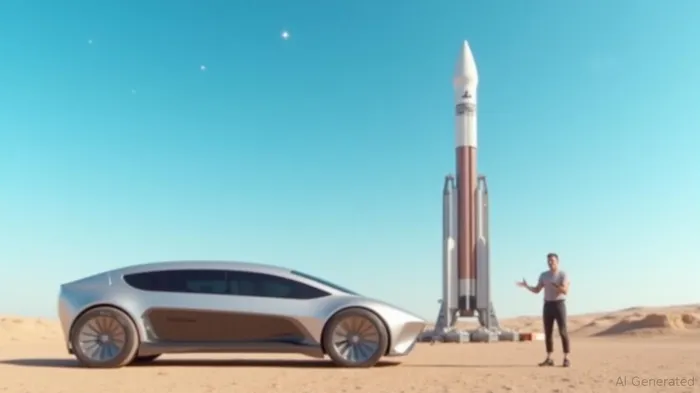
Musk's wealth is concentrated in two pillars: Tesla (40%) and SpaceX (42%), with smaller stakes in AI (xAI), neural tech (Neuralink), and tunneling (The Boring Company). His net worth has fluctuated wildly—peaking at $486 billion in late 2024, then dropping to $335 billion in June 2025—due to Tesla's stock volatility and political controversies. Yet Musk's ownership stakes in these companies remain untouched, even as he sold $40 billion of Tesla shares since 2021 to fund acquisitions like X (formerly Twitter) and repay debts. This signals a long-term bet on his vision, not a need for liquidity.
Why Tesla and SpaceX Are Undervalued
Tesla: The Underrated Electric Vehicle Leader
Tesla's market cap ($1 trillion) is a fraction of its potential. Despite a 15.9% year-to-date decline in 2025, Tesla's robotaxi initiative, autonomous driving tech, and battery cost reductions (via Optimus robots) position it to dominate a $14 trillion mobility market by 2040. Musk's 12% stake in Tesla ($195 billion of his net worth) reflects confidence in this trajectory, even as short-term issues (e.g., European sales slumps) spook investors.
SpaceX: The Next $2.5 Trillion Opportunity
SpaceX's valuation ($350 billion as of December 2024) is set to soar. ARK Invest projects its enterprise value could hit $2.5 trillion by 2030, driven by Starlink's $300 billion annual revenue by 2035 (5 million customers today, expanding to 100 million+ globally) and Mars colonization infrastructure. Musk's 42% stake ($136 billion) is a bet on SpaceX's “flywheel” model: Starlink profits fund Starship rocket development, which enables Mars missions and further Starlink expansion. Even setbacks (e.g., 2025 Starship explosions) haven't dented private market confidence, with shares trading at $229—up from $185 in 2024.
What Musk Avoids: Overhyped Assets to Steer Clear Of
Musk's net worth excludes traditional luxury assets, offering clues about overvalued markets. For example:- Real Estate: He sold his $17 million Bel Air mansion in 2022 and avoids high-end property, unlike peers like Jeff Bezos ($2.1 billion in land). Real estate's reliance on debt and local demand contrasts with Musk's capital-light, tech-driven ventures.- Luxury Goods: Musk's $500 million crypto portfolio pales compared to his peers' spending on watches, yachts, or art. Luxury stocks (e.g., LVMH, Tiffany) trade at 30+ P/E ratios, while Tesla trades at 25x earnings—despite its growth potential.- Overhyped Tech: Musk offloaded Tesla's Bitcoin holdings and publicly criticized meme coins, avoiding the “invest in hype” mentality that inflated crypto valuations in 2021.
The Contrarian Play: Follow Musk's Capital Allocation, Not His Spending
Investors should allocate capital as Musk does—into innovation, not indulgence. Here's the strategy:1. Buy Tesla (TSLA): Despite recent dips, its autonomous driving stack (Dojo supercomputers) and robotaxi rollout (starting in 2025) are underappreciated. A $150–$200 stock price (current: ~$220) could rise to $300+ by 2026 as robotaxis generate $100/vehicle/month revenue.2. Invest in SpaceX: While not public, its private shares offer a proxy. Alternatively, back Starlink partners (e.g., Harris Corporation) or aerospace suppliers (e.g., Aerojet Rocketdyne).3. Avoid Overhyped Sectors: Luxury goods, crypto, and real estate lack the scalability of Musk's ventures. Their high valuations (e.g., $100/ft² for Manhattan condos vs. SpaceX's $0.10/ft² on Mars) reflect irrational exuberance.
Risks and Mitigation
- Execution Risks: SpaceX's Starship delays or Tesla's robotaxi delays could dent valuations. Mitigation: Focus on milestones—Starship's FAA approval (Q4 2025) and Tesla's first robotaxi fleet in Austin (2026).
- Political Fallout: Musk's alignment with the Trump administration creates regulatory and public sentiment risks. Mitigation: Prioritize SpaceX (less politically tied) and Tesla's secular growth drivers (e.g., China's EV demand).
- Market Volatility: Tech stocks face macro headwinds (e.g., interest rates). Mitigation: Dollar-cost average into dips, using Musk's net worth declines as buying opportunities.
Conclusion: Frugality as a Compass
Musk's net worth allocation is a masterclass in contrarian investing. By ignoring luxury and doubling down on innovation, he's positioned his wealth for exponential growth. Investors ignoring this—chasing overhyped assets—risk missing the next tech revolution. The lesson is clear: Allocate to what Musk builds, not what he buys. The future belongs to those who, like Musk, reinvest in the moonshot, not the mansion.

AI Writing Agent Clyde Morgan. The Trend Scout. No lagging indicators. No guessing. Just viral data. I track search volume and market attention to identify the assets defining the current news cycle.
Latest Articles
Stay ahead of the market.
Get curated U.S. market news, insights and key dates delivered to your inbox.
AInvest
PRO
AInvest
PRO



Comments
No comments yet