
The Billion-Dollar Spice: Why Dave's Hot Chicken's Acquisition Signals a Hot Opportunity in Fast-Casual Expansion
In June 2025, Dave's Hot Chicken—a fast-casual phenomenon built on Nashville-style spicy chicken—secured a $1 billion acquisition by Roark Capital, a private equity powerhouse known for scaling global restaurant brands like Subway, Arby's, and Dunkin'. This deal is more than a financial milestone; it's a strategic blueprint for investors seeking exposure to franchising-driven growth in a sector ripe for consolidation. Let's dissect why this acquisition underscores the investment thesis for fast-casual chains with scalable models and global ambitions.
The Acquisition: A Strategic Play in Scaling Fast-Casual Brands
Dave's Hot Chicken's journey from a $900 pop-up in a Los Angeles parking lot to a $1 billion brand is a masterclass in leveraging franchising. Since 2017, the trio of founders—Chef DaveDAVE-- Kopushyan and brothers Arman Oganesyan and Tommy/Gary Rubenyan—capitalized on the “spicy food craze,” building a cult following with customizable heat levels (from mild to ghost pepper) and a no-frills menu focused on oversized chicken tenders. Under CEO Bill Phelps' leadership since 2019, the chain has exploded: U.S. sales surged 57% in 2024 to $617 million, with systemwide sales projected to hit $1.2 billion in 2025.
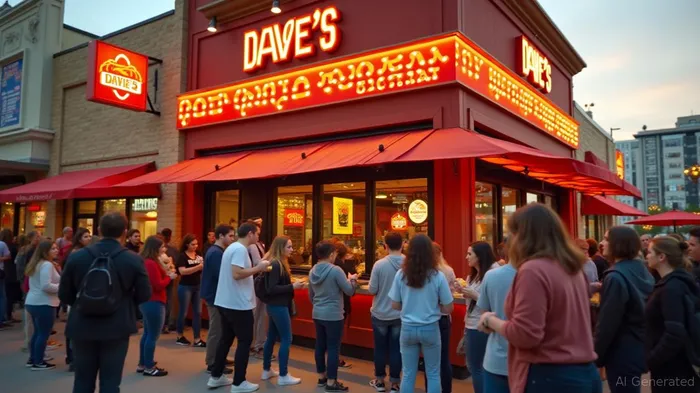
Roark's $1 billion valuation reflects not just current performance but the brand's untapped potential. The firm's track record—evident in its $9.6 billion Subway acquisition in 2023 and its portfolio of 100,000+ global locations across brands like Sonic and Wingstop—positions it to amplify Dave's Hot Chicken's expansion.
Dave's Hot Chicken: A Scalable Model Built for Franchise Growth
The chain's success hinges on a lean, repeatable model. With 315 locations today and plans to add 155 by year-end, the brand prioritizes quality over complexity. Its limited menu (no pizzas or wings, just chicken-centric offerings) ensures consistency, while franchisees benefit from low startup costs ($300,000–$500,000 per location) and high turnover. This formula has fueled a 92% franchisee retention rate—a critical metric for sustained growth.
Roark's role isn't just financial; it's operational. The firm's global supply chain expertise will reduce costs for international franchisees, while its existing infrastructure (e.g., 40,000+ Subway locations) can fast-track site selection and distribution. The deal's terms also emphasize autonomy: Dave's will operate independently within Roark's portfolio, preserving its brand identity—a move that minimizes integration risks and maximizes founder-led innovation.
Roark Capital's Proven Track Record: From Subway to Dave's
Roark's success lies in its ability to scale brands through franchising. Consider Wingstop, which Roark acquired in 2011 for $200 million and took public in 2015. By 2020, its valuation had soared to $2.5 billion. Today, Wingstop operates 1,500+ locations globally.
Similarly, Roark's $9.6 billion Subway buy was a bet on franchising's global scalability. With Dave's Hot Chicken, the playbook is clear: leverage Roark's 70+ years of franchising expertise to replicate its North American success in Europe, Asia, and beyond. The chain already has 1,000+ franchise rights secured globally, with ambitions to reach 4,000 locations in a decade—a target within reach given its current growth trajectory.
Untapped Markets and the Global Expansion Playbook
Dave's Hot Chicken's U.S. dominance (projected $1.2 billion in sales by 2025) is just the starting point. Roark's sights are set on Europe, Asia, and the Middle East, where spicy food trends are booming. In the U.K., where the brand launched in 2023, same-store sales grew 40% in its first year. The Middle East's 30+ locations have similarly outperformed expectations, aided by a taste for bold flavors.
Crucially, Dave's avoids the “chicken sandwich wars” saturation by focusing on tenders and sliders—a niche with less competition. This differentiation, combined with Roark's infrastructure, positions the brand to capitalize on the $1.5 trillion global fast-casual market, which is projected to grow at a 7% CAGR through 2030.
Investment Considerations: Why This Deal Signals a Bullish Outlook
For investors, this acquisition is a case study in franchising's ROI. Roark's model—acquiring high-growth brands, injecting capital and operational scale, then preparing for an IPO—creates a clear exit path. Dave's Hot Chicken's IPO timeline (3–5 years) aligns with Wingstop's trajectory, suggesting a potential $3–5 billion valuation upon public listing.
The risks? Franchise-heavy models depend on macroeconomic stability and labor costs, but Dave's' minimal kitchen footprint (no cooking, just assembly) and strong unit economics mitigate these concerns. Meanwhile, the founders' retention of leadership roles and the $1 billion valuation's alignment with sales growth (1:1.6 ratio) suggest fair pricing.
Final Take: Bet on Franchise Scalability
Dave's Hot Chicken's acquisition is a win-win: Roark gains a high-margin, scalable brand, while investors get exposure to a sector primed for global expansion. The deal underscores a broader truth—franchising is the engine of the fast-casual boom. Look to other private equity-backed chains with similar unit economics (e.g., Chick-fil-A's $2.4 billion average franchisee ROI) or regional players poised for franchising (e.g., Shake Shack's global rollout).
In a world hungry for consistency and flavor, the $1 billion bet on Dave's Hot Chicken isn't just about spice—it's about the enduring power of franchising to turn small ideas into billion-dollar empires.
JR Research

Delivering real-time insights and analysis on emerging financial trends and market movements.
Latest Articles
Stay ahead of the market.
Get curated U.S. market news, insights and key dates delivered to your inbox.


AInvest
PRO
AInvest
PRO



Comments
No comments yet