
The Biggest Hedge Fund Buying Since 2020 Looks More Like a Short Squeeze
U.S. equities looked calm on the surface last week. The S&P 500 rose roughly 1%, a move that might normally suggest a steady rebound in risk appetite. But beneath the index level, the market was far more turbulent.
The real story was not simply that stocks went up. It was that hedge funds first went through a sharp deleveraging shock, and then the market snapped back as shorts were forced to cover.
According to the flow data cited in the original report, hedge funds saw one of their most aggressive deleveraging episodes in years. The three-day reduction in exposure from Friday to Tuesday was the largest since November 2022 in GoldmanGS-- Prime records. In global equities, the deleveraging was described as the largest since the January 2021 meme-stock episode.
That matters because it changes how investors should read the rebound. A rally after forced deleveraging is very different from a rally driven by fresh long buying. The former can be violent, but also fragile.
The pressure was concentrated in crowded momentum and AI-related trades. The report noted that Goldman's high-momentum factor fell 7% for the week before rebounding 13% in a single day. That kind of move points to a positioning event rather than a normal rotation across sectors.
The reversal had two major catalysts.
The first was earnings. Microsoft reported strong cloud numbers, with Azure and other cloud services revenue rising 43% year over year. Amazon also delivered a strong AWS result, with cloud revenue growing 37% year over year. These numbers helped revive confidence in the AI infrastructure trade. For investors worried that AI capital spending was becoming a cost burden, the cloud revenue data gave the market a reason to reprice the trade.
The second catalyst was the easing of a potential forced-selling overhang. Situational Awareness reportedly transferred its public equity portfolio to Citadel. In a market already worried about forced deleveraging, the removal of that potential selling pressure helped shorts cover more aggressively.
That is why the headline net-buying number needs to be interpreted carefully.
The report said U.S. equities saw the largest weekly net buying since November 2020. At first glance, that sounds like a clean bullish signal. But the composition of the flows suggests something more technical. The buying was reportedly driven almost entirely by short covering, while long buying remained relatively limited.
Macro products, including indices and ETFs, accounted for 58% of total net buying. Single stocks accounted for the remaining 42%. In macro products, short covering far exceeded long selling, with a ratio of 3.4 to 1. In single stocks, short covering also dominated, with the ratio of short covering to long buying at 2.1 to 1.
That means the better interpretation is not that hedge funds suddenly became aggressively bullish. It is that short risk was rapidly reduced after a major deleveraging event.
This distinction is important. Short-covering rallies can be powerful because they force investors to buy quickly. But they are not always durable. For a rally to become more sustainable, short covering usually needs to be followed by active long buying.
There are some reasons to believe that could still happen. The report noted that U.S. long-short hedge fund gross leverage rose to 208.1%, but remained only in the 18th percentile over the past year. Net leverage rose to 52.8%, around the 45th percentile. In other words, leverage is not yet stretched. There is still room for funds to add risk if the market backdrop continues to improve.
But the risks have not disappeared.
Long-end Treasury yields remain a pressure point for high-duration AI assets. The 30-year Treasury yield recently rose near 5.24%, a level described as a 19-year high. Higher long-term yields can put pressure on richly valued growth and AI-related stocks.
The more opaque risk is leverage tied to chip exposure. The report warned that there may still be more than $100 billion of highly leveraged chip-related long positions held through total return swaps. That figure is difficult to verify through public filings, but the risk is clear: if chip stocks fall again, forced selling or position transfers could return.
Public filings offer a useful window into the visible side of that risk. Situational Awareness disclosed a $13.7 billion public equity portfolio, with holdings concentrated in semiconductor, AI infrastructure, power and data-center related names.
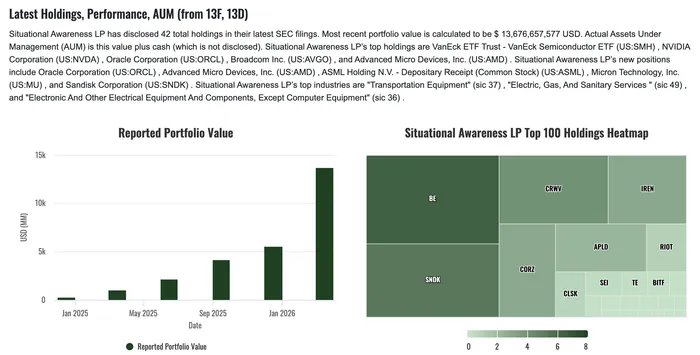
(Situational Awareness disclosed a $13.7 billion public equity portfolio concentrated in AI infrastructure, semiconductor, power and data-center related names. Public filings show visible exposure, but they do not capture total return swaps or real-time leverage.)
But that visibility has limits. Public filings can provide context, but they do not fully capture this risk. 13F filings are delayed, cover only certain securities, and do not reveal total return swaps, financing terms, margin pressure, or real-time exposure. That means visible public equity holdings may understate the actual leverage embedded in the trade.
The cleanest conclusion is this: last week's rally was not a straightforward sign that hedge funds are broadly bullish again. It was a rebound after a major deleveraging event, helped by strong cloud earnings and the removal of a forced-selling overhang. The rally had real catalysts, but the flow structure looked more like short covering than a full return of risk appetite.
The next phase will be critical. Investors should watch whether momentum volatility stabilizes, whether hedge fund flows shift from short covering to active long buying, and whether hidden leverage in the chip trade remains a source of forced-selling risk.

Senior Research Analyst at Ainvest, formerly with Tiger Brokers for two years. Over 10 years of U.S. stock trading experience and 8 years in Futures and Forex. Graduate of University of South Wales.
Latest Articles
Stay ahead of the market.
Get curated U.S. market news, insights and key dates delivered to your inbox.


AInvest
PRO
AInvest
PRO



