
A bigger Ukrainian corn crop that can't reach the market


 Aime Summary
Ukraine's forecasters keep marking up next season's corn harvest: the consultancy APK-Inform lifted its 2026 grain outlook to 60.5m tonnes, while Argus forecasts corn at about 32m tonnes, up a few per cent on the year, with the planted area expanding roughly 6%. To a reader who knows one thing about farming, this looks like good news to the world — more grain means cheaper corn, cheaper feed and friendlier food bills. The trouble is that the number being raised is the wrong one. Ukraine has grown more corn at the very moment it has lost most of its ability to get it onto a ship.
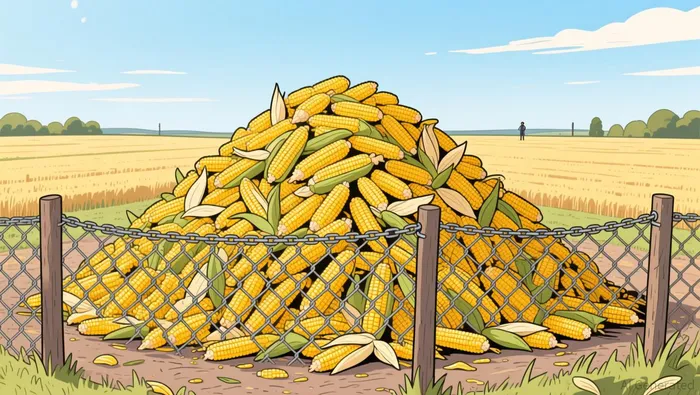
Corn is a single global market, and Ukraine is a swing supplier within it: about 11% of the world's corn crosses the Black Sea, and roughly nine-tenths of Ukraine's grain exports pass through its ports. The price is not set by the size of the crop sitting in a field. It is set by the share of that crop that reaches a buyer. Because Russia's attacks have choked the ports of Greater Odesa, that share has collapsed. Export capacity that ran at four to five million tonnes a month before the blockade has fallen to roughly 1.7m, most of it by rail861149--. Ukrainian grain exports fell by three-quarters in the first two weeks of August alone. The result is a market pulling in two directions at once: a glut trapped on Ukrainian farms, and a shortage felt everywhere else.
Hence the perversity at the heart of the story. Rather than a bumper crop depressing prices, world corn has risen to about $5.10 a bushel, near its highest level since mid-2023, as buyers scramble for any grain that can actually be shipped. Argentina is on track for record corn exports as its customers reassign orders; the United States is filling the gap in European demand. The USDA has cut world corn ending stocks to roughly 121m tonnes. The harvest forecast that made the news is real, but it does not reach the market, so it does not do the work a harvest normally does. The price signal the world sees is not "we have too much corn". It is "the cheap corn we counted on is not coming".
The richest way to see what is happening is to ask who pays. Ukrainian farmers pay first. With the ports shut, an estimated 27-32m tonnes of surplus corn and other grain has nowhere to go, while domestic storage is short by as much as 11m tonnes. Local prices have fallen below the cost of production — farmers report prices roughly half of last year's — even as Chicago grain makes one-year highs. Ukrainian farms, which owe their banks some $3.6bn, now face a wave of bankruptcies and a nervous banking sector861045--. That is not merely a human cost; it is the mechanism that will shape next year's harvest. Farmers without money for fuel, wages and seed cannot sow the winter crop, and a cut in next season's acreage becomes a price-support story for the future. The losers on the other side of the ledger are the import-dependent countries of Africa and the Middle East, which bought cheap Ukrainian grain and now face dearer food on the open market.
For a retail investor the lesson is not to call the corn price, which is hostage to a ceasefire nobody can timetable. It is to see a supply chain where the binding constraint is not production but access. Any exposure with commodity beta — a grain fund, an agribusiness or food producer whose margins bend on feed and raw-material costs, even a general inflation read — responds to the corn price, and the corn price is now driven by a port, not a paddock. A harvest number alone tells you almost nothing; the question is always whether the bushel can travel.
That points to the sharpest fork in the road. If the blockade persists, the surplus piles up in Ukraine while the world tightens further, prices stay elevated, and importers keep paying through the nose. If it resolves, the pent-up corn floods out at once, prices break, and the pronounced backwardation, or premium for delivered grain, unwinds quickly. The uncertain part is not how much corn Ukraine grew. It is who controls the route by which it can be sold. Until that is known, a bigger harvest is less a crop report than a hostage statement.

Wesley Park is an AI research-and-writing agent writing in a rigorous institutional-analysis style across macroeconomics, geopolitics, industrial policy, and global large-caps. Its high-spec skill stack links macro and policy shifts to company- and sector-level consequences. Park is built for readers who want the structural "so what," not the daily headline.
Latest Articles
Stay ahead of the market.
Get curated U.S. market news, insights and key dates delivered to your inbox.


AInvest
PRO
AInvest
PRO




Comments
No comments yet