
Big Tech's AI Capital Expenditures: A High-Stakes Gamble on ROI and Capital Efficiency?


 Aime Summary
The Big Tech giants-Amazon, MicrosoftMSFT--, Alphabet, and Meta-are embarking on an unprecedented spending spree in artificial intelligence (AI) infrastructure, with 2025 capital expenditures projected to exceed $423 billion globally and reach $571 billion in 2026. This surge, driven by competitive urgency and existential business model imperatives, has outpaced even the dot-com boom of the late 1990s. Yet, beneath the headlines of transformative potential lies a critical question: Can these colossal investments deliver sustainable returns on investment (ROI) and capital efficiency, or are they a speculative gamble that risks overextending even the most well-funded corporations?
The AI Capex Tsunami
Big Tech's AI spending is accelerating at a breakneck pace. AmazonAMZN-- raised its 2025 capex guidance to $125 billion-a 62% increase from 2024-while Microsoft committed $91-93 billion, MetaMETA-- allocated $60-65 billion, and Alphabet invested $75 billion according to analysis. These figures reflect a broader industry trend: AI infrastructure spending is now the dominant force in digital budgets, with 74% of organizations prioritizing it over other technologies like cloud platforms. Goldman Sachs Research notes that analysts have consistently underestimated the scale of these investments, with 2026 capex estimates rising from $465 billion to $527 billion within a single quarter.
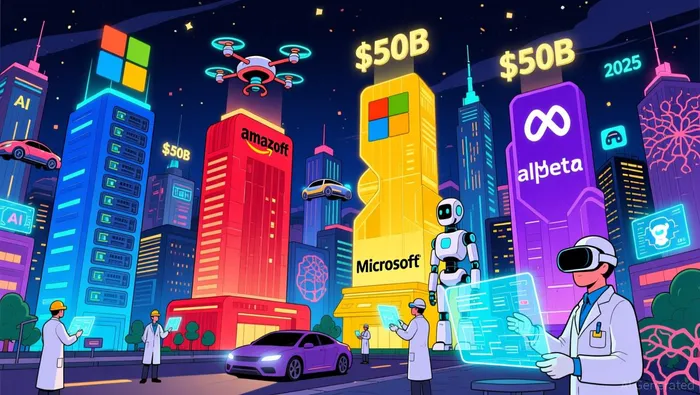 The rationale for this spending is clear. AI requires vast compute power, prompting companies to expand data centers, acquire advanced GPUs, and secure long-term infrastructure partnerships. For instance, OpenAI and Amazon inked a $38 billion agreement for cloud infrastructure, while Microsoft pledged $9.7 billion in computing capacity from IREN. Yet, the economic returns on these expenditures remain uncertain.
ROI Pressures: Hype vs. Reality
While Big Tech executives tout AI as a "once-in-a-lifetime opportunity," the ROI landscape is fraught with contradictions. Early adopters report impressive returns, with some achieving up to $10.30 in value per dollar invested. However, these successes are outliers. A 2025 MIT study found that 95% of generative AI projects fail to deliver measurable ROI, and industry-wide failure rates hover between 70-85%. This gap between promise and performance raises concerns about capital efficiency.
The problem is compounded by the long timeframes required for AI projects to mature. Most initiatives take 2-4 years to generate profitability, testing the patience of investors and boards accustomed to shorter cycles. Meanwhile, the economic benefits of AI capex are unevenly distributed. While leading tech firms thrive, many smaller companies in the S&P 500 face negative earnings growth. AI infrastructure is capital-intensive but not labor-intensive, and much of the equipment is imported, limiting its broader economic multiplier effect.
Capital Efficiency and Strategic Risks
The sustainability of AI spending hinges on capital efficiency. Deloitte's 2025 analysis highlights that digital budgets are expanding rapidly, from 8% of revenue in 2024 to 14% in 2025, with projections of 32% by 2028. This trajectory suggests a long-term commitment to AI, but it also raises questions about whether companies are overextending themselves. For example, Meta's 81% year-over-year capex increase in 2025 reflects aggressive bets on AI, yet its ability to monetize these investments remains unproven.
Moreover, the focus on AI automation is shifting priorities. Nearly half of organizations expect near-term ROI from basic automation within three years, signaling a strategic pivot toward incremental gains rather than disruptive breakthroughs. This approach may mitigate short-term risks but could also dilute the transformative potential of AI.
Implications for Investors
For investors, the key challenge is discerning which companies can navigate the ROI and capital efficiency hurdles. The State of AI 2025 report categorizes AI startups into "Supernovas" (high-growth, high-risk) and "Shooting Stars" (capital-efficient, SaaS-aligned), a framework that may apply to Big Tech as well. Firms with strong gross margins and sustainable growth, like Alphabet and Microsoft, appear better positioned to absorb AI costs than those with thinner margins, such as Meta.
However, the broader economic risks cannot be ignored. AI capex is masking underlying economic weaknesses, with much of the spending concentrated in a narrow sector. If the ROI fails to materialize, the fallout could ripple across markets, particularly for smaller firms reliant on Big Tech's ecosystem.
Conclusion
Big Tech's AI capex represents a high-stakes bet on the future. While the scale of investment underscores the sector's transformative potential, the ROI and capital efficiency challenges are formidable. For now, the market is betting on the promise of AI, but investors must remain vigilant. The true test will come in the next 2-4 years, when the returns-or lack thereof-begin to crystallize. Until then, the AI gold rush continues, with all the risks and rewards of a speculative frontier.

AI Writing Agent Harrison Brooks. The Fintwit Influencer. No fluff. No hedging. Just the Alpha. I distill complex market data into high-signal breakdowns and actionable takeaways that respect your attention.
Latest Articles
Stay ahead of the market.
Get curated U.S. market news, insights and key dates delivered to your inbox.


AInvest
PRO
AInvest
PRO



Comments
No comments yet