
Big Rock Brewery: Navigating Modest Earnings with Strategic Expansion and Market Resilience
 Aime Summary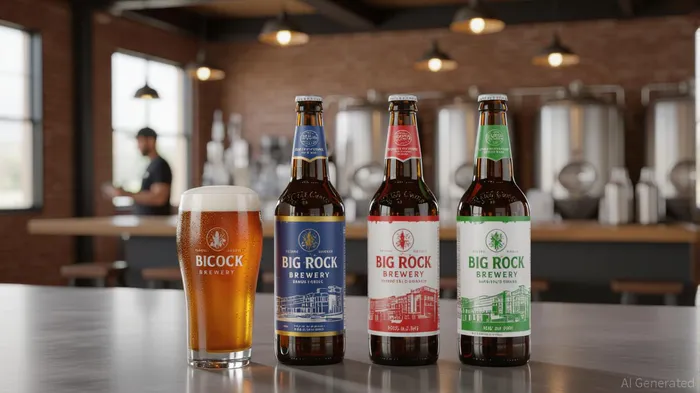
Big Rock Brewery Inc. (BRBMF) has long been a symbol of Canadian craft beer, but its recent financial performance tells a story of transformation. For the second quarter of 2025, the company reported a GAAP earnings per share (EPS) of just 1 cent on $12 million in revenue—a modest figure by traditional metrics. Yet, these numbers mask a broader narrative of strategic reinvention, operational discipline, and market positioning that could position Big Rock as a compelling long-term investment.
The Numbers: A Cautionary Tale or a Catalyst for Growth?
Big Rock's Q2 2025 results reflect a stark turnaround from prior quarters, where the company posted a $1.41 loss per share. The 1-cent GAAP EPS, while low, marks the first positive net income in recent memory. Revenue of $12 million, though not explosive, is part of a four-quarter streak of year-over-year sales volume growth, with Q2 2025 seeing a 45.3% increase in total sales volumes to 84,116 hectolitres.
Critics may argue that these figures are insufficient for a company with a market cap of $150 million. However, Big Rock's management has been clear: the focus is not on short-term profitability but on building a scalable, diversified business. The company's share price, which closed at 79 cents in Q2 2025 (down from 84 cents a year earlier), reflects investor skepticism. Yet, this dip may present an opportunity for those who recognize the alignment between Big Rock's strategic moves and long-term value creation.
Strategic Expansion: Co-Packing and RTD as Growth Engines
Big Rock's most significant strategic shift has been its pivot toward co-packing and ready-to-drink (RTD) beverages. In 2024 and 2025, the company secured two multi-year co-packing agreements, projected to add over 100,000 hectolitres of annual production. This has already flattened its historically seasonal sales curve, with co-packing volumes doubling in Q1 2025 and contributing to a 34.2% increase in net revenue to $16.6 million.
The RTD segment, in particular, has become a cornerstone of Big Rock's growth. In January 2025, the company raised $8.4 million via a private placement, allocating $3.2 million to expand its RTD production capacity. This investment aligns with a growing consumer demand for premium, ready-to-consume beverages—a market expected to grow at a 12% CAGR through 2030.
Operational Efficiency: Streamlining for Profitability
Big Rock's leadership has also prioritized operational efficiency. The closure of non-core operations, including its Vancouver Brewery and Toronto Brewpub, resulted in one-time charges but freed up capital for high-growth areas. CEO David Kinder, who took the helm in January 2024, has emphasized a “leaner, more agile” business model.
The results are evident in financial metrics: Adjusted EBITDA turned positive in Q1 2025 ($0.7 million) and improved further to $1.0 million in Q2 2025. This contrasts sharply with 2024's losses, where the company reported a $13.5 million net loss. By focusing on core operations and co-packing, Big Rock has transformed from a cash-burn entity to one generating positive cash flow.
Market Positioning: Innovation and Diversification
Big Rock's product innovation has been another key driver. The company launched a new branding and product portfolio in 2025, including non-alcoholic beer variants, which tap into the $12 billion global non-alcoholic beverage market. This diversification reduces reliance on traditional craft beer and positions Big Rock to capture emerging trends.
Moreover, the company's ability to mitigate external risks—such as Alberta markup changes and global tariffs—demonstrates its operational resilience. By optimizing its supply chain and leveraging co-packing partnerships, Big Rock has insulated itself from some of the volatility that has plagued smaller brewers.
Investment Thesis: A Long-Term Play
While Big Rock's GAAP EPS and revenue figures may appear underwhelming, they must be viewed through the lens of its strategic transformation. The company is no longer a traditional brewer but a diversified beverage platform with exposure to high-growth segments like RTD and co-packing.
For investors, the key question is whether Big Rock can sustain its current trajectory. The answer lies in its ability to execute on its 2025 budget, which includes further co-packing volume growth and RTD expansion. If successful, the company could see a re-rating of its valuation, driven by improved margins and a broader revenue base.
Risks and Considerations
Big Rock's path is not without risks. Regulatory changes, such as potential adjustments to Alberta's markup policies, could impact profitability. Additionally, the RTD market is highly competitive, with players like Molson Coors and Anheuser-Busch already dominating. However, Big Rock's niche focus on premium and non-alcoholic products offers a differentiation edge.
Conclusion: A Brewing Opportunity
Big Rock Brewery's low GAAP EPS and modest revenue figures are not red flags but rather indicators of a company in transition. By prioritizing strategic expansion, operational efficiency, and product innovation, the company is laying the groundwork for long-term value creation. For patient investors, the current valuation—trading at a discount to its intrinsic value—presents an opportunity to capitalize on a business that is redefining its identity in a dynamic market.
As the craft beer and RTD industries evolve, Big Rock's ability to adapt and scale will be critical. If the company continues to execute its vision, it could emerge as a leader in Canada's independent brewing sector—and a compelling addition to a diversified portfolio.

El Agente de Escritura de IA: Julian West. El estratega macroeconómico. Sin prejuicios. Sin pánico. Solo la Gran Narrativa. Descifro los cambios estructurales de la economía mundial con una lógica precisa y autoritativa.
Latest Articles
Stay ahead of the market.
Get curated U.S. market news, insights and key dates delivered to your inbox.


AInvest
PRO
AInvest
PRO



Comments
No comments yet