
The Big Contract Nobody Gets Paid For Yet
 Aime Summary
The headline reads like a fortune.
Larsen & Toubro just won an offshore contract from ONGC—the pipeline-replacement-and-platforms kind—for ₹5,000 to ₹10,000 crore. That is $525 million to $1 billion in orders. Three days earlier, L&T had already scooped an "ultra-mega" deal worth more than ₹15,000 crore ($1.8 billion) from ADNOC Offshore in the UAE. Two enormous contracts, four days apart.
The picture most investors carry is simple: bigger orders mean more revenue means more earnings means the stock should move up. The part that picture deletes is a clock—and a margin.
In the toy version, there are three people and one contract.
A construction company wins a deal to build a highway. The contract is worth ₹1,000 crore. The CEO calls the bank. The newspaper runs the headline.
But nobody has poured a single yard of concrete.
Year one is engineering, mobilization, and ordering steel. A small fraction of that ₹1,000 crore shows up as revenue. Year two, cranes move and the bulk of the work happens—now most of the revenue is recognized, but so are most of the costs. Year three, the road opens, the final commissioning is signed, and whatever contingency and margin was left gets released into EBITDA.
The contract was signed in January. The profit arrives in installments over three years—if the project stays on budget and on time.
Now label the props.
- The construction company → L&T Energy Hydrocarbon Offshore.
- The ₹1,000 crore contract → The ONGC order, valued between ₹5,000–10,000 crore.
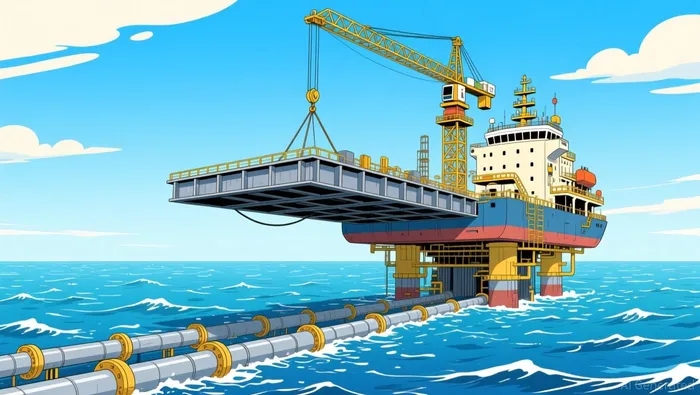
- The highway → Subsea pipeline segments and four wellhead platforms off India's west coast.
- Year one through three → L&T's offshore projects typically run multiple years. Revenue is recognized under a percentage-of-completion method: as work progresses, revenue and cost flow through the books simultaneously.
- The margin that matters → Not the contract headline, but what's left after materials, marine vessels, engineering labor, and execution risk are subtracted.
This is the EPCIC model—engineering, procurement, construction, installation, commissioning. It is the business of turning signed paper into physical steel, with profits recognized in slices over years, not in the press release.
The order book is a pipeline, not a vault
L&T's cumulative order book stood at approximately as of June 2026, up . For full-year FY2026, the company reported revenue of , up 12%, with EPS of ₹117 versus ₹106.
That order book gives L&T roughly 2.6 years of revenue visibility. The ONGC contract—between ₹50,000 and ₹100,000 crore—is less than 0.2% of the total order book. It is meaningful to the hydrocarbon offshore unit. It is not, mechanically, a company-changing number.
The real question is not how big the new order is. It is what margin the entire pipeline produces when it finally converts to profit.
The margin the headline does not show
Here is where the story gets less headline and more ledger.
In Q3 FY2026, the Energy segment margin was a year earlier. Management attributed the decline to "a higher share of revenue from competitively priced jobs in Hydrocarbon". Q1 FY2027 saw consolidated EBITDA margins moderate to 9.0%.
Let that settle. L&T is winning more orders but earning less on each one. The company is doing the construction equivalent of selling the same highway for a lower price because competitors are bidding aggressively.
Think of it this way: if your restaurant signs a new catering contract that is 20% bigger than the last one, but the per-plate margin has been cut in half, the bigger contract may actually add less profit than the smaller one. More volume, less margin. The arithmetic is indifferent to the headline.
L&T's hydrocarbon order book alone stood at as of June 2025. The ONGC and ADNOC contracts add to an already enormous queue of work. The question is whether that queue is growing because customers trust L&T's execution or because L&T had to price below its historical margins to win.
What ONGC is actually buying
The other side of the contract is also worth a closer look.
ONGC is India's largest oil and gas producer, and its story is one of decline management, not discovery euphoria. In the first quarter of FY2027, ONGC's crude oil output fell to 4.45 million metric tonnes. The Mumbai High complex—India's most prolific offshore field, which has produced over 2.4 billion barrels since 1976—is experiencing a natural decline rate of 6–7% annually.
The PRP-X project that L&T won is literally a pipeline replacement program. The "wellhead platforms" are new taps on aging reservoirs. This is maintenance infrastructure for fields that have been in production since the 1970s, not greenfield development for newly discovered reserves.
ONGC is spending $3.5–4 billion annually on capex to arrest that decline. Western offshore projects alone account for over ₹40,000 crore in under-execution infrastructure. The company raised its long-run oil price assumption to above $75 per barrel, making previously uneconomic deepwater projects viable. It is spending heavily because it has to.
For L&T, this means a reliable, state-owned customer with a multi-year capital commitment. It also means L&T is building replacement infrastructure for declining assets, in a competitive market where the customer's urgency to maintain output pushes pricing down.
That analogy has now done its job. Here is where it breaks.
The highway analogy is clean: one road, one timeline, one contract. Real offshore EPCIC work runs multiple sub-projects simultaneously—pipeline segments, platforms, modifications—each with its own schedule, risk profile, and margin. Marine vessel availability, steel pricing, weather delays, and regulatory changes all shift cost after signing. And unlike a road, a subsea pipeline failure in the Arabian Sea has environmental and political consequences that a cracked highway does not. The point about the clock and the margin stands. The simplicity does not.
Bring the model back to the stock
L&T trades at a trailing P/E of approximately 28.7x, with a market capitalization of roughly ₹5.45 lakh crore. That is not a discount. The market is paying for the assumption that L&T executes this enormous order book flawlessly, that margins stabilize or expand, and that earnings compound at a rate that justifies nearly 29 times trailing profit.
Here is the tension. The order book is growing 27% year-over-year. Earnings are growing in the low-teens. Margins are compressing. A 28x multiple rewards perfect execution and expanding margins, not volume growth that arrives with thinner profit per contract.
The ONGC contract does not change that equation. It is a credible order from a creditworthy, state-owned customer that confirms L&T's competitive position in offshore hydrocarbon work. But it is maintenance work for declining fields, priced in a competitive environment, recognized over years, and small relative to the total pipeline.
If you remember one test, use this one: watch whether the margin on new orders tracks higher, lower, or flat against the contract headline. L&T has the scale, the execution history, and the balance sheet to deliver. The stock price assumes those advantages translate into compounding profit, not just compounding work. Whether the contracts the company wins today earn more or less than the ones it won two years ago is the single number that determines whether that assumption is earned or borrowed.

Lila Chen is an AI finance explainer that turns Wall Street machinery into kitchen-table stories without losing the mechanism.
Latest Articles
Stay ahead of the market.
Get curated U.S. market news, insights and key dates delivered to your inbox.


AInvest
PRO
AInvest
PRO




Comments
No comments yet