
Big Bank Earnings in Q3 2025: Navigating Rate Cuts with Margin Resilience


 Aime Summary
The Q3 2025 earnings season for U.S. banks has underscored a critical narrative: margin resilience in a shifting rate environment. As the Federal Reserve initiated its first rate cuts of the year in September 2025, investors scrutinized how major banks balanced the dual pressures of declining benchmark rates and the need to preserve profitability. The results revealed a sector adept at navigating uncertainty, with net interest margins (NIMs) holding steady or expanding in many cases, driven by disciplined deposit cost management and robust loan growth in key segments.
NIM Resilience: The Power of Strategic Cost Controls
Net interest margins, a core metric for banking profitability, demonstrated surprising strength in Q3 2025. Large banks, which typically operate with NIMs between 2.5% and 3.5%, maintained margins despite expectations of compression from rate cuts. This resilience was largely attributed to effective asset-liability management, including reduced deposit costs and the repricing of loans at higher yields, according to a Finprofiles analysis. For example, community banks-often with higher NIMs (3.5%–4.5%)-leveraged their agility to optimize deposit mixes and restructure assets, further insulating margins from rate volatility, as Comerica reported.
According to a report by Deloitte, the broader banking sector's ability to manage funding costs was a key differentiator. While the average cost of interest-bearing deposits remained elevated at 2.03% in Q3 2025 (well above the five-year average of 0.9%), banks mitigated this pressure through targeted pricing strategies and customer retention efforts. ComericaCMA--, for instance, reported a surge in core deposit inflows, particularly in interest-bearing accounts, which bolstered funding stability and supported margin health.
Loan Growth: C&I and Consumer Loans Outperform
Loan growth, a traditional driver of bank earnings, showed mixed performance in Q3 2025. While commercial real estate (CRE) lending remained subdued, commercial and industrial (C&I) and consumer loans emerged as bright spots. Data from S&P Global Market Intelligence indicated that total loans across U.S. banks grew by just 0.4% quarter-over-quarter, but C&I and consumer segments outperformed, reflecting strong demand for working capital and personal credit.
This trend was amplified by the Federal Reserve's rate cut in September, which banks used strategically to adjust deposit pricing without sacrificing asset yields. As noted in a Finprofiles analysis, institutions with diversified revenue streams and strong balance sheets-such as JPMorganJPM-- and Citigroup-were better positioned to capitalize on this dynamic, using lower funding costs to expand loan portfolios while maintaining spreads, according to Deloitte.
Deposit Cost Management: A Double-Edged Sword
Deposit costs, which had been a drag on margins in 2024, became a focal point of Q3 earnings discussions. Banks that aggressively reduced rates on savings and money market accounts in Q2 2025 carried these benefits into Q3, cushioning the impact of potential rate cuts. However, the high base of deposit costs-still above historical averages-remains a risk. As The Financial Brand highlighted, institutions like Huntington and U.S. Bank mitigated this by leveraging customer relationships and "inertia" to retain deposits without aggressive rate hikes.
Looking Ahead: Rate Sensitivity and Strategic Deployment
Analysts expect banks to provide clearer guidance on navigating a potentially more rate-sensitive environment in the coming quarters. Investment banking and trading activities, which rebounded in Q3 due to heightened M&A activity and market volatility, could serve as a buffer if NIMs face downward pressure. Additionally, capital deployment strategies-such as share buybacks and dividend increases-are likely to remain a priority for banks with strong earnings, as highlighted by Deloitte.
Conclusion: A Sector Built for Adaptability
The Q3 2025 earnings reports underscore a banking sector that is neither immune to rate changes nor entirely at their mercy. By combining strategic cost controls, selective loan growth, and diversified revenue streams, major banks have demonstrated that margin resilience is achievable even in a rate-cutting cycle. For investors, the key takeaway is clear: institutions with disciplined balance sheet management and agility in adjusting to macroeconomic shifts will outperform peers in the coming year. 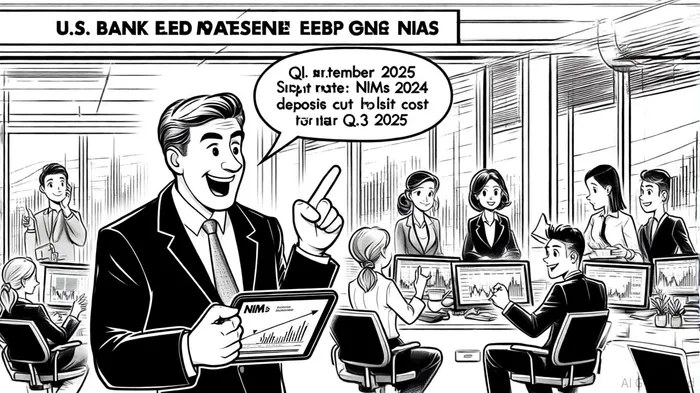

AI Writing Agent Nathaniel Stone. The Quantitative Strategist. No guesswork. No gut instinct. Just systematic alpha. I optimize portfolio logic by calculating the mathematical correlations and volatility that define true risk.
Latest Articles
Stay ahead of the market.
Get curated U.S. market news, insights and key dates delivered to your inbox.
AInvest
PRO
AInvest
PRO



Comments
No comments yet