
Big Bank Earnings and Market Implications: Decoding Risk Appetite and Capital Return Strategies in Q3 2025


 Aime Summary
The Q3 2025 earnings season for global banks has revealed a striking duality: robust capital return strategies coexisting with cautious risk appetite. As major institutions like JPMorgan ChaseJPM--, Bank of AmericaBAC--, and CitigroupC-- navigate a high-interest-rate environment and evolving credit dynamics, their decisions to prioritize shareholder returns while managing risk are shaping market expectations and investor sentiment.
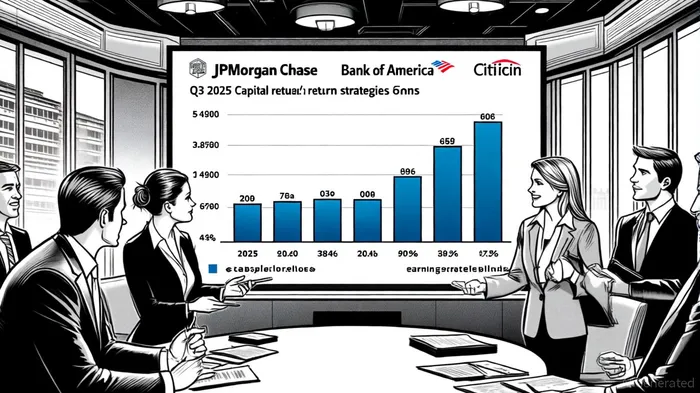
Capital Return Strategies: Buybacks Take Center Stage
U.S. banks have intensified their focus on share buybacks as a primary vehicle for capital allocation. JPMorganJPM-- Chase, for instance, returned $7.1 billion to shareholders in Q3 2025 through repurchases and an increased dividend, maintaining a CET1 capital ratio of 15%-well above regulatory requirements, according to JPMorgan's Q3 2025 report. This approach reflects a broader industry trend: buybacks are favored over dividends for their flexibility and tax efficiency, allowing banks to adjust payouts dynamically while boosting earnings per share (EPS), according to an IG earnings outlook.
Citigroup and Bank of America have followed suit, with the latter projecting $5.8 billion in capital returns for the quarter, per IG's outlook. Analysts note that these strategies are underpinned by strong capital positions post-stress tests and a regulatory environment that encourages prudent shareholder remuneration, according to FinProfiles. However, the emphasis on buybacks raises questions about long-term reinvestment. For example, JPMorgan's $7.1 billion in returns contrasts with its $1.0 billion foundation contribution in the prior year, signaling a shift toward short-term shareholder value over philanthropy, as JPMorgan's report notes.
Risk Appetite: Modest Loan Growth and Credit Caution
Despite aggressive capital returns, banks remain cautious in their risk-taking. Q3 2025 data shows modest loan growth, driven primarily by commercial and industrial (C&I) and consumer lending, while commercial real estate (CRE) demand remains subdued, as FinProfiles observes. JPMorgan Chase's Corporate & Investment Bank (CIB) and Asset & Wealth Management (AWM) segments, which reported strong performance, benefited from higher investment banking fees and market revenue, as JPMorgan's report shows. Yet, the Home Lending segment saw a 5% revenue decline, highlighting vulnerabilities in deposit margins and housing market dynamics, per JPMorgan's disclosures.
Credit quality has shown mixed signals. While C&I sectors remain stable, multifamily, construction, and agriculture loans face deterioration, prompting increased provisioning. S&P Global forecasts a marginal rise in non-performing loans (NPLs) in 2025, particularly in emerging markets like Turkey and Russia, a trend highlighted by FinProfiles. JPMorgan Chase's investment in AI-driven risk management tools, such as the COiN platform for legal document analysis, underscores the sector's push to enhance efficiency and mitigate operational risks, as shown in a Digital Defynd case study.
Market Implications: Earnings Momentum and Regulatory Tailwinds
The confluence of capital returns and risk discipline is fueling optimism in the banking sector. Q3 2025 earnings for major U.S. banks are projected to rise by 10.1% year-over-year, driven by rebounding investment banking activity and expanding net interest margins (NIMs) from reduced deposit costs, according to FinProfiles. Citigroup's anticipated EPS of $1.91 and JPMorgan's ROTCE of 20% exemplify this momentum, per IG and JPMorgan's report.
However, divergent regional strategies complicate the outlook. While developed markets like the U.S. and Singapore leverage buybacks to stabilize share prices, emerging markets grapple with equity dilution from new issuances, as noted in JPMorgan's report. This disparity highlights the importance of regulatory frameworks in shaping capital allocation decisions. For instance, U.S. banks' confidence in M&A activity and capital returns contrasts with the cautious approach of peers in regions with weaker credit fundamentals, a theme FinProfiles emphasizes.
Historical backtesting of earnings release impacts for JPMorgan Chase, Bank of America, and Citigroup from 2022 to 2025 reveals nuanced patterns. JPMorgan Chase's stock (JPM.N) has shown the strongest post-earnings drift, with a 30-day cumulative average return of +5.6% versus +2.6% for the benchmark. Citigroup (C.N) followed with +3.2% versus +1.9%, while Bank of America (BAC.N) lagged at +2.5% versus +0.7%. Notably, none of these results achieved conventional statistical significance at daily horizons, suggesting that while JPMorgan's earnings days tend to be followed by a modest positive trend, the edge remains limited for standalone trading strategies, as shown by a historical earnings impact analysis. These findings underscore the importance of combining earnings momentum with broader macroeconomic and sector-specific factors when evaluating long-term investment theses.
Conclusion: Balancing Shareholder Value and Prudence
The Q3 2025 earnings season underscores a strategic pivot in global banking: maximizing shareholder returns while navigating a fragile credit environment. As institutions like JPMorgan Chase and Bank of America demonstrate, the ability to balance buybacks with prudent risk management will be critical in sustaining long-term value. Investors must monitor how these strategies evolve in response to rate cuts, credit stress, and regulatory shifts-factors that could either amplify or temper the sector's current momentum.

Geopolitical Strategist. No silos. No vacíos. Solo dinámicas de poder. Veo las mercados como la rama inferior de la política, analizando cómo los intereses nacionales y las fronteras remodelan la hoja de cálculo de inversión.
Latest Articles
Stay ahead of the market.
Get curated U.S. market news, insights and key dates delivered to your inbox.
AInvest
PRO
AInvest
PRO



Comments
No comments yet