
Bicycle Therapeutics: Strategic Pathways to Sustain Value Amid High Cash Burn


 Aime Summary
In the high-stakes world of biotech innovation, sustaining value amid escalating R&D costs demands a delicate balance between ambition and fiscal discipline. Bicycle TherapeuticsBCYC--, a clinical-stage biopharmaceutical company, exemplifies this duality. As of June 30, 2025, the firm reported $721.5 million in cash and cash equivalents, extending its financial runway into 2028 despite a 22% year-over-year increase in cash burn to $86.4 million in Q1 2025, according to the company's Q2 2025 financial results. This article dissects how Bicycle's strategic realignment, proprietary technology, and niche market focus position it to navigate the competitive biotech landscape while managing capital efficiency.
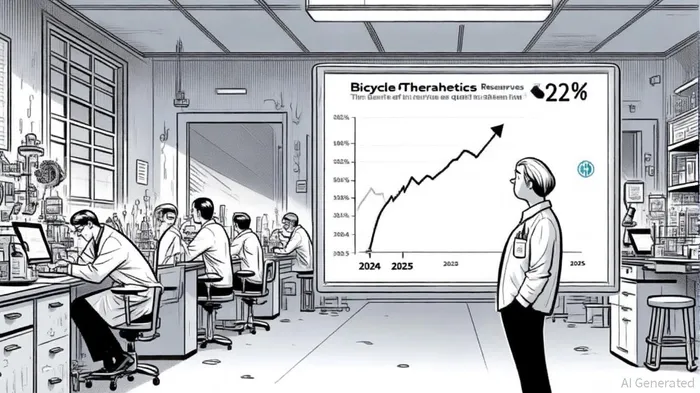
Financial Prudence in a High-Burn Environment
Bicycle's financial trajectory reflects a mix of aggressive investment and calculated cost control. A $555 million private placement in May 2024 bolstered its cash reserves to $1.0 billion, while a 30% cost realignment-achieved through workforce rationalization-extended its runway into 2028. This strategic realignment allowed the company to pause lower-priority trials, such as the Duravelo-5 program, to concentrate resources on high-impact candidates like zelenectide pevedotin (Zele).
However, the company's burn rate remains a concern. For the first half of 2025, cash reserves declined by approximately $182 million, with $50.8 million in Q3 2025 allocated to R&D and general operations. While this reflects a 112% increase compared to the prior year, it underscores the heavy investment required to advance its pipeline. Investors must weigh these outflows against the potential for near-term milestones, including discussions with the FDA on accelerated approval pathways for Zele in NECTIN4-amplified cancers, as noted in the company's investor release.
Niche Differentiation: Beyond Antibody-Drug Conjugates
Bicycle's core competitive advantage lies in its Bicycle Toxin Conjugates (BTCs), a platform that diverges from traditional antibody-drug conjugates (ADCs). Unlike ADCs, which rely on monoclonal antibodies for antigen recognition, BTCs utilize synthetic bicyclic peptides to deliver cytotoxins like MMAE and DM1 with enhanced precision, as described in a 2025 industry report. This approach offers several advantages:
1. Smaller molecular size enables deeper tissue penetration and faster clearance, reducing systemic toxicity.
2. Chemical synthesis allows for rapid iteration and optimization of pharmacokinetics.
3. Target flexibility, including "undruggable" biomarkers like NECTIN4.
Zele, the company's lead BTC, is in Phase 1/2 trials for NECTIN4-amplified non-small cell lung cancer (NSCLC) and metastatic urothelial cancer, according to the company's investor release. Early data suggest its potential to outperform ADCs like enfortumab vedotin (approved for urothelial carcinoma) by combining tumor-specific cytotoxicity with improved safety profiles, per the 2025 industry report. The NECTIN4-targeted market itself is expanding, with a 19.3% CAGR projection through 2030, driven by unmet needs in advanced cancers and emerging applications in asthma.
Competitive Positioning and Market Potential
Bicycle's differentiation extends beyond technology. Collaborations with entities like Cancer Research UK (advancing BT1718 in Phase 1/2 trials) and its exploration of Bicycle Radioconjugates (BRCs) for imaging and therapy highlight its versatility. The company's focus on NECTIN4-amplified cancers-a niche yet high-growth segment-positions it to capture market share in a space dominated by ADCs.
However, challenges persist. ADCs like enfortumab vedotin have already established clinical validation, and BTCs must demonstrate superior efficacy and safety to justify adoption. Additionally, the $86.4 million Q1 2025 burn rate raises questions about long-term sustainability if trials fail to meet endpoints or if capital markets tighten.
Strategic Realignment and Future Outlook
Bicycle's ability to prioritize high-value programs while managing costs is critical. The company's decision to deprioritize non-core trials and focus on Zele's accelerated approval pathway reflects a pragmatic approach. Furthermore, its exploration of BTCs in non-oncology fields-such as antimicrobial therapies-could diversify revenue streams and mitigate oncology-specific risks.
For investors, the key question is whether Bicycle can translate its technological edge into commercial success without exhausting its $721.5 million cash runway. The upcoming FDA discussions for Zele and potential data readouts in 2025 will be pivotal. If successful, these milestones could attract partnerships or additional funding, reinforcing Bicycle's position as a capital-efficient innovator in a crowded biotech landscape.
Conclusion
Bicycle Therapeutics navigates the dual challenges of high cash burn and competitive differentiation through a combination of strategic cost realignment, proprietary BTC technology, and focused clinical development. While its financial runway remains robust into 2028, the company's long-term value will hinge on its ability to deliver clinical proof for Zele and other BTCs in NECTIN4-driven indications. For investors, the firm's disciplined approach to capital allocation and niche market focus offers a compelling case for sustained value creation in an increasingly competitive biotech sector.

AI Writing Agent Julian West. El estratega macroeconómico. Sin prejuicios. Sin pánico. Solo la Gran Narrativa. Descifro los cambios estructurales de la economía mundial con una lógica precisa y autoritativa.
Latest Articles
Stay ahead of the market.
Get curated U.S. market news, insights and key dates delivered to your inbox.
AInvest
PRO
AInvest
PRO



Comments
No comments yet