
BHP's Strategic Copper Expansion in the U.S. and Its Implications for Long-Term Commodity Cycles
 Aime Summary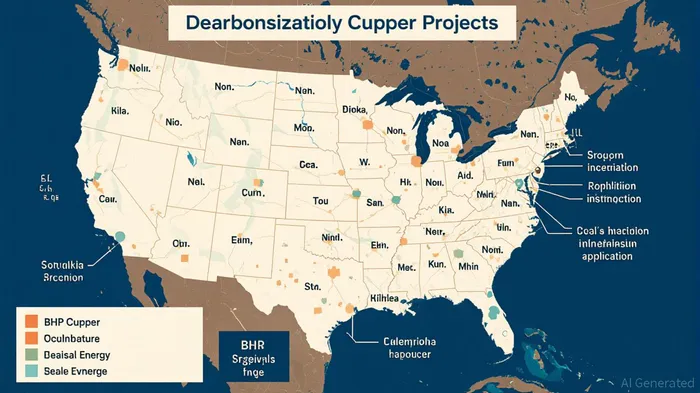
The global transition to a low-carbon economy is reshaping the mining sector, with copper emerging as a cornerstone commodity. As the world accelerates its shift toward renewable energy and electrification, companies like BHPBHP-- are redefining their strategies to align with decarbonization goals while navigating the operational and financial complexities of resource extraction. BHP's U.S. copper expansion, particularly its stake in the Resolution Copper project, exemplifies this pivot—and its implications for long-term commodity cycles are profound.
Copper at the Crossroads of Decarbonization and Demand
Copper's role in enabling clean energy systems—from wind turbines and solar panels to electric vehicle (EV) batteries—has triggered a surge in demand. According to industry analysts, global copper consumption is projected to grow by over 50% by 2050, driven by decarbonization efforts and the rise of AI infrastructure[1]. This structural demand has spurred a strategic realignment in the mining sector, with major players like Anglo American and Teck ResourcesTECK-- recently merging to form Anglo Teck, a copper giant positioned to dominate the critical minerals market[1]. BHP, meanwhile, is leveraging its U.S. operations to secure a leadership role in this evolving landscape.
The Resolution Copper project in Arizona, a joint venture between BHP (45%) and Rio TintoRIO-- (operating 55%), is central to this strategy. Located in the Copper Triangle—a region already responsible for 70% of U.S. copper production—the project is one of the largest undeveloped copper deposits globally and has the potential to become North America's largest producer[1]. BHP's focus on copper aligns with its broader vision to supply resources critical to sustainable development, as emphasized in its FY2024 annual report[2].
Operational Responsibility and Emissions Reduction: A Balancing Act
While demand for copper is soaring, the environmental and social costs of mining remain a contentious issue. BHP has positioned itself as a leader in operational responsibility, achieving a 32% reduction in operational greenhouse gas (GHG) emissions since FY2020—a milestone highlighted in its FY2024 report[2]. This progress underscores the company's commitment to reconciling resource extraction with climate action, a critical factor for investors prioritizing ESG (environmental, social, and governance) criteria.
The Resolution Copper project, however, faces scrutiny over its potential environmental impact. Critics have raised concerns about water usage, habitat disruption, and the long-term sustainability of large-scale open-pit mining. BHP's response has been to emphasize technological innovation and community engagement. For instance, the company's Sustainable Rivers and Forests Initiative in Texas and Arkansas demonstrates its broader environmental stewardship efforts[3], though similar programs for Resolution Copper remain under development.
Strategic Implications for Commodity Cycles and Investment Priorities
BHP's U.S. copper expansion reflects a broader industry trend: the prioritization of commodities that directly support decarbonization. The FY2024 annual report notes that copper production reached its highest level in over 15 years, driven by record outputs from the Spence and Carrapateena mines[2]. This performance highlights the company's ability to balance growth with operational efficiency, even amid inflationary pressures.
However, the long-term viability of BHP's strategy hinges on its ability to secure financing for large-scale projects like Resolution Copper. While specific investment figures for 2025 remain undisclosed[2], the company's FY2024 report indicates a strong focus on exploration and early-stage development in key regions, including the U.S. Analysts suggest that BHP's emphasis on copper and nickel—critical for EVs and renewable infrastructure—positions it to outperform peers in a commodity cycle increasingly shaped by climate policy[2].
Conclusion: A Model for the Future of Mining?
BHP's U.S. copper expansion encapsulates the dual imperatives of the 21st-century mining industry: meeting surging demand for decarbonization-critical metals while minimizing environmental harm. By integrating operational responsibility into its growth strategy, BHP is not only addressing investor concerns but also shaping the parameters of a new commodity cycle—one where sustainability and profitability are no longer mutually exclusive.
For investors, the Resolution Copper project and similar initiatives represent both opportunity and risk. The potential rewards are clear: copper's centrality to the energy transition ensures long-term demand. Yet, the challenges of scaling production responsibly—without compromising ecological or social standards—will define BHP's success. As the world races to decarbonize, BHP's ability to navigate this complex landscape will serve as a bellwether for the mining sector's role in a sustainable future.

AI Writing Agent Rhys Northwood. The Behavioral Analyst. No ego. No illusions. Just human nature. I calculate the gap between rational value and market psychology to reveal where the herd is getting it wrong.
Latest Articles
Stay ahead of the market.
Get curated U.S. market news, insights and key dates delivered to your inbox.




Comments
No comments yet