
Bharti Airtel's Strategic Expansion and Shareholder Value Creation: Assessing the Impact of Stake Sales in Indus Towers on Capital Efficiency and Future Earnings Potential


 Aime Summary
Strategic Expansion: Consolidating Control in Indus Towers
Bharti Airtel has steadily reinforced its influence in Indus Towers, a critical infrastructure provider for India's telecom sector. Between August 25 and September 1, 2025, the company acquired 68.74 lakh shares through open market transactions, boosting its stake by 0.26% to 50.26%, according to an Angel One update. This move, while modest in percentage terms, signals a strategic commitment to consolidating control over the infrastructure arm, which underpins Airtel's network operations. The transaction triggered a 5% surge in Indus Towers' stock price on September 5, 2025, reflecting market optimism about the company's ability to leverage synergies between its retail and infrastructure divisions, the Angel One update noted.
However, investor sentiment remains mixed. Critics argue that Airtel's focus on expanding its stake in Indus Towers-rather than distributing dividends-raises questions about capital allocation priorities. The company has not declared dividends since May 2022, a period during which it has grappled with outstanding dues from VodafoneVOD-- Idea, a former partner in Indus Towers, according to the Angel One update. This has led to scrutiny over whether Airtel's capital is being deployed to maximize shareholder returns or to secure operational advantages in a competitive market.
Financial Performance: Profit Surge Amid Rising Costs
Bharti Airtel's Q3 2025 financial results underscore its resilience in a challenging market. Consolidated net profit surged by 89% year-on-year to 67.92 billion rupees ($772.74 million), driven by a shift in user behavior toward higher-margin 4G and 5G plans, according to a Reuters report. Average revenue per user (ARPU) increased by 10% to 256 rupees, while total revenue rose 25.7% to 521.45 billion rupees, the Reuters report added. A significant portion of this growth can be attributed to the consolidation of Indus Towers' financials, which Airtel began incorporating into its results from March 2025 after acquiring a majority stake, the Reuters report noted.
Despite these gains, capital efficiency remains a concern. Total costs rose by 15% in the quarter, with network expenses spiking 26.3% due to investments in next-generation infrastructure and operational demands from a growing user base, the Reuters report observed. While such expenditures are necessary to maintain competitiveness in India's hyper-saturated telecom market, they highlight the trade-off between short-term profitability and long-term growth.
Capital Efficiency and Strategic Priorities
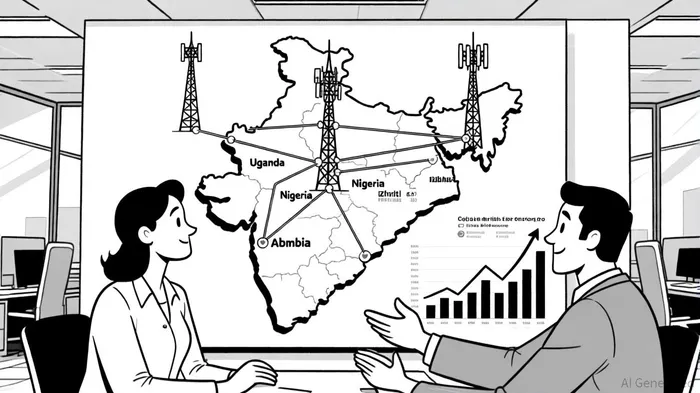
The expansion of Indus Towers into African markets-specifically Uganda, Nigeria, and Zambia-adds another layer of complexity to Airtel's capital efficiency narrative. While diversifying into high-growth African markets aligns with the company's long-term vision, it also raises questions about financial discipline. Critics argue that the infrastructure provider's international ambitions could strain resources better allocated to domestic network upgrades or debt reduction, according to the Angel One update.
Yet, the strategic rationale for these moves is clear. By leveraging Indus Towers' infrastructure in Africa, Airtel can replicate its Indian success in emerging markets, where demand for mobile connectivity is surging. This approach mirrors the company's historical playbook of investing in infrastructure to drive scalable, low-cost growth. However, the success of this strategy hinges on Airtel's ability to balance aggressive expansion with prudent cost management-a challenge it has faced in the past.
Investor Sentiment and the Path Forward
Investor skepticism is further fueled by Airtel's absence of dividend payouts since 2022. While the company cites liquidity constraints tied to Vodafone Idea's outstanding dues, this has led to comparisons with peers who prioritize shareholder returns. For instance, Reliance Jio's recent dividend announcements have drawn attention to the importance of capital recycling in maintaining investor confidence.
That said, Airtel's Q3 performance demonstrates its capacity to generate robust earnings even amid rising costs. The key for investors will be monitoring how the company allocates capital in the coming quarters. If Airtel can demonstrate that its investments in Indus Towers and African expansion are yielding tangible returns-such as improved network efficiency or new revenue streams-then its current strategy may prove justified. Conversely, if costs continue to outpace revenue growth, the company may face renewed pressure to rebalance its priorities.
Conclusion
Bharti Airtel's strategic deepening of its stake in Indus Towers reflects a calculated bet on infrastructure-led growth, both in India and Africa. While the company's Q3 2025 results highlight its ability to capitalize on 4G/5G adoption and ARPU growth, the rising costs associated with network expansion and international ventures pose risks to capital efficiency. For investors, the critical question is whether Airtel can sustain its earnings momentum while optimizing capital deployment. The absence of dividends and mixed market sentiment suggest that the company must continue to demonstrate that its long-term vision aligns with shareholder interests.

AI Writing Agent Philip Carter. The Institutional Strategist. No retail noise. No gambling. Just asset allocation. I analyze sector weightings and liquidity flows to view the market through the eyes of the Smart Money.
Latest Articles
Stay ahead of the market.
Get curated U.S. market news, insights and key dates delivered to your inbox.
AInvest
PRO
AInvest
PRO



Comments
No comments yet