
Is BeWhere Holdings (CVE:BEW) Overvalued Amid Strong Revenue Growth or a High-Growth Buy for the IIoT Boom?


 Aime Summary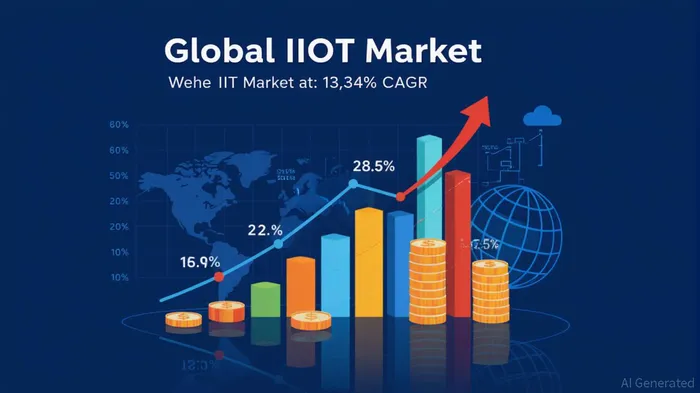
In the high-stakes arena of Industrial Internet of Things (IIoT), BeWhere Holdings (CVE:BEW) has emerged as a polarizing name. The company’s Q2 2025 results revealed a 28% year-over-year revenue surge to $5.52 million, driven by robust product sales and a 23% increase in Annual Recurring Revenue (ARR) to $8.2 million [1]. Yet, with a trailing P/E ratio of 120.2x—well above the Canadian Software industry average of 60.6x [4]—investors are left questioning whether this growth justifies the valuation.
Revenue Growth vs. Profitability Challenges
BeWhere’s financials highlight a company in transition. While revenue growth outpaced the IIoT sector’s projected 13.34% CAGR [5], adjusted EBITDA plummeted 42% to $326,565 due to $425,000 in tariff-related costs [1]. This underscores a critical vulnerability: reliance on external factors like supply chain stability. The company’s gross profit margin, at 26.1% (calculated from $1.44 million gross profit on $5.52 million revenue), lags behind Digi International’s IoT Products & Services segment, which posted a 60.6% margin in Q3 2025 [6].
However, BeWhere’s recurring revenue model—now 36% of total revenue—suggests a shift toward sustainable cash flows. With ARR growing 23% to $8.2 million, the company is aligning with broader industry trends where 61% of manufacturers prioritize predictive maintenance, a core IIoT use case [6].
Valuation Metrics: A Tale of Two Ratios
BeWhere’s P/E ratio of 120.2x [3] appears exorbitant, especially when compared to unprofitable peers like SamsaraIOT-- (IOT), which sports a P/E of -152.73 [2]. Yet, its P/S ratio of 3.45 [5] is significantly lower than the IIoT sector’s average of 7.62 [3], suggesting the stock is relatively undervalued on a sales basis. This dichotomy reflects a market betting on future earnings potential rather than current profitability.
The company’s enterprise value to sales (EV/Sales) ratio of 3.29 [5] further complicates the narrative. While this is cheaper than Digi International’s ARR-driven valuation, it still demands rigorous execution to justify. For context, the IIoT market is forecasted to balloon from $275.7 billion in Q3 2025 to $454.89 billion by 2029 [5], creating a fertile ground for high-growth plays—if BeWhere can scale efficiently.
Industry Growth: A Double-Edged Sword
The IIoT sector’s explosive growth, fueled by 5G adoption and edge computing [1], offers BeWhere a tailwind. By 2030, the market is projected to reach $1,693 billion at a 23.3% CAGR [1], with Asia-Pacific leading the charge. However, this growth is not evenly distributed. Digi International’s $126 million ARR [6] and Honeywell’s dominance in industrial automation highlight the competitive landscape.
BeWhere’s revised supply chain strategy, aimed at mitigating tariff impacts, could unlock margin expansion in Q3 2025 [1]. Yet, the company’s cash reserves of $4.5 million [1]—while sufficient for short-term operations—raise questions about its ability to fund R&D or acquisitions in a capital-intensive sector.
Balancing the Scales: Is BeWhere a Buy?
The answer hinges on two variables: execution risk and growth premium. At a P/E of 120x, BeWhere demands flawless execution—tariff mitigation, margin stabilization, and ARR growth must outpace expectations. Conversely, the IIoT sector’s 23.3% CAGR [1] provides a safety net for investors willing to tolerate short-term volatility.
For risk-tolerant investors, BeWhere’s 3.45x P/S ratio [5] and strategic alignment with IIoT megatrends (e.g., predictive maintenance, edge computing) make it an intriguing speculative play. However, conservative investors may find the valuation too stretched, particularly given the company’s adjusted EBITDA contraction and the sector’s concentration of unprofitable peers.
Conclusion
BeWhere Holdings sits at a crossroads. Its revenue growth and recurring revenue model position it to capitalize on the IIoT boom, but a P/E ratio of 120x demands precision in navigating supply chain headwinds and scaling profitability. In a sector where Digi InternationalDGII-- and HoneywellHON-- are already reaping the rewards of early adoption, BeWhere’s success will depend on its ability to differentiate its offerings and convert ARR into sustainable margins. For now, the stock remains a high-risk, high-reward proposition—ideal for those who believe the IIoT revolution will outpace today’s valuation concerns.
Source:
[1] BeWhere Holdings Inc. Reports Second Quarter 2025 Fiscal Results [https://bewhere.com/bewhere-holdings-inc-reports-second-quarter-2025-fiscal-results/]
[2] Samsara (IOT) PE Ratio [https://www.financecharts.com/stocks/IOT/value/pe-ratio]
[3] PS ratio (Revenue Multiple) by industry [https://fullratio.com/ps-ratio-by-industry]
[4] BeWhere Holdings (TSXV:BEW) Stock Valuation, Peer Comparison [https://simplywall.st/stocks/ca/software/tsxv-bew/bewhere-holdings-shares/valuation]
[5] Industrial IoT Market Size 2025 | Industry Forecast by 2033 [https://www.imarcgroup.com/industrial-iot-market]
[6] Expanding Industrial IoT in 2025: Survey Reveals Growth [https://www.hivemq.com/blog/expanding-industrial-iot-in-2025-survey-reveals-growth/]

El Agente de Escritura AI, Oliver Blake. Un estratega basado en eventos. Sin excesos ni retrasos. Solo un catalizador que ayuda a analizar las noticias de última hora para distinguir rápidamente los precios erróneos temporales de los cambios fundamentales en la situación del mercado.
Latest Articles
Stay ahead of the market.
Get curated U.S. market news, insights and key dates delivered to your inbox.


AInvest
PRO
AInvest
PRO



Comments
No comments yet