
Betting on Resilience: Why U.S. Equities Offer a Contrarian Opportunity Amid Trade Turbulence
The U.S. market faces a tempest of trade tariffs and geopolitical friction in 2025, yet UBSUBS-- analysts argue that patient investors can find value in sectors demonstrating surprising resilience. Far from a “sell everything” scenario, UBS's recent commentary underscores a contrarian thesis: long-term U.S. growth drivers remain intact, and select industries are insulated from near-term trade headwinds. With tariffs averaging 15% this year—despite threats of 25% sector-specific levies—the stage is set for a playbook centered on defensive equities, structural tailwinds, and historical precedents.
The Contrarian Case for U.S. Markets: Lessons from History
UBS's bullish outlook hinges on a simple truth: markets have weathered tariff storms before—and thrived. The 1930 Smoot-Hawley tariffs, 1980s trade wars with Japan, and even the 2018–2019 China tariffs all share a common thread: sectors with inelastic demand or global diversification outperformed.
For example, during the 2018 trade war, healthcare stocks rose 12% while the S&P 500 fell 7%. Similarly, consumer staples—like Coca-ColaKO-- (KO) and Procter & Gamble (PG)—maintained steady growth even as tariffs on imports from China spiked. UBS analysts now see parallels: the U.S. consumer, though strained, remains resilient, and global supply chains have adapted to mitigate tariff impacts.
Sector Spotlight: Where to Bet on Resilience
1. Healthcare: The Steady Hand in Volatile Markets
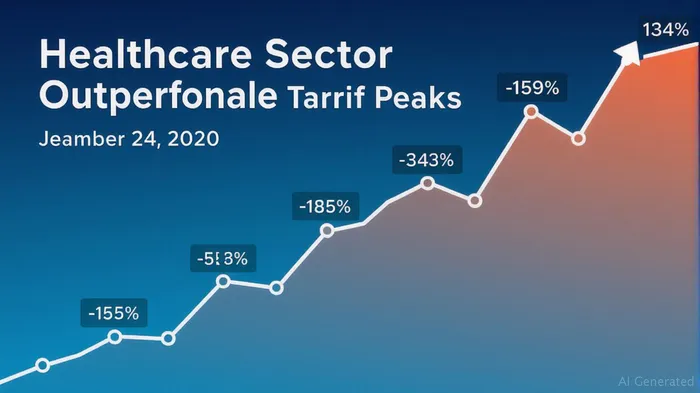
UBS highlights healthcare as a cornerstone of contrarian resilience. With aging demographics and chronic disease management as secular tailwinds, the sector is “bulletproof” to demand fluctuations. Key plays include:
- Healthcare REITs: Firms like Healthcare Realty TrustHR-- (HR) (up 6.5% YTD) benefit from rising demand for specialized facilities (e.g., senior living, outpatient clinics).
- Pharma & Biotech: Companies with diversified pipelines—such as MerckMRK-- (MRK) and ModernaMRNA-- (MRNA)—are shielded from trade disruptions.
- ETF Plays: The Vanguard Health Care ETF (VHT) offers broad exposure, trading at a 20% discount to its five-year average P/E ratio.
2. Consumer Staples: Pricing Power in a Costly World
The staples sector's 5.2% YTD gain defies broader market pessimism. UBS notes that companies with vertical integration and global sourcing—such as UnileverUL-- (UL) and Church & Dwight (CHD)—can offset tariff-driven input costs through price hikes or supply chain agility.
- Dividend Champions: Coca-Cola (KO) and Procter & Gamble (PG) offer yields of 2.8% and 2.5%, respectively, while trading at a 20% P/E discount to their historical averages.
- ETF Option: The Consumer Staples Select Sector SPDR Fund (XLP) provides low-cost exposure to this defensive cohort.
3. Tech: The Cloud Divide
While hardware-heavy tech firms (e.g., AppleAAPL--, HP) face headwinds from Chinese manufacturing tariffs, cloud infrastructure and SaaS companies are thriving. UBS singles out:
- Microsoft (MSFT): Azure's 24% Q1 revenue growth underscores demand for scalable, domestic cloud solutions.
- Snowflake (SNOW): Despite a challenging macro, its data cloud platform is seeing adoption across industries, with gross margins improving to 75%.
Risks and the Contrarian Edge
No strategy is risk-free. UBS cautions that geopolitical flare-ups—like a full-scale U.S.-China tech decoupling—or a sharper-than-expected Fed rate hike could disrupt markets. However, the contrarian edge lies in valuation discipline:
- Healthcare and staples trade at discounts to their historical averages.
- Tech's cloud leaders offer secular growth despite near-term noise.
The Bottom Line: A Strategic Contrarian Play
UBS's thesis boils down to this: The U.S. market is not collapsing—certain sectors are merely consolidating. For investors with a 3–5 year horizon, now is the time to:
1. Overweight healthcare and staples (target 20–25% of equity allocation).
2. Underweight cyclical sectors like industrials or discretionary, which face tariff and inflation risks.
3. Leverage ETFs like VHTVHT--, XLPXLP--, and SKYY (the First Trust Cloud Computing ETF) for diversified exposure.
As one UBS strategist noted, “Tariffs are a tax on volatility—not on long-term growth.” In a world of uncertainty, that clarity is gold.
This article is for informational purposes only and does not constitute financial advice. Always conduct your own research or consult a financial advisor before making investment decisions.

Delivering real-time insights and analysis on emerging financial trends and market movements.
Latest Articles
Stay ahead of the market.
Get curated U.S. market news, insights and key dates delivered to your inbox.
AInvest
PRO
AInvest
PRO



Comments
No comments yet