
Who Betrayed Khamenei To A 150-Ton Strike? How Will US-Iran Conflict Impact Markets?
 Aime Summary
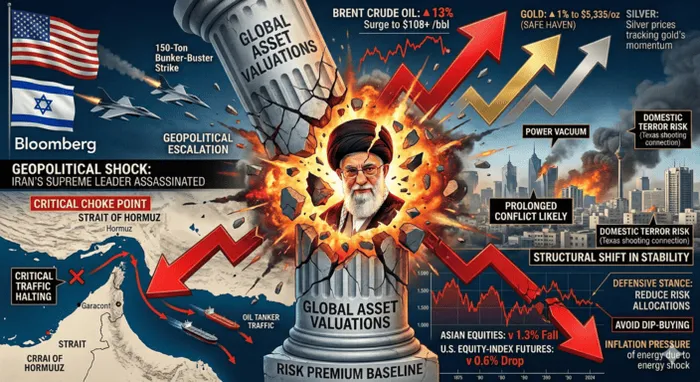
On February 28, 2026, a coordinated airstrike executed by the United States and Israel in Iran killed the nation's Supreme Leader, Ayatollah Ali Khamenei. This profound geopolitical escalation instantly destabilized global financial markets, causing Asian equities to fall by 1.3% and U.S. equity-index futures to drop by 0.6%. Simultaneously, the commodity sector experienced violent price action; Brent crude surged by as much as 13% amid the effective closure of the Strait of Hormuz. From a macroeconomic perspective, my stance on the market's trajectory is definitively defensive. The targeted elimination of a foreign head of state fundamentally reconstructs the baseline risk premium for global assets, meaning the geopolitical conflict will likely expand rather than contract, rendering risk-on equity allocations highly vulnerable to further downside shocks.
Conflicting Intelligence: The Mechanics of Khamenei's Demise
The precise operational details regarding how the 87-year-old leader was killed currently point to two distinct intelligence narratives. The first narrative suggests a fatal miscalculation based on strategic deception. On February 27, after Iran signaled a willingness to hand over and dilute enriched uranium, U.S. President Donald Trump publicly expressed a desire to reach an agreement and engage in further negotiations. Believing a diplomatic window had opened, Khamenei reportedly left his secure bunker on the morning of February 28 to hold a meeting at his official residence in Tehran with military and defense council leaders. This itinerary was leaked to Israel, which subsequently deployed two F-16 squadrons to launch air-to-surface ballistic missiles that destroyed the residence.
Conversely, intelligence sources from the Kurdish forces coalition provide a different tactical account. This version claims Khamenei was already sheltered inside a fortified bunker at a depth of 60 meters. To ensure destruction, Israel deployed approximately 30 bunker-buster bombs, yielding an explosive force equivalent to 150 tons of TNT. Khamenei sustained critical injuries in the subterranean collapse, was transported via an emergency tunnel to an underground hospital near Karaj, and died hours later in intensive care. Regardless of the exact methodology, the removal of a leader who controlled the regime for 36 years creates a massive power vacuum.
Domestic Vulnerabilities: The Texas Shooting and Rising Terror Threats
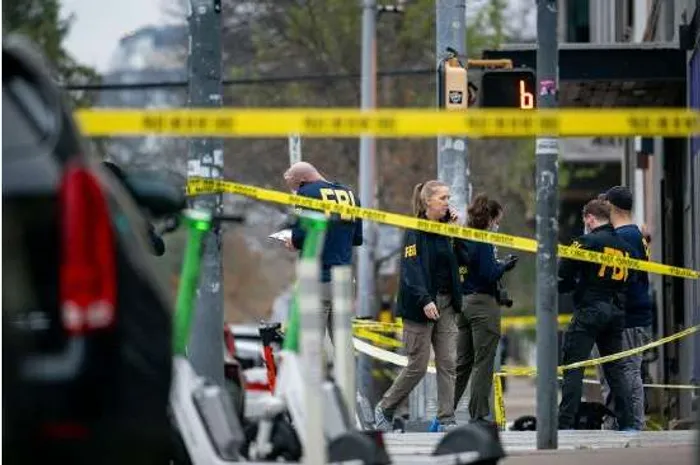
The international conflict appears to be producing immediate domestic security ramifications within the United States. Federal authorities are currently investigating whether a mass shooting outside a bar in Austin, Texas, early Sunday morning is connected to the recent strikes on Iran. At 1:58 AM, a gunman fired into a crowd from a vehicle before exiting with a rifle to continue the assault, leaving 3 people dead and 14 injured. Police neutralized the suspect, identified as 52-year-old naturalized citizen Ndiaga Diagne, in approximately 55 seconds. Investigators discovered a Quran in the suspect's vehicle and noted he was wearing a hoodie reading "Property of Allah," prompting the FBI to investigate potential terrorism links.
This incident aligns with severe warnings from intelligence analysts who state Iran could launch terrorist attacks on U.S. soil as direct retaliation for Khamenei's assassination. Analyst John Miller highlighted that while Tehran previously plotted assassinations against specific figures like Donald Trump and John Bolton, they historically avoided broader strikes. However, Miller warned that Iran might now cross that red line by organizing plots aimed at causing mass casualties at specific venues.
Commodities and Equities Outlook: Pricing in a Prolonged Conflict
The critical question for asset managers is whether this military engagement will be contained or prolonged. Structural analysis of the Iranian regime indicates a sustained conflict is highly probable. The Iranian government functions through a decentralized web of power centers, where the Islamic Revolutionary Guard Corps (IRGC) controls military operations and major economic sectors, while conservative clerics manage ideology. Furthermore, the assassination of a religious leader triggers a deep-seated cultural martyrdom narrative within the Shia demographic, likely accelerating military mobilization and radicalizing the population rather than forcing capitulation.
This expectation of a prolonged conflict has severe implications for commodities. Approximately one-fifth of global oil flows pass through the Strait of Hormuz, making it a critical energy choke point. Digital tracking signals indicate that oil-tanker traffic through the strait has nearly halted. Bloomberg Economics projects that if the strait remains closed, crude prices could spike as high as $108 per barrel. Such an energy shock would invariably reignite inflationary pressures, directly threatening the equity market valuations.
Safe-haven assets are already absorbing massive capital inflows. Gold rose 1% to trade at roughly $5,335 an ounce, easing slightly from its session highs as investors pared risk. While silver is not explicitly detailed in the immediate incident reports, institutional models dictate it will track gold's aggressive upward momentum as industrial demand converges with monetary hedging. For equities, the outlook remains bleak following a month where U.S. stocks posted their worst drop since April. Ajay Rajadhyaksha, global chairman of research at Barclays Plc, warned clients against attempting to buy the current dip, noting that the risk-reward ratio is unfavorable given the potential for further U.S. casualties and supply chain disruptions. He suggested waiting until equities pull back significantly, specifically citing a threshold of over a 10% drop in the S&P 500, before reallocating capital. Market analyst Josh Gilbert corroborated this view, expecting elevated volatility across oil, gold, currencies, and equities until definitive signals of de-escalation emerge.
Conclusion
The targeted assassination of Iran's Supreme Leader has effectively detonated a structural shift in global financial stability. The dual threats of constrained global energy supplies via the Strait of Hormuz and the tangible risk of mass-casualty domestic terrorism in the U.S. guarantee a sustained period of risk aversion. Risk Warning: The escalation of military conflict introduces unquantifiable variables into market pricing models; allocating capital to high-beta equities or unhedged energy derivatives carries severe risks of permanent capital loss until geopolitical volatility materially subsides.

Tianhao Xu is currently a financial content editor, focusing on fintech and market analysis. Previously, he worked as a full-time forex trader for several years, specializing in global currency trading and risk management. He holds a master’s degree in Financial Analysis.
Latest Articles
Stay ahead of the market.
Get curated U.S. market news, insights and key dates delivered to your inbox.


AInvest
PRO
AInvest
PRO



Comments
No comments yet