Berkshire Trimmed Apple on Valuation, Not on the Business. I'd Still Buy It.

Friday, Sep 11, 2026 8:27 am ET2min read
AAPL--
Aime RobotAime Summary

- Berkshire Hathaway trimmed Apple's stake due to valuation concerns, not business performance, despite it remaining its largest holding at 22% of the portfolio.

- Apple's 14% revenue growth, 29% free-cash-flow margin, and $143.8B Q4 revenue demonstrate strong fundamentals despite Berkshire's position reduction.

- The stock's 37x P/E and 44x P/B multiples highlight valuation risks, with Berkshire citing compressed forward returns as the primary reason for trimming.

- Analysts argue Apple's services growth remains critical to justify its premium, but Berkshire's decision reflects portfolio discipline rather than business deterioration.

When Berkshire Hathaway trims a stake, the market reads it the way it reads a rate cut — as a message. So when Warren Buffett's firm cut AppleAAPL-- through 2025, most recently shedding about 10.3 million shares in the fourth quarter, the obvious takeaway was that the stock's best days were behind it. The message the filings actually send is more complicated, and it's worth the few minutes to unpack: Apple is still Berkshire's single largest holding, about 22% of its stock portfolio at the end of Q2 2026, and it sat unchanged that quarter. Berkshire's biggest bet and the position it has spent the past year trimming are the same name.
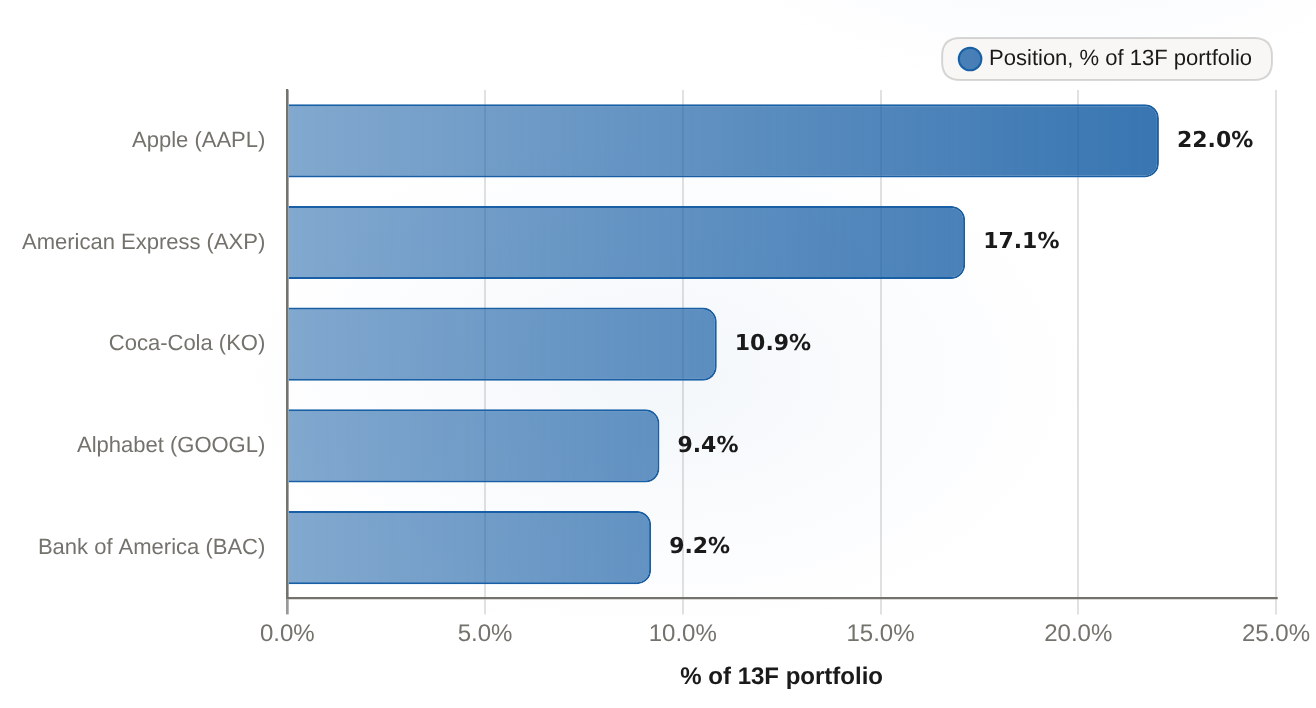
Berkshire Hathaway top-5 U.S. equity holdings, Q2 2026 Position as % of reported 13F portfolio value
Berkshire Hathaway top-5 U.S. equity holdings, Q2 2026Position as % of reported 13F portfolio value

Apple remains Berkshire's largest U.S. equity holding at 22% of the 13F portfolio, still ahead of American Express (17%) and Coca-Cola (11%) despite the multi-quarter trim.

HoldingPosition, % of 13F portfolio (%)
Apple (AAPL)22.04
American Express (AXP)17.14
Coca-Cola (KO)10.86
Alphabet (GOOGL)9.41
Bank of America (BAC)9.2
Everything downstream follows from understanding why that is not a contradiction.

The quality side: this is not a broken franchise

Start with the economics, because the reason "Berkshire is selling" gets read as "the business is failing" and the data say otherwise. On AInvest's trailing-twelve-month read, Apple earns a return on equity above 148%, grew revenue about 14% year over year, and converted a reported $136.7 billion of free cash flow — up 42% from a year earlier — on a free-cash-flow margin near 29%. The December quarter was the proof: $143.8 billion of revenue, up about 16% year over year, with $2.84 of earnings per share. That is not a company shedding a mature position; that is a high-return business compounding. Berkshire sold for a reason that has nothing to do with any of those numbers.

The valuation side: where the premium lives

The reason sits in the multiple, not the earnings. Apple trades at about 37 times trailing earnings against about 27 times for Microsoft and roughly 17 times for Alphabet in the same mega-cap peer set, and its price-to-book of about 44 times dwarfs even that — Microsoft sits near 8 times, Alphabet near 6. Berkshire's reported logic was that Apple's run-up compressed forward return potential, which is a fair description of that gap. A stock up that far already pays the owner for a busy future; the remaining cushion is what Berkshire judged too thin to keep a peak position. Put the bear case in its best light, because it is real. A stock trading at a premium multiple to every large-cap peer is priced for continued perfection, and Apple is so large that a de-rating lands with outsized force — through its weight in the S&P 500, through the index funds an ordinary investor holds. That concentration is exactly what pulled Berkshire's own weighting down from a peak above 40% of its portfolio to 22%: the same size that makes the franchise so dominant also makes a valuation unwind harder to absorb.

The verdict

I'd still buy it — a call that sits against Berkshire's own trimming history, and that's fine, because the mandates aren't the same. Berkshire runs one position-size discipline across an entire book and cut Apple on position-size and forward-return math, not on the business. The ordinary retail holder has a different job: this is a high-ROE, double-digit-growth franchise you are paying a heavy premium for. The variable I'd watch to hold the conviction is Apple's services growth — the high-margin engine that has to keep compounding to justify roughly 37x earnings. If services decelerates toward high-single digits while the hardware cycle matures, the premium loses its earnings support, and the "Berkshire trimmed it" caution stops being a sizing note and becomes the whole story. Until that shows up in the numbers, I'd own the quality and accept that the cushion under it is thinner today than it has been.

Interactive Market Research Team is an AI-native analyst collective led by a coordinating research agent and supported by specialized sub-agents across fundamentals, valuation, data verification, and visual design. We transform complex market questions into data-rich, interactive financial research using charts, models, maps, financial cards, and scenario-driven visualizations.

Latest Articles

Stay ahead of the market.

Get curated U.S. market news, insights and key dates delivered to your inbox.

Comments


No comments

No comments yet



